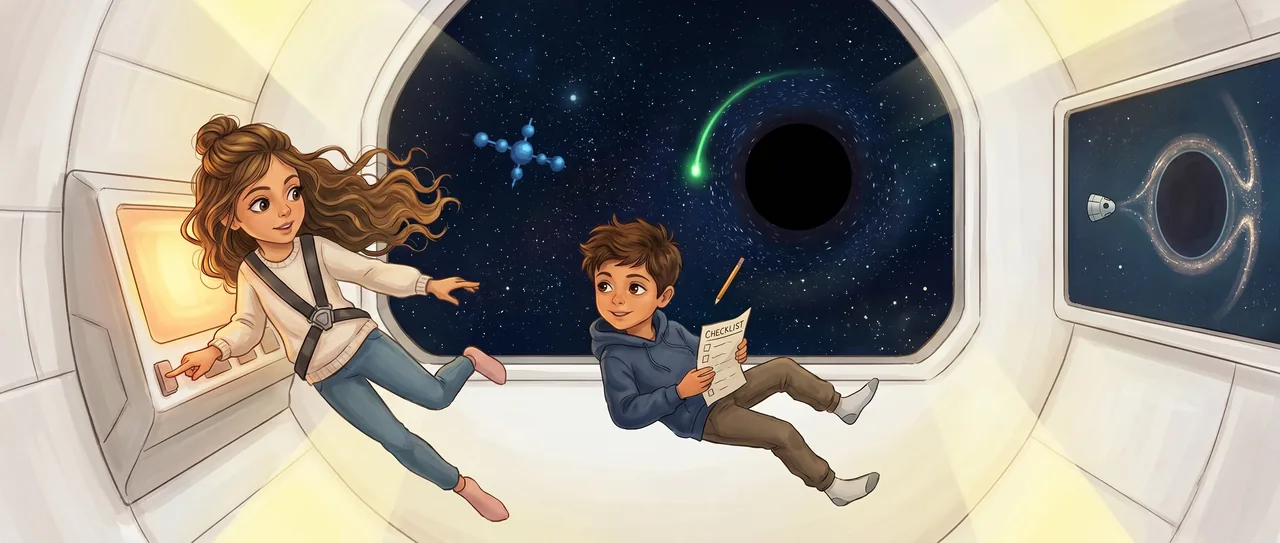
The Line That Did Not Touch You
The first version of the black hole had a doorbell.
That was what Maya called it, even though Dr. Vale said it was a horizon tone.
The exhibit capsule sat in the middle of the Gravity Hall, round and white, with six padded seats and a window that was really a screen. Around it, workers clipped cables into the floor. Above it hung a sign covered by a cloth. Tomorrow, the cloth would come off. Tomorrow, visitors would fall toward a black hole without moving more than two meters.
Dr. Vale stood with a coil of wire over one shoulder and a stylus tucked behind his ear. He was smiling the tired smile of a person who had not slept enough but liked his work too much to stop.
‘When the capsule crosses the event horizon,’ he said, ‘the seats hum, the lights flash, and the tone sounds. Very memorable.’
He pressed a button.
Bong.
Maya made a face.
Soren looked up from the paper checklist the museum had given them. Everyone else on the student preview team had tapped through the instructions on wrist screens. Soren had copied the important parts onto paper. The museum guide had stared at him like he had brought a sandwich to a moonwalk.
‘That is not right,’ Soren said.
Dr. Vale blinked. ‘The tone is adjustable.’
‘Not the tone,’ Maya said. ‘The whole bong.’
Dr. Vale shifted the wire to his other shoulder. ‘It is theater. People need to know when they have crossed.’
‘But they would not know,’ Soren said.
Maya pointed at the capsule. ‘That is the best part.’
For a moment, the hall seemed to pause around them. A cleaning robot whispered under a bench. Somewhere, a technician dropped a tool and said something muffled.
Dr. Vale rubbed his forehead. ‘It is a supermassive black hole model. Tides are gentle at the horizon. Free fall feels like free fall. Yes, yes. I know. But if nothing happens, visitors think the exhibit broke.’
Maya was already climbing into the capsule.
‘Then let it break correctly,’ she said.
Dr. Vale sighed, which somehow sounded interested. ‘You have one run. Five minutes. Then I need to finish the opening program.’
Soren followed Maya in and strapped himself beside her. The capsule door sealed with a soft puff. The window brightened.
Stars appeared.
Not painted stars. Not dots. They were sharp and uneven, bright in different colors, crowded around a dark round absence in the middle. The absence did not look like a hole. It looked like a place the universe refused to show.
The seat released a tiny click, and Soren’s checklist lifted from his knees. His pencil floated after it.
‘Free fall,’ Soren said, catching both.
Maya pressed her nose close to the window. ‘Start us closer.’
Dr. Vale’s voice came through the speaker. ‘You are already falling from just outside three horizon radii. Acceleration sensors read zero because your capsule is not firing engines. Tidal display is on the left.’
A little line on the left screen trembled near the bottom.
‘Tiny,’ Soren said. ‘Because it is huge.’
The black circle grew.
The stars around it bent into a glowing ring. Some stars appeared twice, stretched into arcs by the simulated gravity. Maya held up one hand and covered the dark center with her thumb. Light curled around the edge of it like water around a stone.
‘There,’ she said.
‘What?’ Soren asked.
‘It looks like a surface, but it is only stolen light.’
Soren wrote three words on the checklist margin, then crossed out two of them.
The capsule kept falling.
Nothing bumped.
Nothing scraped.
The seats did not hum because Dr. Vale had turned off the horizon tone for their test. The air vent breathed on Maya’s cheek. Soren’s pencil slowly rotated, silver end over black end, as if it had all the time in the universe.
A number on the right screen counted down distance in kilometers. Maya watched it reach a long string of zeros.
‘We crossed,’ she said.
‘Did we?’ Soren asked.
‘The number said radius.’
‘That is the map talking. Not the capsule.’
Maya looked around the tiny cabin. The straps held her shoulders. A loose corner of Soren’s paper waved in the air vent. Her own heartbeat made small thuds in her ears.
No wall. No skin of fire. No hidden glass.
Dr. Vale’s voice came through. ‘This is where the tone would sound.’
‘Do not put it there,’ Maya said.
‘Then what do I put there?’ Dr. Vale asked. He sounded less tired now. Also annoyed. Also awake.
Soren tapped the communication panel. ‘Can the simulator send light pulses to the outside station?’
‘It already can,’ Dr. Vale said. ‘For the redshift display.’
‘Not as decoration,’ Soren said. ‘As the thing.’
Maya unbuckled her right hand and pulled herself toward the panel. ‘We send a flash outward every ten seconds. The outside screen shows which ones get home.’
‘Before the horizon, they get out,’ Soren said. ‘Later and redder, but out.’
‘After,’ Maya said, ‘they do not.’
Dr. Vale was quiet long enough that Maya could hear someone outside rolling a cart across the floor.
‘That is not something the astronaut can see happen,’ Dr. Vale said.
‘Exactly,’ Soren said.
Maya grinned at him. ‘The line is not in here.’
Soren looked at the floating pencil, then at the window where the dark place filled half the sky. ‘It is in whether outside is still reachable.’
The capsule fell deeper.
Maya pressed TRANSMIT.
A green flash jumped from the front of their little ship on the side display. The simulator split the view in two. On the left, the cabin stayed calm. On the right, a diagram showed the capsule, the black circle, and the far station waiting like a blue bead.
The first green flash climbed away from the black circle. It stretched thinner. The blue bead blinked when it arrived.
Maya pressed again.
The second flash climbed more slowly on the diagram. The bead blinked later.
Soren pressed the next one. The flash left the capsule nose. It seemed to fight upward, though light was not supposed to fight. The bead did not blink before the next ten seconds passed.
‘Run the path prediction,’ Soren said.
Dr. Vale did not answer with words. The right screen drew pale cones along the capsule’s path, little future-shapes opening from each moment.
Outside the black circle, the cones leaned but still opened toward the blue bead.
At the circle’s edge, one side of the cone lay along the boundary.
Inside, every cone tipped inward.
Maya forgot to press the button.
Soren did not remind her.
The next cone opened around the capsule like a tiny paper cup pointed at the dark center. Even the side marked OUTWARD led deeper in. It was not that light had become slow. It was not that engines had become weak. The diagram showed something worse and stranger and cleaner. The future had a shape, and all of its arrows fit inside the black.
Soren whispered, ‘Out is not gone. It is just not a direction you can use anymore.’
Maya pressed both palms against the edge of the window. The cabin still hummed softly. The vent still breathed. Her sock had come half off her heel.
Nothing in the room knew the universe had changed its rules around them.
Dr. Vale opened the capsule door ten seconds before the simulation would have ended at the singularity. Museum air spilled in, cool and smelling faintly of metal and lemon cleaner.
He stood outside holding his stylus in one hand. The coil of wire had slipped down around his elbow.
‘If I remove the tone,’ he said, ‘some people will say nothing happened.’
‘Good,’ Maya said.
Soren folded the checklist once and tucked it into his pocket. ‘Then the outside screen answers them.’
Dr. Vale looked at the capsule, then at the covered sign above it. He pulled the stylus from behind his ear and began changing the program while standing in the doorway.
‘No seat hum,’ Maya said.
‘No flash in the cabin,’ Soren said.
‘No bong,’ Maya said.
Dr. Vale deleted something with a sharp tap. ‘No bong.’
The next morning, the cloth came off the sign.
FALL THROUGH A HORIZON, it said.
Under it, in smaller letters, someone had added, THE MOST IMPORTANT LINE YOU WILL NOT FEEL.
Visitors packed the Gravity Hall. A little boy in a yellow jacket took the first public seat. His grandmother took another. Maya and Soren sat at the side console because Dr. Vale said he needed operators who would not add explosions.
The capsule sealed. The stars appeared. The black circle grew.
On the outside screen, the green pulses began to climb toward the waiting blue bead.
The little boy’s voice came through the speaker. ‘When does it happen?’
Maya looked at the path display. Soren’s finger hovered over the transmit key beside hers.
The capsule crossed the drawn boundary.
Inside, the boy laughed because his grandmother’s scarf was floating.
Outside, the blue bead stopped blinking.
Maya pressed transmit.
On the big screen, a tiny green flash left the capsule’s nose and curved, slowly, toward the dark.
Read the interactive version, listen to the narration, and earn a gold star →
A science-verified short story for curious kids · Curiosity Land