The Light-Bearer Valve
The exhibit was supposed to glow at fourteen hundred hours.
At thirteen forty-six, it was still dark.
Soren crouched under the display table with half his body inside the service hatch. His paper notebook stuck out of his back pocket like a small white flag.
"Still zero," he called.
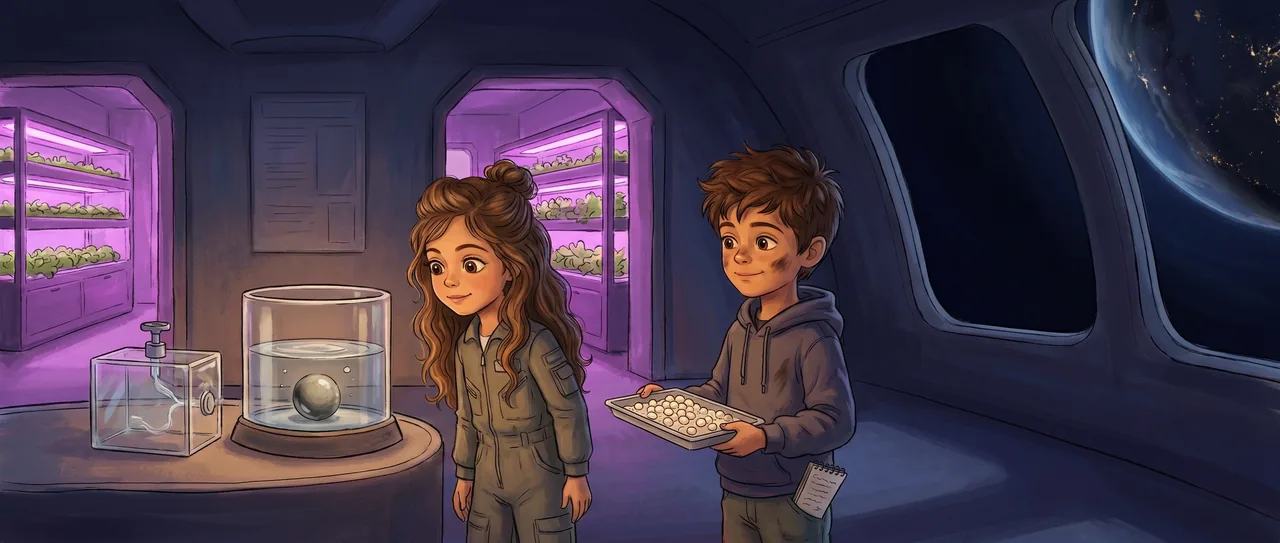
Maya leaned close to the glass chamber. Inside it, under three layers of shielding and one layer of water, sat a bead the color of old candle wax. The label below it said WHITE PHOSPHORUS, SEALED SAMPLE, DO NOT EXPOSE TO AIR.
Above the chamber, in friendly museum letters, the title read: FAILED GOLD.
Maya hated the title.
"It isn't failed anything," she said.
"The oxygen line is closed," Soren said. "The computer thinks the demonstration already ran. But it didn't. The photometer log is flat. No light spike. No slow rise. Nothing."
Dr. Ivo swept past carrying a tray of printed name badges and three cups of algae coffee balanced against his chest. His silver hair floated slightly in the station's gentle spin.
"Children," he said, without stopping, "if the glow refuses to appear, we tell the funny version. Man boils barrels of pee, does not make gold, makes a smelly surprise. Visitors love humility."
"He made an element," Maya said.
"Eventually," said Dr. Ivo. "Please do not let anyone touch the valve. The board arrives in twelve minutes."
He vanished toward the hydroponic gallery, where visiting ministers were being shown lettuces the size of hats.
Soren slid out from the hatch. A smudge crossed his cheek. "He locked the valve."
"He locked the story," Maya said.
On the other side of the aisle, the Loop Day crowd gathered. Every station child had brought a sealed morning sample to the recycler, because nothing left an orbital farm except data, heat, and occasionally a shuttle. The recycler had already separated water for drinking, nitrogen for nutrient tanks, and phosphate salts for the roots.
A boy from Deck C wrinkled his nose at their sign. "Your element comes from toilets."
"So do strawberries up here," Maya said.
He made a face and left.
Soren tapped the display diagram. It showed a line from a pretend seventeenth-century furnace, to Brand's boiled urine, to waxy white phosphorus glowing in the dark, to modern phosphate recovery, to plant roots.
"The diagram cheats," he said.
Maya turned. "Where?"
"Here." He tapped the glowing bead. "The phosphate pellets from the recycler won't glow. They're stable salts. The white phosphorus glows when it reacts with oxygen. Same element, different form. If we connect the recycler line, people will think today's pellets shine in the dark."
Maya looked at the bins of pale fertilizer pellets waiting by the garden doors. They were ordinary and chalky. Useful, quiet, not magical.
Then she looked back at the waxy bead under water.
"So the glow needs air," she said.
"A tiny amount. In the teaching chamber. Not out here." Soren pointed to the safety box. "White phosphorus is poisonous and can catch fire in air. That is why it lives under water. The museum chamber is supposed to lift one microflake into a sealed space and add a trace of oxygen. The light comes from slow oxidation."
"Slow burning that doesn't flame."
"Slow reacting," Soren said. "Mostly."
Maya grinned. "Mostly is a door."
"Mostly is also why there are four safety interlocks."
The crowd noise swelled. The board had arrived. Dr. Ivo's voice boomed from the central stage.
"Welcome to Loop Day, where waste becomes water, air, food, and future voyages. Our first student team will present the most embarrassing discovery in chemistry."
Maya's shoulders went stiff.
Soren stood. "We can skip the glow."
"No," Maya said.
"We cannot unlock the valve."
"Not that valve."
She ducked under the table.
There were two oxygen lines. The red one led to the real chamber and wore Dr. Ivo's lock. The blue one led to a clear practice cell no bigger than Soren's thumb. It was empty except for a sensor and a sealed cartridge labeled TRAINING MATERIAL, NONREACTIVE, LIGHT EMITTER DISABLED.
Maya stared at it.
"That one is fake," Soren said.
"Exactly. It can show the valve moving without pretending the fake thing is phosphorus."
"But then no glow."
Maya backed out and reached for the display controls. "We don't need to fake the glow. We need to show why it is not glowing."
Soren's face changed in small pieces. First his eyebrows. Then his mouth. Then he grabbed his notebook and flipped to the page where he had copied the exhibit sequence.
"If the red line is locked, the real sample stays dark because no oxygen reaches it," he said. "If the blue line opens, the practice cell shows the motion."
"And the photometer stays flat."
"And the label says why."
"No," Maya said. "The label asks why."
They changed the title first.
Failed Gold disappeared.
The Light-Bearer appeared.
Dr. Ivo reached them just as the first visitors did. His name badge was crooked. "What happened to my title?"
"It was the wrong experiment," Maya said.
Before he could answer, the lights dimmed for the presentation.
The display became the brightest dark place in the room. Not because anything glowed. Because everyone leaned toward the glass, waiting.
Soren spoke into the table microphone. His voice came out smaller than Dr. Ivo's and steadier.
"In sixteen sixty-nine, an alchemist named Hennig Brand boiled a huge amount of human urine. He wanted gold, or something close to it. He got a white, waxy substance that glowed in the dark. It was later called phosphorus, from a Greek word meaning light-bearer."
A few children giggled at urine. One adult did too, then coughed.
Maya pressed the blue control. In the practice cell, a tiny valve opened. A thread of gas flowed through clear tubing. The oxygen meter blinked.
Nothing in the real chamber moved.
The waxy bead sat under its water, dull as a tooth.
Maya said, "The old glow was not because waste is magic. It was because Brand had made a dangerous form of an element, and air could touch it. The slow reaction with oxygen gave off light. Today, we keep this sample sealed. The safe phosphorus from our recycler goes to roots instead."
She nodded to Soren.
He lifted a tray of recovered phosphate pellets. They looked like crumbs of moon dust.
"This came from the station this morning," he said. "From us. The water went back to the taps. The nutrients go to the garden. The phosphorus in these pellets will help make leaves, seeds, and the molecules every living cell uses to move energy around."
The boy from Deck C stopped making his face.
Behind the exhibit, the hydroponic doors slid open. Rows of green stretched under violet lamps. Tubes clicked softly as nutrient solution pulsed toward the roots.
Dr. Ivo looked from the dark phosphorus chamber to the pellet tray, then to the new title. He opened his mouth, closed it, and put his algae coffee down on the floor.
"May I," he said, "stand somewhere not in the way?"
"There," Maya said, pointing.
He stood there.
A little girl in a yellow jumpsuit raised her hand. "But did Brand know he found something for plants?"
"No," Soren said.
"Did he know it was in bones?"
"No," said Maya.
"Did he know it was in people?"
Soren held up the tray. "He started with people. He just didn't know what that meant yet."
The room stayed quiet after that. Maya looked through the glass at the bead that would glow only if the world touched it wrong. She looked at the pellets that did not glow at all and would become roots if the world touched them right.
Then the station passed into Earth's shadow.
The observation windows darkened. City lights pricked the planet below in bright tangled nets. In the garden, the violet lamps brightened over the leaves.
Soren set the pellet tray onto the feed rail. The rail chimed once, ready.
Maya pinched one pale pellet from the feeder and pressed it into the black soil beside an unopened seed.
Read the interactive version, listen to the narration, and earn a gold star →
A science-verified short story for curious kids · Curiosity Land