The Gate That Said No
The first thing Soren got wrong was the wall.
He had drawn it in his notebook before the demonstration began. A brain in the middle. A thick black castle wall around it. Little spikes on top, because walls in drawings needed spikes. Outside the wall, he had drawn germs with angry eyebrows and bottles labeled poison.
The scientist in the yellow clogs passed behind him, holding a tray of tiny glass tubes.
"That is a very dramatic brain," she said.
Soren covered the poison bottle with his thumb. "It has to keep things out."
"It does," the scientist said. She looked at the clock above the door and winced. "But if it were only a wall, my job would be easier."
Then she hurried away to fix something that was beeping.
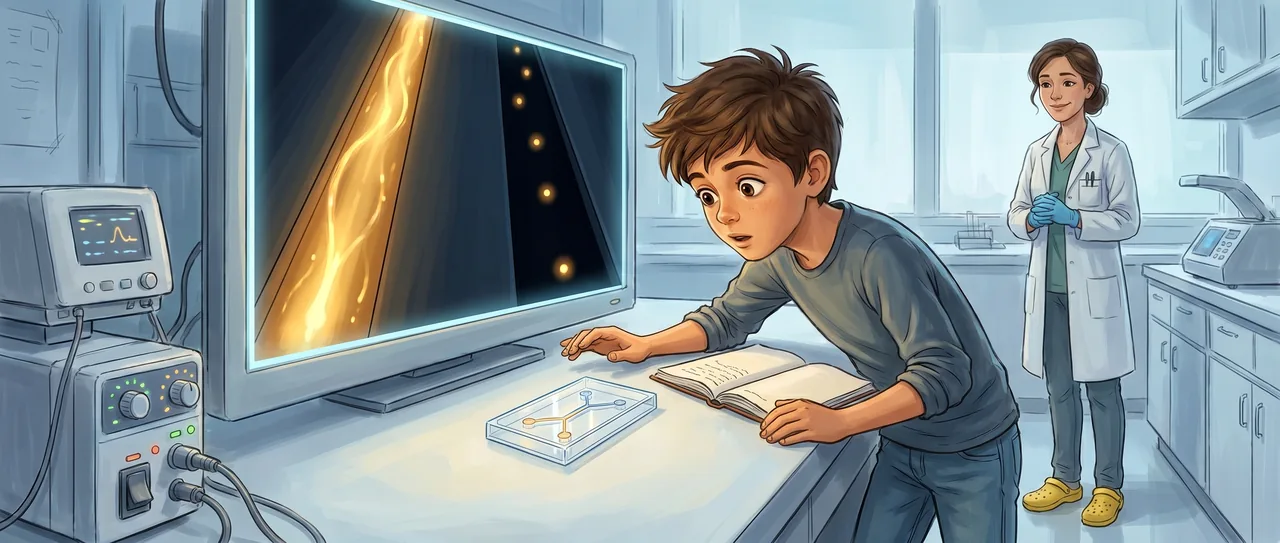
The lab did not look like a castle. It looked like a kitchen for ants. Clear tubes looped over silver pumps. Little lights blinked. In the center of the table sat a rectangle of clear plastic no longer than Soren's smallest finger. Two hair-thin channels ran through it side by side.
A sign beside it said living blood-brain barrier chip.
Soren looked from the sign to his drawing. He added a question mark over the wall.
Other visitors pressed closer. The scientist tapped the plastic rectangle with one gloved finger.
"This is not a brain," she said. "And it is not an animal. It is a model. One channel is like blood. The other is like the space on the brain side. Between them are human cells like the ones that line the tiniest blood vessels in your brain. They make tight seams. They choose what gets through."
"Like bouncers," someone said.
The scientist smiled too quickly. "If bouncers were very, very small and had spent millions of years practicing."
She placed a tube of green liquid into a holder. "This glowing tracer is the size and kind of thing many medicines resemble. We are going to see whether it reaches the brain side."
On the screen above the table, two black rivers appeared. The left river brightened as green flowed into it. The right river stayed dark.
Everyone waited.
The green river kept moving. The dark river stayed dark.
The scientist leaned toward the screen. "Give it a moment."
Soren did. He gave it twelve moments. He counted by the pump clicks. The green slid along the blood channel, turned the corner, and flowed away into waste. Not one spark crossed into the brain-side channel.
A small groan went through the visitors.
The scientist's smile bent at one corner. "Well. This is research. Sometimes the public demonstration becomes very public research."
She touched the pump controls. The green moved faster. Still nothing crossed.
Soren looked at the tubes, then at the screen, then at the chip. He did not look at the wall in his notebook. Something about it had become embarrassing.
"Is the pump broken?" the scientist asked herself.
Soren followed the left channel with his finger in the air, not touching the glass. "No. It goes in. It comes out."
"Maybe the lamp is off on that side," she said.
Soren leaned until his nose nearly touched the screen. Tiny white ruler marks glowed along both channels. The right side was lit. Empty, but lit.
"The dark side is working," he said.
The scientist glanced at him. "How do you know?"
"I can see the scratches in the plastic. If the light were off, I couldn't."
She stopped pressing buttons.
The room became quiet except for the pumps.
Soren's notebook felt heavy in his hand. At school, when a problem gave no answer, everyone wanted to skip it and come back later. Soren did not like coming back later. Later was where questions went to get dusty.
He looked at the screen again. The green had not failed to arrive by accident. It was being refused.
"Your barrier is good," Soren said.
The scientist laughed once, surprised. "Yes. Too good for my grant video."
"But not too good for a brain."
Her smile changed. This one stayed. "No. Not too good for a brain."
She lifted the tray of glass tubes and set it where he could read the labels without touching them. Some labels had long names that folded over themselves. One said fluorescent dextran. One said antibody fragment. One said caffeine. One said glucose tracer.
Soren read that one twice.
He knew the brain used sugar. Everyone said that when they meant you should eat breakfast before a test. But breakfast did not pour straight into thoughts. Blood carried it. Blood touched everything. Most things in blood did not belong in the brain.
So there had to be a way in that was not a hole.
"That one," Soren said, pointing. "The glucose one."
The scientist's eyebrows rose. "Why?"
"The brain eats. The barrier cannot say no to all food."
"Good," she said softly.
She did not take over. She slid a tablet toward him and pointed to three large buttons. "This only controls the safe demo fluids. Rinse, load, run. Tell me the order."
Soren wiped his hands on his jeans even though he was not touching the tubes. "Rinse first. Or the green will mix with it."
"Yes."
He pressed rinse.
Clear fluid washed through the left channel. The green faded to a ghost, then to nothing. The pumps clicked like small teeth.
"Load," Soren said.
The scientist placed the glucose tracer tube into the holder. On the screen, the left river filled with a warm gold color.
"Run," Soren said.
The gold moved.
For three pump clicks, nothing happened.
For four, nothing happened.
On the fifth, the right channel answered.
Not with a flood. Not with a leak. With points of light, tiny and separate, appearing along the dark river as if stars were being switched on one at a time.
A sound went through the room, not a cheer exactly. More like everyone had leaned forward at once and forgotten to breathe.
The scientist whispered, "Transporters."
Soren did not say anything. He watched the gold specks gather where the green had never gone. The same cells that had refused one thing had opened for another. Not a wall. Not a hole. A border made of living doors, each door shaped for certain guests.
The castle in his notebook was suddenly much too simple. Salt. Water. Oxygen. Sugar. No to many poisons. No to many germs. No, also, to medicines that might help if only they could get through.
The scientist set the tray down with both hands.
"That," she said, "is why brain treatments are so hard. We can make a medicine that works beautifully in a dish. Then the barrier keeps it waiting outside. So we try to learn the doors. We try to build the right handles."
Soren looked at the tube labeled antibody fragment. Then at caffeine. Then at a small gray cassette with a label printed in careful black letters.
Experimental carrier. Permeability unknown.
"You don't know that one?" he asked.
"Not yet," the scientist said. "Tomorrow's run."
The visitors began talking again, louder now, but Soren could still hear the pumps. He crossed out the spikes on his notebook wall. He did not draw a new picture. Not yet.
The scientist picked up the gray cassette, weighed it in her palm, and put it beside the chip.
"If you were setting the order," she asked, "what would you run before the unknown?"
Soren lined up the tubes without touching the glass, reading each label from left to right. Refused green. Rinse. Glucose. Rinse. Unknown.
The gold points still shone in the brain-side channel.
Soren moved the gray cassette into the last empty slot and watched the clear river under the lens.
Read the interactive version, listen to the narration, and earn a gold star →
A science-verified short story for curious kids · Curiosity Land