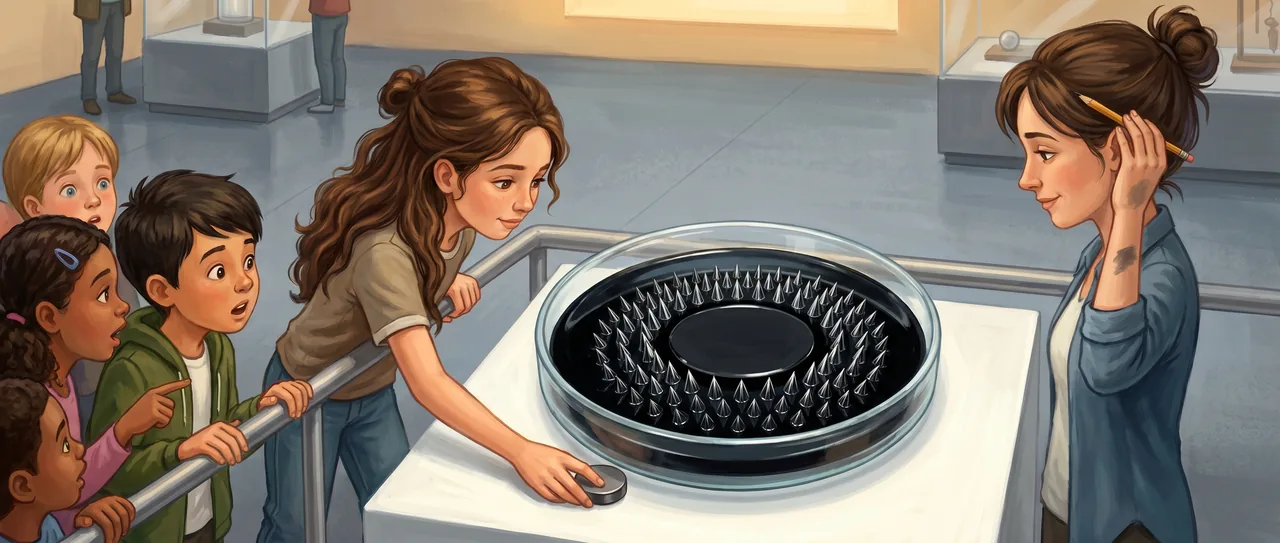
The Black Liquid That Counted
The liquid failed beautifully.
It was supposed to sit inside the glass dish like a black mirror until the exhibit maker pressed the green button. Then, according to the taped-up plan, one smooth hill would rise in the middle, neat as a gumdrop.
Instead, the black surface bristled.
Tiny cones snapped upward. Not one cone. Not a puddle splash. A whole field of them, each with a sharp silver point where the ceiling lights caught it. They stood in rows that were almost, but not quite, perfect.
The exhibit maker made a sound like a drawer sticking.
“No,” she said. “Absolutely not. I ordered smooth.”
Maya leaned over the safety rail until the rubber edge pressed into her ribs.
The dish was sealed. Under it sat a white plastic platform with slots for magnets and electromagnets. The sign behind it said: FERROFLUID. LIQUID WITH TINY MAGNETIC PARTICLES. TOUCH NOTHING BUT THE CONTROLS.
Maya had seen videos. In videos, ferrofluid climbed magnets like black fur. In videos, it looked like a trick.
This did not look like a trick.
It looked as if the liquid had made a decision.
The exhibit maker jabbed the red button. The cones folded down into a glossy puddle.
“Bad batch,” she said. “Or the coils are miswired. Or both. I have nineteen minutes before the school group comes in.”
“It made a pattern,” Maya said.
“It made the wrong pattern.”
“Wrong for the plan.”
The exhibit maker looked at Maya properly for the first time. She had a pencil behind one ear and another pencil holding up her hair. There was a smudge of black grease on her wrist.
“You’re the early kid from the lobby,” she said.
“Maya.”
“The early Maya from the lobby. Do not open the dish. Do not touch the wiring. Do not lick anything.”
“I wasn’t going to lick it.”
“That is what everyone says before museums become paperwork.”
She crouched beneath the table and pulled out a tray of magnets, each sealed in a plastic puck with a handle. “I’m getting the spare bottle. You may slide these in the slots. Not the coils. If it spills, shout before it reaches carpet.”
“It’s sealed.”
“If it spills through a seal, shout louder.”
Then she hurried away, muttering about donors and gumdrops.
Maya waited until the footsteps turned the corner.
The green button glowed.
She did not press it.
First she slid one magnet puck under the middle of the dish, where the plan showed the gumdrop. The puck made a soft plastic scrape in its track. The liquid above it stayed flat and black, holding the reflection of Maya’s nose upside down.
She pressed the green button.
The black mirror broke into cones.
They did not rise only above the magnet. They spread around it in a patch, taller near the center, smaller near the edge. Between the cones were dark little valleys. The cones were not touching. They had made room for each other.
Maya turned the power down with the slider.
The cones shortened.
She turned it up.
They sharpened.
Too high, and some cones leaned together into ugly clumps. Too low, and they sank back into the shine.
“Not bad,” Maya said. “Picky.”
She tried to make the gumdrop anyway.
One magnet in the center. Low power. Medium power. High power. No gumdrop.
Two magnets side by side. The liquid made two bristling islands with a sag between them.
Three magnets in a triangle. The cones appeared in a triangle too, but not exactly above the handles. Some rose in the spaces, as if the liquid cared about the hidden push from every direction at once.
Maya frowned.
People always said magnets pulled.
That was too small a word.
The magnet under the plastic was not touching the liquid. The liquid was not one thing, either. It was oil and tiny magnetic pieces too small to see, all pretending to be smooth until the field reached through the glass. Then the pretending ended.
She slid four magnet pucks into a square.
The surface jumped into spikes around the edges.
The middle stayed flat.
Maya turned the power up.
The edge cones grew taller. The middle stayed flat, a round black eye among the bristles.
“That’s not nothing,” Maya said.
She leaned closer.
The empty-looking middle was the strangest part. Four magnets surrounded it. Four invisible pushes met there. The liquid did not spike because it was not being ignored. It was being argued over equally.
Maya moved one magnet a finger-width outward.
The black eye broke. Cones crawled toward the gap.
She moved it back.
The eye returned.
Her mouth opened, but no sound came out.
Thirty seconds before, a flat patch had been a place where nothing happened. Now it was a place where too much happened to choose one direction.
The exhibit maker rushed back carrying a silver bottle in a foam sleeve.
“Please tell me the carpet is alive,” she said.
Maya did not look up. “Your display shouldn’t be a gumdrop.”
“That is not the comfort sentence I wanted.”
“It’s trying to show the field.”
“It is trying to embarrass me in front of fifth graders.”
Maya pressed the red button. The cones vanished.
Then she pressed green again.
The square of spikes rose, leaving the round flat center untouched.
The exhibit maker stopped moving.
Maya slid one magnet out of line. The flat center slid away and shattered into little peaks. She pushed the magnet back. The dark center returned, round and quiet.
The exhibit maker set the spare bottle down slowly.
“It’s canceling in the middle,” she said.
“It’s not just making spikes where magnets are,” Maya said. “It’s making the shape it can keep. Pulling up, falling down, surface trying to stay together.”
The exhibit maker reached toward the controls, then stopped herself with her fingers in the air.
“Show me again,” she said.
Maya did.
This time she set the power just below the clumping place. The cones rose cleanly. They arranged themselves with tiny gaps, each spike separate, each one finding its own place. Maya did not say that last part. She only moved the magnets and watched the black surface answer.
The exhibit maker smiled with one side of her mouth.
“I spent two weeks trying to force it into a logo,” she said.
“It doesn’t want a logo.”
“It wants physics.”
“It wants room.”
The first children arrived in a clatter of shoes and zippers. They pressed toward the rail. A teacher began saying something about keeping hands inside the line, but the sentence fell apart when the exhibit maker turned on the dish.
The cones rose.
Every child went quiet at once.
That was better than applause.
The exhibit maker pointed to the flat black center.
“Who thinks there is nothing happening there?” she asked.
Hands shot up.
Maya kept both of hers down.
A boy in a green jacket said, “It’s the only boring part.”
Maya slid one of the pucks out of place.
The boring part vanished into spikes.
The children made a noise like a flock of startled birds.
“Put it back,” someone said.
Maya did.
The flat circle returned.
The boy in the green jacket leaned so far forward that the teacher caught his backpack handle.
“So the empty place is important,” he said.
Maya looked at the liquid. The cones were not smooth. Up close, each one trembled a little, as if it was continuously being made. The whole field held still by never quite holding still.
The exhibit maker pushed a blank white label across the table to Maya. “What should this station be called?”
Maya looked at the printed choices stacked beside the rail.
MAGNETIC LIQUID.
SPIKES AND FIELDS.
INVISIBLE FORCES.
All of them were true. None of them made the back of her neck prickle.
She turned the blank label over and left it blank.
“Don’t name it yet,” she said.
The exhibit maker laughed once. “That is terrible exhibit design.”
“Good.”
A smaller child at the rail pointed. “Can it make a hole with no walls?”
Maya looked down at the four magnet pucks, then at the empty tracks between them.
“I don’t know,” she said.
The exhibit maker did not answer for her.
Maya slid the magnets farther apart, one finger-width at a time. The cones shortened, separated, and sank at the edges. The flat center widened into a glossy black circle.
Maya picked up a fifth magnet puck and held it over an empty slot.
The children leaned forward.
Maya slid the magnet under the glass one finger-width at a time. The black surface shivered, rose, and arranged itself into a ring of sharp shining cones around an empty center.
Read the interactive version, listen to the narration, and earn a gold star →
A science-verified short story for curious kids · Curiosity Land