Who Is Here
The body broke at the lentils.
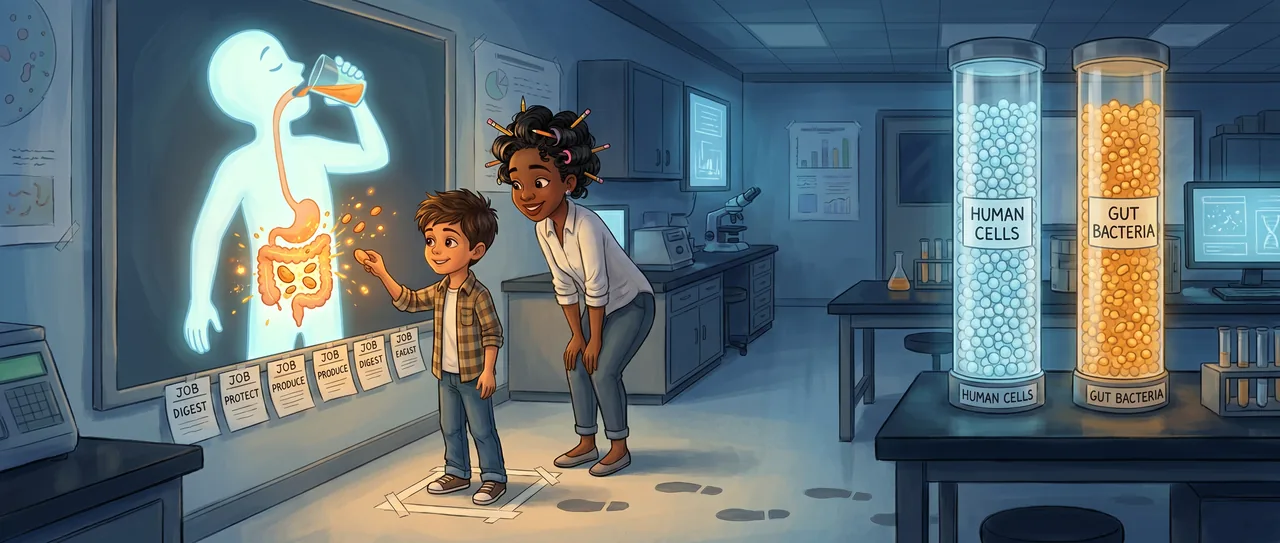
On the wall of the Open Genome Room, a person made of light swallowed a spoonful of orange soup. The soup slid through the shining mouth, crossed the shining stomach, reached the shining loops of gut, and stopped.
A red message appeared.
Missing system.
Soren stood on the taped footprints in front of the display, still holding the lentil tile between two fingers.
Dr. Imani made a sound through her teeth. She was under the control table with a cable in one hand and a flashlight in her mouth. Her black curls were pinned up with two pencils and one plastic pipette.
“It is not supposed to do that,” she said around the flashlight.
“That is what broken means,” Soren said.
“It is what opening night in forty minutes means.” She pulled the flashlight from her mouth. “Try chicken.”
Soren set the lentil tile down and picked up a chicken tile. The light person swallowed. The chicken moved down, broke apart into smaller lights, and disappeared into the bloodstream with a soft chime.
“Again,” Dr. Imani said.
Soren tried rice. Chime.
Apple. Chime, but slower.
Lentils. Stop.
Missing system.
Dr. Imani slid out from under the table. “It is the lentil tile.”
Soren turned it over. The back was clean. The corner was not bent. The little metal chip sat in its square exactly like the others.
He tried the lentil tile upside down.
Missing system.
He tried it with his left hand.
Missing system.
He tried holding it next to the apple tile.
The apple chimed. The lentils stopped.
“It is not the tile,” Soren said.
Dr. Imani looked at the clock above the incubators. “I built this exhibit to show that your genome is the instruction book for your body. Mouth, stomach, enzymes, cells. Clean. Simple. Friendly for donors.”
Soren looked at the sign beside the display.
YOU ARE WRITTEN IN YOUR DNA.
Under it, a row of bright cards waited in slots. Skin. Blood. Muscle. Bone. Brain. Liver. Stomach. Small intestine. Large intestine.
The large intestine card was glowing, but not brightly. More like a hallway with the lights on during the day.
“What does the missing system do?” he asked.
“Food processing,” Dr. Imani said. “The program checks whether the body can break down what you give it.”
“Human bodies do not break everything down by themselves.”
Dr. Imani stopped reaching for the keyboard.
Soren had copied a fact three months ago from a library book because it looked wrong enough to keep. Human cells, about thirty trillion. Gut bacteria, about thirty eight trillion. “Do you have the bacteria part?” he asked.
Dr. Imani looked toward a wheeled cart covered with a blue cloth.
“That is for later,” she said.
“For after the body works?”
“For after the speech.”
Soren walked to the cart. He did not lift the cloth yet. He looked back at her.
Dr. Imani sighed. “It is a microbiome demo. Stool samples from volunteers, DNA extracted, human DNA filtered out, bacterial DNA sequenced. Very interesting. Also very much not the first thing donors want to think about while eating cheese cubes.”
“Lentils are not cheese cubes,” Soren said.
“No,” Dr. Imani said. “They are apparently a rebellion.”
Soren lifted the cloth.
Under it was a second display, smaller and stranger. Clear tubes held colored beads. A screen showed ragged lines of letters, not one long code but thousands of broken bits. Names sat beside some of them. Bacteroides. Bifidobacterium. Ruminococcus.
There was no neat person shape here. No head. No hands. No single outline that said where the body ended.
At school, when Soren’s notebook pages had arrows going sideways and labels tucked into margins, people told him to recopy them cleanly. The sequencer screen looked like a page no one had forced flat. Bits from many living things crossed and overlapped, and the machine had been built to read them that way.
He touched one tube. Amber beads clicked softly against the glass.
“What does each bead stand for?” he asked.
“One trillion cells,” Dr. Imani said. “For scale. The human cell counter is over there.”
Soren went still.
Beside the wall display stood a tall clear column filled with pale blue beads. Its label read HUMAN CELLS, ROUGHLY THIRTY TRILLION.
On the cart, the amber tube was filled almost to the same height.
GUT BACTERIA, ROUGHLY THIRTY EIGHT TRILLION.
The room did not get louder, but it seemed to make space for another room inside it. Soren looked at his own middle, at the place behind his shirt where lunch had gone, and the amber beads clicked again because his hand was shaking the tube a little.
“Mostly in the large intestine,” Dr. Imani said quietly. “Not everywhere. Not all the same kinds. Different from person to person.”
Soren picked up the tube and carried it to the glowing body.
Dr. Imani took one quick step. “Careful. That took three weeks to prepare.”
“I am being careful.”
“You are walking toward my main exhibit with thirty eight trillion imaginary bacteria.”
“Scale bacteria,” Soren said.
“That is not as comforting as you think.”
The large intestine card had a blank slot beside it. It was the only blank slot on the body board.
Soren pointed to it. “What was supposed to go there?”
“Nothing,” Dr. Imani said.
“Then why is there a slot?”
Dr. Imani opened her mouth. Closed it. Looked under the table where the cables lay in loops.
“The board template came from the older metabolism exhibit,” she said. “I did not use that part.”
Soren set the amber tube gently in the slot.
Nothing happened.
Dr. Imani raised one eyebrow.
“It needs a card, not a tube,” she said.
Soren went back to the cart. The microbiome demo had cards too, smaller than the body cards. They were not labeled as body parts. They were labeled with jobs.
Ferments some fibers.
Makes short chain fatty acids.
Helps train immune cells.
Crowds out some invaders.
He chose the fiber card first. Then he hesitated and took the whole stack.
“You cannot put all of those in one slot,” Dr. Imani said.
Soren fanned them on the table below the large intestine instead, the way he arranged notes when one line was not enough. The fiber card touched the gut loop. The immune card touched the blood line. The crowding card touched the edge of the body shape without going inside it.
Dr. Imani leaned closer.
Soren tried the lentil tile.
The light person swallowed. The orange soup reached the gut and paused. This time, amber sparks appeared around it. The lentils broke into smaller lights. Some drifted into the bloodstream. Some continued on.
The wall chimed.
Dr. Imani laughed once, very softly, as if the sound had escaped before she could schedule it.
“That is not the exhibit I designed,” she said.
“It is the one that works,” Soren said.
Voices sounded in the hallway. Adults arriving early. Shoes on polished floor. Someone shaking rain off an umbrella.
Dr. Imani looked at the old sign.
YOU ARE WRITTEN IN YOUR DNA.
She looked at the two bead columns, pale blue and amber, standing almost level.
“I need a new opening question,” she said.
Soren took the removable letters from the sign box. The plastic pieces were cold and smooth. He did not use the word you. It was too small by itself.
He snapped letters into place while Dr. Imani taped the microbiome cards beneath the glowing gut. In the hall, the first visitors began to gather.
No one said anything for a breath.
Soren touched the green start square. Above the empty footprints, the new question lit up: WHO IS HERE?
Read the interactive version, listen to the narration, and earn a gold star →
A science-verified short story for curious kids · Curiosity Land