The Weight of a Strange Clue
The first answer Maya gave was wrong in public.
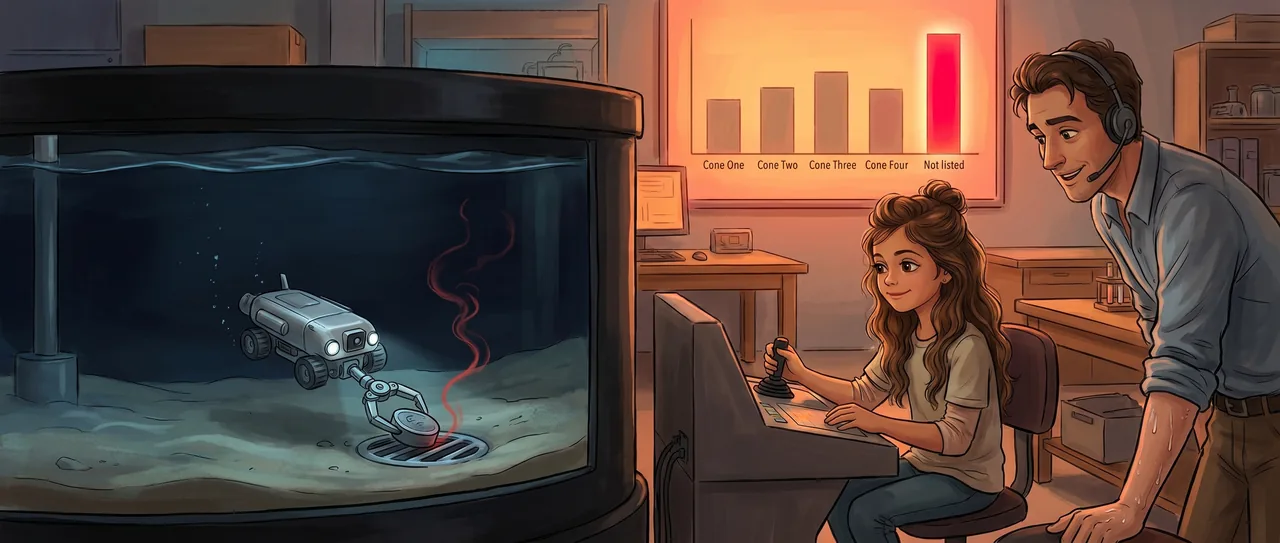
The little rover dipped its silver nose into the black water tank, shivered its propellers, and glided toward Cone Two. Above the tank, the big screen showed the reason in glowing orange letters.
Warmest reading: Cone Two.
The crowd made the soft sound people make when a machine is about to be clever.
Maya folded her arms tighter. The tank was supposed to be a pretend piece of the deep ocean. One of the four black cones hid a model hydrothermal vent, a puck that warmed the water and leaked a safe chemical dye the sensors could smell. The rover reached Cone Two. Its claw lifted the cone.
Nothing was underneath except black sand.
The crowd made a different sound.
The coordinator laughed too loudly. He wore a headset and had one sleeve rolled up higher than the other, as if he had been fixing three things at once all morning.
“Thermal glare,” he said. “The overhead lights warm the cones sometimes. No problem. We will reset.”
Maya did not move.
On the screen, Cone Two still glowed orange. Wrong, but not useless. Wrong had shape. Wrong belonged on the list.
The coordinator reached for the reset button.
“Don’t,” Maya said.
He blinked at her. “It is only a demo.”
“That is why we can break it properly,” Maya said.
A few adults smiled. The coordinator did not. He looked at the line of people waiting behind her, then at the rover, then at the dripping cone in its claw.
“You get one more dive,” he said. “Battery rule. Then I really do reset.”
Maya nodded and stepped closer to the evidence table.
It was not a table for answers. It was a table for changing your mind. Four clear columns stood under the cone numbers. Each column had the same stack of blue glass beads at the start. Above them were cards from the morning calibration.
Heat signal: if the vent is there, happens nine times out of ten.
Heat signal: if the vent is not there, happens six times out of ten.
Chemical signal: if the vent is there, happens seven times out of ten.
Chemical signal: if the vent is not there, happens one time out of ten.
Current swirl: if the vent is there, happens five times out of ten.
Current swirl: if the vent is not there, happens four times out of ten.
Maya stared at the cards until the numbers stopped being numbers.
Heat was loud, but heat was a gossip. It talked even when nothing important had happened.
Chemical was quieter. If it spoke in the wrong place, something had to answer for it.
The rover’s first sweep had left a trail on the screen. Orange around Cone Two. A thin green swirl near Cone One. No chemical at the cones.
But at the back of the tank, close to the drain, there was one red speck.
It was so small the screen had almost hidden it under the label that said pump return.
Maya pointed. “What is that?”
The coordinator leaned in. “Background dye. The game only scores the four cones.”
“Does background dye happen one time out of ten too?”
“It can.” He glanced again at the waiting line. “Probably.”
“Probably is not a number,” Maya said.
The coordinator opened his mouth, closed it, and rubbed his forehead with the back of his wet wrist.
Maya took one empty plastic sample cup from the table and placed it beside the four columns.
“What is that for?” he asked.
“Not the cones.”
“The vent is supposed to be under a cone.”
“Supposed to be is not a sensor.”
Someone in the crowd laughed once, then stopped.
Maya moved the beads herself. She did not know the official way, so she used the table the way her hands understood.
Cone Two had heat. She let it keep more beads than the others. But not many more, because heat happened a lot even when a cone was empty.
Cone Two had no chemical. She took most of its beads away.
Cone One had a swirl. She gave it a tiny push, then frowned and took nearly the same push back, because swirl happened almost as often when nothing was there.
The other cones sagged into small piles.
Then she touched the red speck on the screen. The one near the drain.
For the four cone columns, the red speck did not fit. It was not at them. It did not help them. It made them look worse.
For the sample cup, the red speck was different. If the vent was not under any cone, if it had slid somewhere near the back, a chemical trace by the drain was not ridiculous at all.
Maya poured beads into the cup.
The cup was not the biggest because she wanted it to be. It was biggest because the strangest clue had nowhere else honest to go.
The coordinator stared at it.
“The software will not accept that as a target,” he said.
“The joystick will,” Maya said.
He hesitated. Then he stepped back.
Maya took the rover controls. The joystick was cold from other people’s hands. The tank water looked like night with a ceiling.
The rover turned away from the four cones.
A little murmur passed through the crowd, the sound of people seeing a game stop being a game.
Maya guided the rover low over the sand. Cone Two glowed warmly behind it, proud and wrong. The red speck on the screen blinked once, vanished, then returned nearer the drain.
The rover’s camera found the grate.
Something round was wedged under its edge.
Maya lowered the claw.
The first grab slipped. The puck rocked, and a thread of red dye curled out of the shadow like smoke in water.
The coordinator said something under his breath.
Maya tried again, slower. The claw pinched the puck and pulled. It came loose all at once. The rover’s temperature bar climbed. The chemical bar flashed red so brightly the black tank seemed to answer back.
Behind Maya, the evidence table chimed. The four cone columns dimmed on the big screen. A fifth column appeared beside them, gray at first, then brightening bead by bead.
Not listed.
Maya did not laugh. She watched the new column grow.
The tank was still the same size. Four cones. One drain. One rover with a tired battery.
It was also larger than it had been thirty seconds before.
Before, it had been a hiding game with four choices. Now it was a machine for being less wrong, even when the right place had not been invited.
The coordinator crouched and peered into the tank. His headset had slipped crooked over one ear.
“The magnet lock must have failed,” he said. “The pump tugged the puck under the grate.”
Maya looked at the calibration cards. Heat, chemical, current. Loud clues. Quiet clues. Clues that mattered because they almost never happened by accident.
On the wall beyond the tank, another screen woke up from sleep. It showed a practice map made from real public ocean data, with squares of temperature and chemistry spread across a blue-black grid. There was no hidden answer printed at the top. No cones. No reset button.
The coordinator followed her eyes.
“That one is harder,” he said. “It is for older visitors.”
Maya held out her hand.
After a second, he gave her the controls.
The practice screen showed an ocean grid and black water beyond the last square. Maya dragged one gray bead off the grid and dropped it into the black.
Read the interactive version, listen to the narration, and earn a gold star →
A science-verified short story for curious kids · Curiosity Land