The Two Ways to Be Wrong
The robot was wrong in two different ways before lunch, which was the first interesting thing about it.
It had one arm, three rubber fingers, and a camera for a face. On the table in front of it sat a mug, a bowl, a spoon, a fork, a flowerpot, a roll of red tape, a folded silicone cup, a paper drawing of a cup, and a cracker shaped like a fish.
The open lab smelled like warm plastic and pizza boxes. Above the table, a sign said: TEACH A ROBOT TO PACK A PICNIC FOR SPACE.
The coordinator clapped once, too loudly. She had a badge, a soldering iron burn on one sleeve, and the expression of someone who had lost five minutes somewhere and wanted them back.
“Visitors arrive in forty minutes,” she said. “You have the rule editor, the training camera, and one robot that must not fling forks. Pick the cleverest method.”
“Only one?” Soren asked.
“Please,” the coordinator said. “My projector is already arguing with the ceiling.”
She hurried away, carrying a coil of cable like a captured snake.
Soren opened the rule editor. It had neat boxes with words like IF, AND, NOT, THEN. His shoulders lowered a little, the way they did when a thing gave him handles.
“Cup,” he said. “If it is hollow, open at the top, and can stand upright.”
Maya was already holding the training camera over the mug from six angles.
“You’re making a robot lawyer,” she said.
“You’re making a robot guesser,” Soren said.
“Good. Guessing is how you get near things.”
“Near things is how you put a flowerpot in someone’s lunch.”
Maya grinned. “Try yours.”
Soren typed. The robot’s camera clicked. Its arm hovered over the flowerpot.
“Cup,” the robot said.
“No,” Soren said.
The arm lifted the flowerpot and placed it in the picnic tray. A crumb of dirt fell out of the drainage hole.
Maya leaned close to the hole. “People on spacecraft would complain.”
Soren added a rule. NOT if bottom has hole.
The robot tried again. It rejected the flowerpot. It accepted the mug. It accepted the bowl as a cup.
Soren added another rule.
The robot rejected the bowl. It rejected the folded silicone cup.
“That is a cup,” Maya said.
“It is flat.”
“It’s hiding.”
Soren unfolded it with one finger. The silicone popped into a little blue cylinder. The robot accepted it.
Maya made a sound like a tiny bell. “Your rules only like things after they confess.”
Soren looked at the folded cup, then at the editor. “Your turn.”
Maya fed the camera pictures. Mug. Cup. Cup from above. Cup from the side. Cup upside down. Red cup. Blue cup. Paper cup. Metal cup. She moved fast, but not carelessly. When the robot’s screen showed a blurry picture, she did it again.
Soren watched the numbers climb beside the word CUP.
“You didn’t tell it hollow,” he said.
“Nope.”
“You didn’t tell it upright.”
“Nope.”
“You didn’t tell it anything.”
“I showed it.”
The robot looked at the folded silicone cup.
“Cup,” it said.
Maya pointed both hands at it.
Then the robot looked at the roll of red tape.
“Cup,” it said.
Soren did not smile exactly. His mouth considered it.
The robot lifted the tape and placed it proudly beside the mug.
Maya stared at the tray. “Why?”
Soren opened the training pictures. “Most of your cups are red.”
“It saw redness as cupness.”
“It saw a pattern,” Soren said. “Just not the one you meant.”
Maya took the red tape out of the tray. She put the paper drawing of a cup under the camera.
“Cup,” the robot said.
Maya was quiet.
Soren was quiet too, which was one of the reasons Maya liked thinking near him. He did not rush into the empty space with victory.
The coordinator returned with her cable, which now had a piece of tape stuck to it.
“How are we doing?” she asked.
“We have a robot lawyer and a robot guesser,” Maya said.
“Do either of them impress parents?”
“One puts flowerpots in lunch,” Soren said. “The other packs drawings.”
The coordinator looked at the table, then at the ceiling projector, then at the door where voices were starting to gather.
“Could we choose the less embarrassing wrong?” she asked.
Maya and Soren looked at each other.
“No,” Maya said.
Soren said, “We need both embarrassing wrongs.”
The coordinator shut her mouth, opened it again, then pointed at the robot. “Twenty minutes. No fork flinging.”
Maya pulled the training screen beside Soren’s rules. The two windows did not match. One was a cloud of pictures and percentages. The other was a stack of locked gates.
“What if yours goes first?” Soren asked.
“It finds possible cups,” Maya said.
“And mine cross-examines them.”
“Your robot lawyer can ask if the guess is lying.”
“Not lying,” Soren said. “Incomplete.”
They made the network give three guesses instead of one. They made the rules refuse flat things, things with holes in the bottom, and things that could not stand unless held. They made a new box called TEST.
If the picture system said cup, but the rules were unsure, the robot had to turn the object and look again.
The first test was the mug lying on its side with the handle hidden.
Maya’s window said CUP, sixty-two percent.
Soren’s window said UNKNOWN, opening not seen, base not seen.
The robot’s arm came down. It rolled the mug gently. The dark oval of the opening appeared. The flat base appeared. Two green boxes lit at once.
“Cup,” the robot said.
The room seemed to tilt wider without moving. The robot had not become Maya’s kind of thinker or Soren’s kind of thinker. It had used one kind of wrong to aim the other kind at the place where it was blind.
Maya grabbed the paper drawing and slid it under the camera.
CUP, ninety-four percent.
The rules blinked red. FLAT. CANNOT HOLD LIQUID.
The robot left the drawing on the table.
Soren put the flowerpot under the camera.
PLANT POT, fifty-one percent. CUP, forty-seven percent.
The rules blinked red. BOTTOM HOLE.
The robot left the flowerpot too.
Maya folded the silicone cup flat again.
CUP, eighty-eight percent.
The rules blinked yellow. SHAPE UNCERTAIN. TEST.
The robot poked the blue disk. It sprang open. The rules blinked green.
“Cup,” the robot said, and placed it in the tray.
The visitors came in while the robot was sorting the fork from the spoon. Adults bent over the table. Smaller kids pushed between coats. The coordinator stood beside the projector, which had finally surrendered and was showing the robot’s camera view on the wall.
The robot packed the mug, the spoon, the fork, and the folded cup. It rejected the flowerpot, the tape, and the drawing. When someone slipped the fish cracker onto the table, the picture window offered FISH, SNACK, TOY. The rule window offered NOT UTENSIL. The robot did not pack it.
A little kid ate the evidence.
The coordinator pressed both hands to the top of her head.
“It works,” she said. “I do not know which part made it work.”
Maya pointed at the two windows. “That part argues with that part.”
Soren added, “And when they argue right, the arm knows what to test.”
On the screen, the program had begun making a list of conflicts. RED TAPE LOOKED LIKE CUP. PAPER CUP DRAWING LOOKED LIKE CUP. FOLDED CUP DID NOT LOOK OPEN. Beside each one was a small empty box labeled KEEP FOR LATER.
Maya touched the first box.
The program kept it.
Soren touched the second.
The program kept it too.
The coordinator stared at the saved conflicts. “The mistakes are useful?”
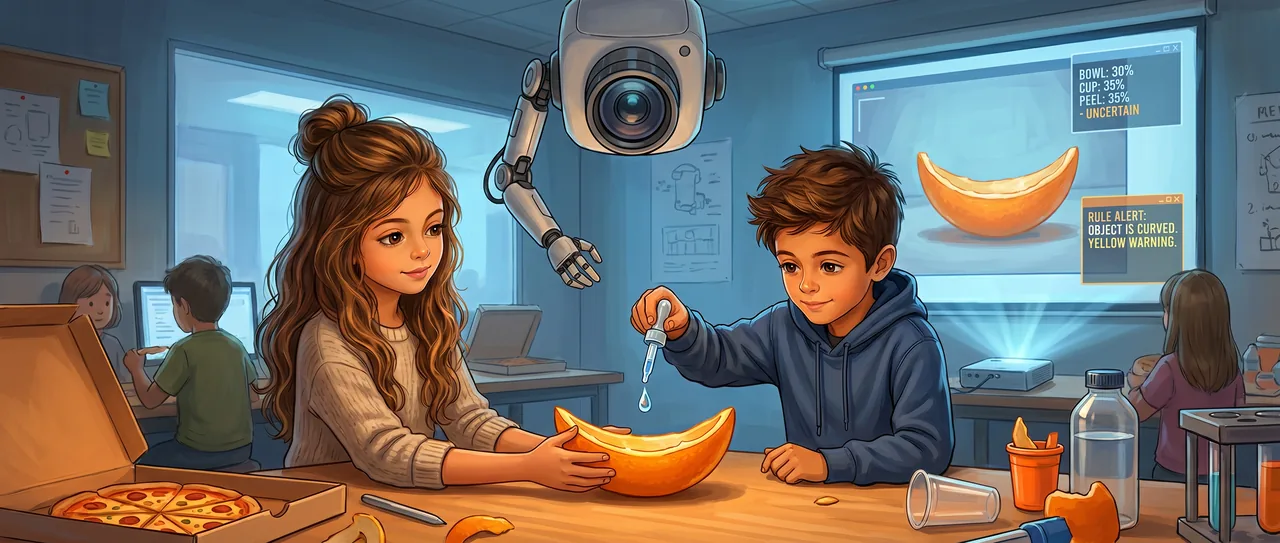
Maya had already picked up the orange peel left from someone’s lunch. It was a single curved piece, bright and dimpled, with its ends lifted like a tiny boat.
She set it on the table.
The robot looked down.
BOWL, forty-one percent. CUP, thirty-eight percent. PEEL, thirty-five percent.
The rules blinked yellow. CAN HOLD LIQUID, UNKNOWN.
The robot’s arm did not move.
Soren brought the water dropper from the test tray. Maya steadied the orange peel with two fingers.
Soren squeezed, and one clear drop fell into the orange peel’s hollow.
Read the interactive version, listen to the narration, and earn a gold star →
A science-verified short story for curious kids · Curiosity Land