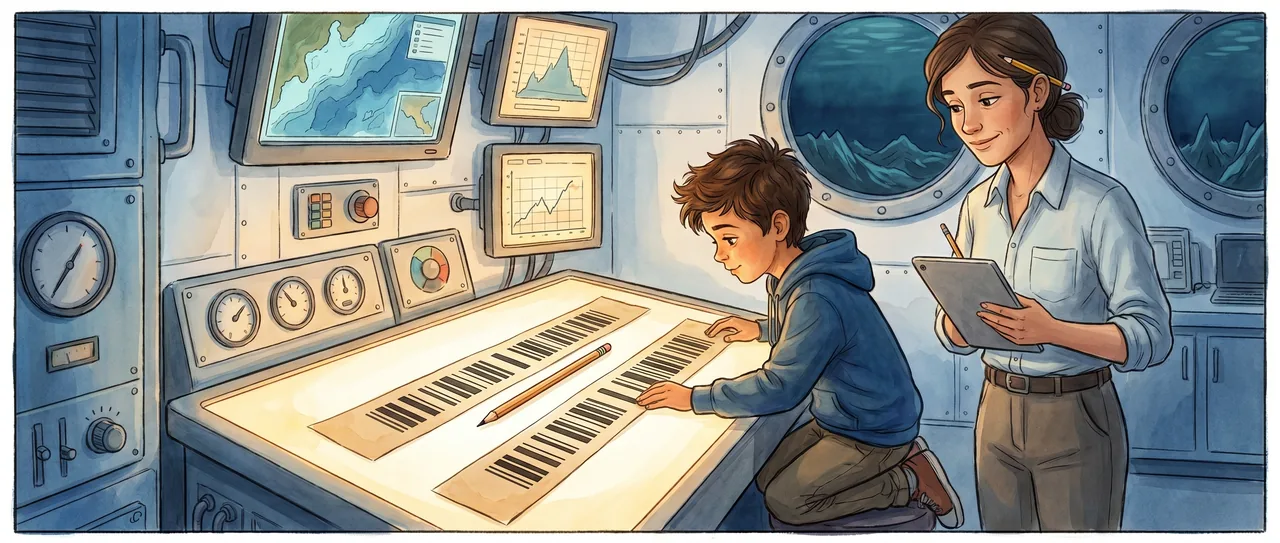
The Tape Under the Sea
The first thing Soren did with the map was try to make it stop being interesting.
The research vessel rolled gently over the mid-ocean ridge, though the ridge itself was more than two thousand meters below. On the lab screen, the seafloor looked like a long, dark scar stitched through blue water. On the printer beside Soren, it looked like a barcode that had lost its temper.
Black stripe. White stripe. Black. Black. White. Thin black. Wide white.
The chief technician tore off the paper and handed it to him without looking. She had a pencil behind one ear, a radio in one hand, and the expression of someone who had already been asked where the bathroom was too many times.
“Live magnetometer run,” she said. “Do not spill juice on it.”
“I don’t have juice,” Soren said.
“Good. Continue not having it.”
She turned back to three glowing screens.
Soren sat on the rubber floor with the strip across his knees. The magnetometer was being towed behind the ship like a silver fish with no eyes. It measured tiny changes in Earth’s magnetic field as they passed over the ocean floor.
He knew what a compass did. He knew magnets had north and south. He knew the Earth had a magnetic field because compasses were not magic, no matter what his cousin said.
But this did not look like north.
This looked like someone had dragged a comb through the planet.
He took out his paper notebook. The chief technician glanced over her shoulder.
“Paper,” she said. “Brave choice.”
“It doesn’t run out of battery,” Soren said.
“It does run out of paper.”
“That takes longer.”
She made a sound that might have been a laugh, if it had not been interrupted by the radio.
Soren copied the stripe pattern into his notebook. He wrote small letters under it.
Strong. Weak. Strong. Strong. Weak.
Then he stopped and crossed out the words. Strong and weak were not enough. The ship’s display labeled the stripes normal and reversed, but the words sat in his head like shoes on the wrong feet.
Normal compared to what?
Reversed from when?
He stood and carried the strip to the technician.
“I think your fish is confused,” he said.
The technician kept typing. “My fish cost more than this galley and has better manners.”
“It keeps changing its answer.”
“It is supposed to.”
“Magnets are supposed to point one way.”
“Compasses point one way. Rocks remember whatever way there was.”
The radio crackled. She leaned closer to it and said, “Say again, deck team?”
Soren waited. She did not turn back.
Rocks remember whatever way there was.
That was the kind of sentence adults dropped and then walked away from, as if it were not buzzing.
Soren returned to the floor.
He drew a line down the middle of the printed strip and tried to make the pattern sensible as a path. Maybe the magnetometer had swung left and right behind the ship. Maybe metal in the ship made false stripes. Maybe the silver fish was picking up old anchors, lost engines, meteorites, sunken cities.
He liked sunken cities, but the stripes were too neat for them.
He numbered the blocks from the left edge. One, two, three, four. Then from the right edge. One, two, three, four.
The numbers did not help.
He tried covering every other stripe with his sleeve.
That helped less.
The lab door slid open, and wet air rushed in. The technician came over carrying another strip of paper, fresh from the printer.
“Second pass,” she said. “Other side of the ridge. Compare it if you want. I have to convince the satellite link that the sky exists.”
She dropped the new strip beside him and left before he could ask what compare meant.
The second strip was another barcode. Soren lined it under the first.
It did not match.
Of course it did not match. The ship had crossed a different part of the seafloor. The ocean was enormous. Expecting two random strips to match would be like expecting two handfuls of beach sand to have the same shells in the same order.
He almost put the second strip aside.
Then he noticed the wide white stripe.
Not the first one. The second one from the center. It had a thin black stripe next to it, then two medium whites, then a narrow black like a nail clipping.
The first strip had the same little group, but backward.
Soren held both strips closer.
Wide white. Thin black. Medium white. Medium white. Nail black.
On the other strip, nail black. Medium white. Medium white. Thin black. Wide white.
He forgot to breathe for a moment, then took one strip and turned it around.
The patterns shook into place.
Not perfectly. The ocean was not a ruler. But enough.
He put the strips on the light table used for checking sample labels. He slid them until the stripes touched across a blank space where the ridge would be.
Black met black.
White met white.
Thin met thin.
Wide met wide.
A mirror made of stone, buried under water.
The technician came back, still frowning at her tablet. “Please tell me you have not taped anything to anything expensive.”
“No tape,” Soren said. “Look.”
She looked because his voice had gone flat and careful, which was how his voice got when the inside of his head had become too crowded.
He pointed to the middle. “If this is the ridge, the stripes match outward. Not as a line. As two lines going away.”
The technician lowered the tablet.
Soren moved his fingers from the center to the left and right at the same time.
“New rock comes up here,” he said. “It cools. Whatever the magnetic field is doing gets stuck in it. Then more new rock comes up and pushes the older rock away. Both sides. Same time.”
He pointed to a black pair. “Field one way.”
He pointed to a white pair. “Field the other way.”
He pointed outward, stripe after stripe. “Again and again.”
The technician was quiet long enough that Soren checked her face to see if he had said something wrong.
Then she took the pencil from behind her ear and set it across the middle of his two paper strips.
“You found the ridge axis,” she said.
Soren looked at the pencil. It lay exactly where the patterns folded into each other.
“From the broken-looking part,” she said.
“It wasn’t broken,” Soren said.
“No.”
The ship rolled. Somewhere below them, black rock was being made in darkness. Not fast like pouring syrup. Not even fast like a tree growing. Slower than fingernails, the technician had said earlier, while pointing at an animation nobody else watched because lunch had arrived.
Soren had heard that part. A seafloor could move at the speed of a growing fingernail and still open an ocean.
He looked at the stripes again.
They were not decorations. They were not mistakes. They were dates without numbers, laid down in basalt. The planet had been writing in both directions from a seam.
“When did it flip last?” Soren asked.
“The magnetic field?” the technician asked.
“Yes.”
“About seven hundred eighty thousand years ago for the last full reversal.”
Soren looked down at the newest black stripe on the screen.
“When is the next one?”
The technician opened her mouth, then closed it. Her smile changed shape.
“We do not know,” she said.
The answer did not feel empty. It felt deep.
Soren took the pencil from the paper and placed it on the light table beside the strips. Without it, the center did not disappear. The stripes still leaned away from it, paired and waiting, as if the missing line had become more real because nothing marked it.
The technician tapped the ship’s live map. “The next classroom call starts in six minutes. Do you want to show them?”
Soren looked at the wall screen, at the glowing ridge, at the silver path of the towfish trailing behind the ship. Then he looked at the paper in his hands.
“What if they ask why Earth’s field flips?” he asked.
“Then you can say that is a very good question.”
“That sounds like what adults say when they do not know.”
“It is also what scientists say when nobody knows enough yet.”
Soren stood. The floor shifted under his feet. The ship was moving over a mountain range it could not see, pulling a metal fish through black water, listening to rocks remember.
On the printer, the live strip kept coming.
The technician reached for it, but Soren was closer.
The printer clicked. Soren lifted the warm paper strip with both hands, and at its farthest edge, one more black square appeared.
Read the interactive version, listen to the narration, and earn a gold star →
A science-verified short story for curious kids · Curiosity Land