The Star That Became a Note
The first star broke a little after nine in the morning.
It was supposed to spin on a silver stand while visitors watched white dots blur around its painted blue equator. Instead, the rubber belt screamed, the foam sphere leaped off its axle, and one of the white dots stuck to the model Moon.
The planetarium director stared at it. She had coffee on her sleeve and three visitor badges clipped to the wrong side of her jacket.
“Excellent,” she said. “You found the bad habit.”
Soren picked the foam star out of the model crater. “Its bad habit is escaping.”
“Its bad habit is being honest,” Maya said.
The director looked at the clock. “I have six minutes before the donors arrive and twenty before the first school group. The sign says a neutron star can spin seven hundred sixteen times a second. This thing stops being charming at thirty-eight.”
Soren had already written thirty-eight in his notebook. He added belt failure, then circled it.
The director pointed at the table. “Make it feel impossible. Do not melt the motor. Do not frighten accounting. I’ll be back.”
She hurried away, leaving behind the escaped star, the wobbling Moon, and a banner that said, SMALLER THAN A CITY. HEAVIER THAN THE SUN.
Maya stood very still, which was usually the sign that her mind had run ahead without asking permission.
“Wrong kind of fast,” she said.
Soren set the star back on the stand. “Fast is fast.”
“No.” Maya looked at the painted dots. “This is eye-fast. The number is not eye-fast.”
Soren did not disagree yet. He liked to know exactly where a wrong idea began before he threw it away. He opened the exhibit drawer and found a small strobe lamp, two speakers, a blender from the planetarium café, and a plastic tub labeled Emergency Comets.
“The visitors need to see it,” he said.
Maya tapped the speaker grille. “Maybe they don’t.”
Soren connected the strobe to the control pad and set it to blink once each rotation. At ten flashes a second, the painted dots jumped. At thirty, they smeared. At sixty, the star looked as if it had stopped trying.
He typed in seven hundred sixteen.
The strobe became a pale, steady shine.
“That’s worse,” Soren said.
“That’s eyes giving up,” Maya said. “Try ears.”
He frowned at the number. Seven hundred sixteen pulses each second, if a beam swept past once each turn. Pulses that close together were not clicks anymore. They were pitch.
He plugged the number into the sound pad.
The speaker gave a thin, bright note.
It did not sound like a giant thing. It sounded like a silver wire pulled tight. It slid through Maya’s teeth and settled behind her eyes.
Soren turned on the café blender. It roared and rattled on the table, blades ripping air into a kitchen scream. He checked the tachometer sticker on its base, did the division under his breath, and stopped it.
The neutron-star note kept going.
“Faster than the blender,” he said.
Maya leaned closer to the speaker. “And cleaner.”
Soren opened the planetarium archive on the wall screen. There were folders of telescope recordings, sorted by object. He found the name from the exhibit sign, PSR J seventeen forty-eight minus twenty-four forty-six ad, the fastest spinning neutron star astronomers had measured. The file was not a picture. It was a row of pulses, squeezed so close together they looked like woven thread.
He sent the data through the speaker.
The made-up tone vanished. The real one came in rougher, narrower, alive with tiny uneven edges. A dead star, far beyond the planets, was turning so quickly that its lighthouse beam had become something an eleven-year-old could hear in a room with carpet squares and a broken foam Moon.
Maya put two fingers on the speaker casing. It trembled against her skin.
The room seemed to move backward from her. The table stayed where it was. The chairs stayed. The Moon still had a white dot stuck to it. But the space behind all of it went on and on, wide enough to hold a city-sized star spinning hundreds of times between one heartbeat and the next.
Soren did not write anything down for several seconds.
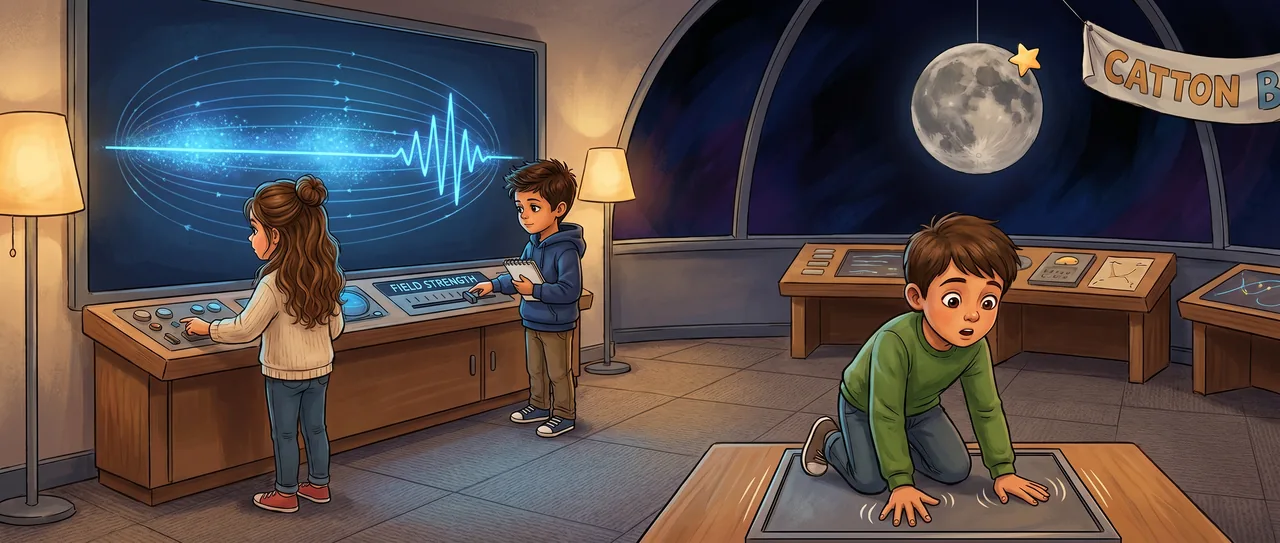
Then the magnetic exhibit popped.
It was only a small pop, but both of them turned.
On the next table, iron filings stood in black hedgehog spikes around a hidden magnet. A sign above it said, A TRILLION TIMES EARTH’S MAGNETIC FIELD.
Maya’s face changed.
“No,” she said.
Soren came beside her. “It’s a magnet.”
“It’s a refrigerator pretending to be a dragon.”
He read the smaller label. “Neutron stars can have magnetic fields a trillion times stronger than Earth’s. Magnetars are even stronger.”
Maya picked up the plastic shaker of iron filings. “This makes metal do hair.”
Soren looked at the atom display next to it. It showed a neat round electron cloud, glowing blue around a red nucleus.
He tapped the field slider. At Earth strength, the cloud barely changed. He pushed the number higher. The cloud flattened, then stretched along the field line until it was no longer round at all.
Maya watched without blinking.
“So it doesn’t just pull things,” she said.
“No.” Soren slid the number back and forth. “At fields like that, atoms don’t get to keep their usual shape.”
The old display had hidden the best part under a bowl of filings.
Maya moved quickly now. She dragged the bar magnet table aside and turned the atom display toward the room. Soren found a second speaker and placed it under the floor panel, low enough that the neutron-star pitch could be felt through shoes without hurting ears.
Maya pulled down the banner with the cartoon star flexing magnet arms.
“Careful,” Soren said. “That tape is stronger than accounting.”
She peeled slower.
They made two paths instead of one. The left side said, FASTEST SPIN WE HAVE MEASURED. The right side said, MAGNETIC FIELDS THAT CHANGE ATOMS. Under that, Soren added, NOT ALWAYS THE SAME STAR.
The director returned with a tablet under one arm and a look of cheerful disaster on her face.
“Please tell me the star is no longer in orbit around the Moon,” she said.
Maya pressed the start button.
The room filled with the thin, bright pulse of seven hundred sixteen turns each second. The floor panel hummed under their sneakers. On the screen, the electron cloud stretched as the field rose, roundness giving way to a long blue shape aligned with invisible lines.
The director’s mouth opened. Then closed. Then opened again.
“That is less cute,” she said.
“Yes,” Maya said.
“It is also much better.” The director looked at Soren’s label and winced a little. “I was trying to make it simple.”
“If you mix them together,” Soren said, “the real ones get smaller.”
The first school group arrived in a rush of damp coats and squeaking shoes. The director started her welcome speech, but the neutron-star note was already in the floor.
A few kids stepped back from the sound. A few stepped closer. One bent down and put both palms flat on the vibrating panel.
Maya watched that kid’s face when the atom cloud narrowed on the screen.
Soren watched the pulse trace crawl across the wall, peak after peak after peak, too fast for eyes until the machine folded it into a pattern.
The director forgot half her speech. It did not matter. The room had found its own way of talking.
After the group moved on, the archive screen remained open. Below the famous pulsar file was another folder, pale and unplayed. Then another. Then a column of them, waiting.
The finished exhibit kept humming behind them.
Maya slid the volume lower until the star was almost gone. Soren tapped the next pale square on the screen, and the speaker began to tick in the dark.
Read the interactive version, listen to the narration, and earn a gold star →
A science-verified short story for curious kids · Curiosity Land