The Shape Water Keeps
By the time Maya reached the biomaterials lab, the tiny kidney had already torn three times.
It was not a real kidney. The engineer said that twice before Maya had even taken off her backpack. It was a clear oval of hydrogel, printed with branching channels inside it, a model for the kinds of scaffolds scientists were trying to build so cells might grow into useful tissue one day.
Still, it looked like a tiny kidney.
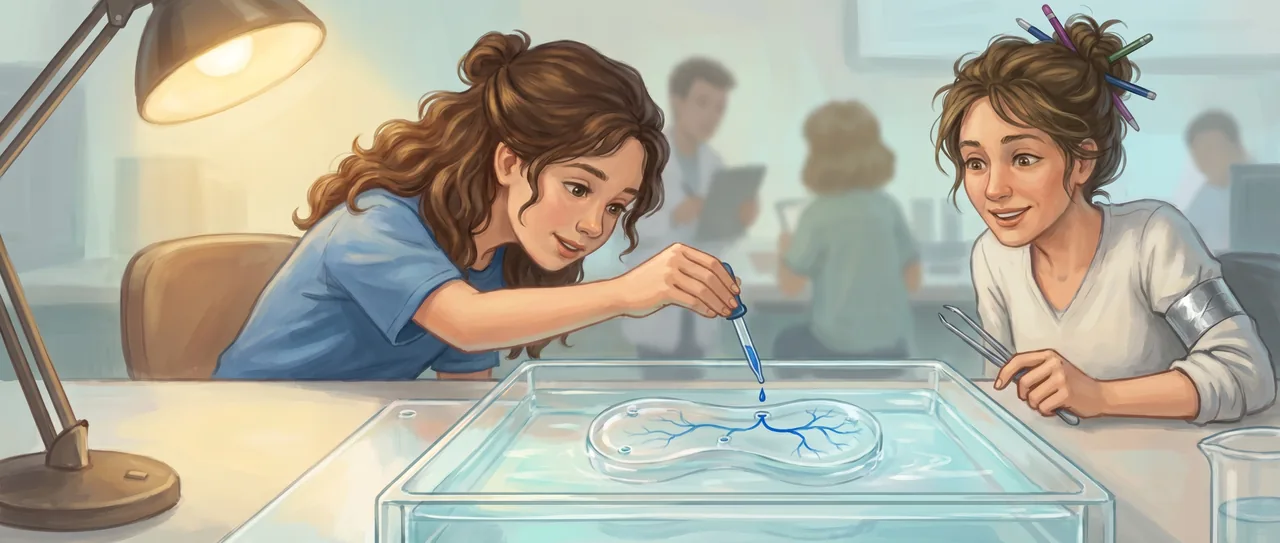
It floated in a glass dish under a lamp. It shivered when the air system clicked on. It was almost invisible until the engineer added a drop of blue dye to one end and the channels lit up like rivers seen from space.
Then the engineer tried to lift it with forceps.
The gel stretched, pinched white, and split.
“Too soft,” the engineer said. She had a streak of silver tape stuck to one sleeve and three pens in her hair. “Again. The visitors arrive in twenty minutes, and I have made soup with ambitions.”
Maya leaned closer to the dish.
The torn edge did not look broken like plastic. It looked like jelly pulled apart by a spoon. The blue river stopped at the rip.
“How much of it is water?” Maya asked.
“More than ninety-nine percent,” said the engineer, already reaching for another sample. “That is the beautiful part and the annoying part.”
“Ninety-nine,” Maya said.
“Sometimes more.”
Maya watched the next clear oval tremble in its dish. Her first thought was that anything that watery should not be trusted to hold anything up. Scaffold meant bars, beams, climbing frames, the hard bones around a building before the walls went on.
“Make it less water,” she said.
“That was my first thought too,” said the engineer. “There is alginate on the side bench. Calcium bath beside it. Demo materials only. No cells. No sterile work. If you make the miracle version in the next nineteen minutes, I will name my lunch after you.” On the side bench sat paper cups, droppers, a beaker labeled calcium chloride, and a bottle labeled sodium alginate. There were also blue beads for pretending to be cells, though the label said very clearly that they were plastic and not alive.
Maya squeezed alginate into the calcium bath. Clear worms formed where the drops fell, soft and slippery. She poked one with a stir stick. It bent around the stick and kept being a worm.
She added more calcium. The next worm formed faster. It felt tougher. Better, she thought.
She added even more calcium and made a small cube in a mold. When she pressed it, it did not wobble as much. It felt like something that could be trusted.
“Good,” Maya said.
She put three blue beads on top of it.
They sat there.
She pressed them lightly with the stir stick. They skated across the wet surface and rolled off the side.
Maya frowned.
She made a softer cube with less calcium. It sagged when she touched it, but when she dropped the blue beads onto it, one bead settled halfway into the surface and stayed. Another followed a tiny wet crease down into the gel.
The harder cube sat beside it, proud and useless.
Across the room the engineer said, “Fourteen minutes.”
Maya picked up the soft cube. It tore between her fingers.
“Still soup,” the engineer said, without looking.
Maya did not answer. She set the torn piece back in the bath. The two halves drifted apart, then stopped moving when they reached the side of the cup. The bead inside one half did not fall out.
A scaffold that behaved like a rock would not let anything in.
Maya looked at the kidney-shaped gel again. The engineer had printed another one. It floated perfectly in its dish. The blue channels held their branching shape as long as nobody pinched them.
“What if it is not failing?” Maya asked.
The engineer’s forceps paused in the air.
“It tore,” she said.
“You keep grabbing it like it is dry.”
“It has to come out for the camera.”
“Why?”
The engineer opened her mouth, closed it, then pointed with the forceps toward the lab door. “Because people like seeing things held up.”
Maya looked at the posters taped along the wall. One showed a contact lens, enlarged until it looked like a glass moon. Another showed a hydrogel patch releasing medicine through skin. Another showed green dots, cells, spread through a clear material like stars caught in ice.
“Contact lenses are hydrogels,” Maya said.
“Yes.”
“They live in liquid until someone puts them on an eye.”
“They do not live,” said the engineer automatically.
“You know what I mean.”
The engineer pushed one of the pens higher into her hair. “I do.”
Maya pointed at the dish. “So do not hold it up. Make the water hold it up.”
The engineer looked at the clear oval. For the first time since Maya had entered, she stopped moving.
Maya was already searching the bench. She found a shallow glass tray, the kind used for microscope slides, and a flat square of clear acrylic. She slid the acrylic into the dish under the hydrogel, but the gel rode the current and bumped the wall.
“Slowly,” the engineer said, then bit her lip as if trying to swallow the word.
Maya started again from the far side. She lowered the acrylic until it lay flat on the bottom. Then she tilted the whole dish, just enough that the gel drifted, not enough that it folded. The oval slid over the acrylic like a jellyfish deciding to become a map.
Maya lifted the acrylic without lifting it out of the water. She moved both together into the shallow tray. The engineer poured clear solution around it until the hydrogel floated just above the acrylic, touching almost nothing.
The tiny kidney held its shape.
The engineer laughed once, very quietly.
The lab door opened. Voices gathered outside. Shoes squeaked. Someone asked where the organ scaffold demonstration was.
“Here,” said the engineer.
She sounded surprised.
Maya stood behind the tray while the visitors came in. The engineer spoke quickly about polymer chains, water, softness, and how living cells did not grow in buildings made of steel. Maya did not listen to all of it. She watched the clear oval. It was more water than anything else, and still the channels waited inside it.
The engineer handed Maya a dropper of blue dye.
Maya looked up.
“You fixed the stage,” the engineer said. “You run the river.”
Maya put the dropper tip into the inlet, which was smaller than a freckle. Her hand had to be steady. The room leaned closer.
She squeezed.
Blue entered the clear gel and traveled forward. At the first fork, it split. At the next forks, it split again. The branches thinned until they seemed to vanish, but the color kept moving, carried through paths inside something that was almost entirely water and not water at all.
One visitor whispered, “It is so delicate.”
“No,” Maya said, before she meant to speak. “It is delicate if you treat it like the wrong thing.”
The engineer did not correct her.
After the visitors left, the lab felt larger than before. The printer hummed in the corner, lowering a needle into a bath one careful layer at a time. On the screen beside it, tomorrow’s design waited, a branching pattern even finer than the first.
The engineer slid a clean tray toward Maya.
“This one has narrower channels,” she said. “It may not work.”
Maya picked up the dropper.
The new hydrogel trembled when the table fan turned its head.
Maya lowered the tip to the tiny opening, and a blue thread slipped into the clear oval, divided, divided again, and disappeared into water that did not spill.
Read the interactive version, listen to the narration, and earn a gold star →
A science-verified short story for curious kids · Curiosity Land