The Line the Drip Drew
The cave scientist said the exhibit was simple, which was the first sign it was not.
"Tree rings, but cave," she said, tapping the glass case with one knuckle. "Children like tree rings. They understand tree rings. This is the same idea, only slower and wetter. I need it ready before the morning tour. Can you test it?"
Soren looked at the slice of stone under the glass.
It was not shaped like a tree cookie. It was a long polished piece, pale brown and honey white, with stripes inside it that bent like stacked smiles. Some were thick as thread. Some were almost not there. The top was rounded. The bottom was broken flat. A silver label beside it said:
Stalagmite core, limestone cave, forty-two thousand years.
Forty-two thousand years fit inside a thing shorter than Soren’s arm.
The cave scientist hurried to the far side of the room, where two workers were trying to make a curtain of dripping water fall in even lines. She had a headset on one ear and a pencil stuck through her hair. She was excited in the way adults got when they had already decided what everyone else should be excited about.
Soren stood alone at the exhibit table.
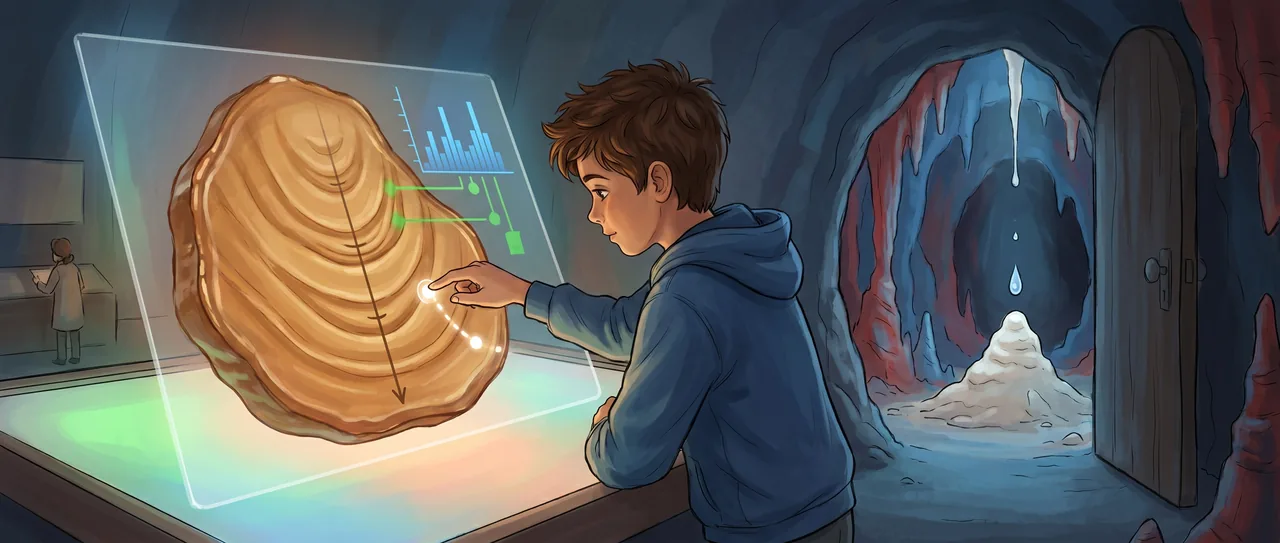
The table screen showed a blue rainfall graph from the nearby valley, measured by people for the last one hundred and eighty years. Beside it, the screen showed the same one hundred and eighty years supposedly marked on the stalagmite slice.
The lines did not match.
Soren pressed the replay button.
A bright dot started at the outside edge of the stone and marched inward, counting pale and dark bands. On the screen, wet years were supposed to widen the bands. Dry years were supposed to squeeze them tight. The computer sang a cheerful note each time a band matched the rain record.
It sang three notes, then made a disappointed burp.
Soren pressed replay again.
Three notes. Burp.
He took out his paper notebook, then stopped. The cave scientist had not asked for notes. She had asked whether children would understand.
He watched the bright dot crawl from the outside toward the middle, exactly the way people counted tree rings.
"It is not a tree," Soren said.
The water curtain on the far side splashed wrong. The cave scientist groaned.
Soren bent closer to the glass.
The stone bands did not make circles. They made nested roofs, each one sitting over the one before. Near the center, the stripes curved sharply upward. Near the sides, they sagged and thinned, as if they had slipped away from whatever made them.
He looked through the open doorway into the cave.
The public path went only twenty steps in, with a rail and a low red light that did not warm the rock. Beyond it, the cave kept going into black. The air smelled cold and damp and faintly like pennies.
A drop fell from the ceiling.
It struck the top of a small white mound on the floor.
Plink.
Another drop swelled above it, waited, then fell in the same place.
Plink.
The mound was not doing anything a person could see. It was still. It was being made.
Soren went back to the table and pressed his fingertip against the glass over the rounded top of the slice. If drops had fallen here, year after year, the newest skin would not begin at the side. It would lie over the drip point, on top, wrapped across the older stone.
The exhibit was reading the stalagmite as if it had grown outward from a trunk.
The stalagmite had grown upward into falling water.
Soren found the control pad. It was meant for visitors, so the buttons had pictures. A tree. A cave. A raindrop. A hand lens.
He tapped the hand lens.
The bright dot appeared again.
He dragged it away from the outside edge and set it on the rounded top, where the curved bands stacked most neatly. Then he pulled the path downward along the center line, through the nested smiles, one layer at a time.
The computer hesitated.
One note.
Then another.
Then five in a row, clear as drops in a metal cup.
Soren leaned over the screen.
The blue rain graph rose into a wet decade. Along the path he had drawn, the pale bands widened. The graph dropped into years of drought. The bands pinched thin and darker. Not perfectly. Not like a code made for people. But close enough that the computer stopped burping and began to sing.
"What did you touch?" the cave scientist called.
"The path," Soren said.
"Please don’t break the path. The minister is coming at nine."
"It was already broken. It was a tree path."
She crossed the room quickly, headset bouncing against her shoulder. "A what?"
Soren moved the path back to the edge. Three notes. Burp.
He moved it to the rounded top and down the center. The screen filled with notes.
The cave scientist stared.
"Oh," she said.
Soren liked that kind of oh. It was not the oh adults used when they had finally found a smaller sentence for a child. It was the other kind, the one that had a hole in it.
"The drip draws the time line," Soren said.
The cave scientist pulled the pencil from her hair and almost dropped it. "Yes. Of course it does. I was so busy making the tree comparison work that I made the cave wrong."
On the screen, the matched section glowed green. The exhibit asked if they wanted to continue beyond human rain gauges.
The cave scientist reached for the button, then pulled her hand back.
"You found the line," she said. "You press it."
Soren pressed continue.
The green section did not stop at the first written rain records. It narrowed and kept going, down through the stone. The dates slid past the founding of the town. Past the oldest road. Past the first farms in the valley. A thin gray mark appeared, tagged with ash chemistry from a volcano far away. Other marks showed dustier air, wetter centuries, long dry stretches when the cave had received only patient drops.
The line kept going.
Ten thousand years.
Twenty thousand.
Thirty.
The slice of stone lay quiet under glass while the screen followed weather that no person had stood in, seasons that had soaked through soil, slipped into cracks, carried dissolved limestone through the dark, and left a little calcite behind when the drop met cave air.
Soren touched the glass very lightly, not on the stone, only above it.
At school, his notebook made people laugh sometimes. Not mean laughing, mostly. The kind that said he was doing a thing from another century. They stored everything in wrist screens and cloud rooms and classroom walls that remembered for them.
Here was a cave that had kept a record by letting water fall on the same place for longer than cities had existed.
The cave scientist whispered, "We have cores from three other caves in the archive. Different mountains. Different storms. Different air. If we trace the right lines, we can compare them."
Soren looked toward the open cave door.
"Are they still writing?" he asked.
The cave scientist smiled, but she did not answer fast. That was good.
She led him to the rail inside the cave. She did not step past it. Neither did Soren.
The little white stalagmite waited under its dark ceiling point.
A drop swelled, let go, and struck the white tip with a sound small enough to fit between two heartbeats.
Read the interactive version, listen to the narration, and earn a gold star →
A science-verified short story for curious kids · Curiosity Land