The Lens Made of Holes
The Moon outside was doing its part perfectly.
It was silent.
A rover rolled past the museum window, kicking gray dust in a slow fan. Its wheels flashed in the sunlight. Its antenna turned. Its shadow crawled over the rocks.
Not one scrape came through the glass.
Inside the gallery, the sound lens made a noise like someone sitting on a bag of soup.
Bloop.
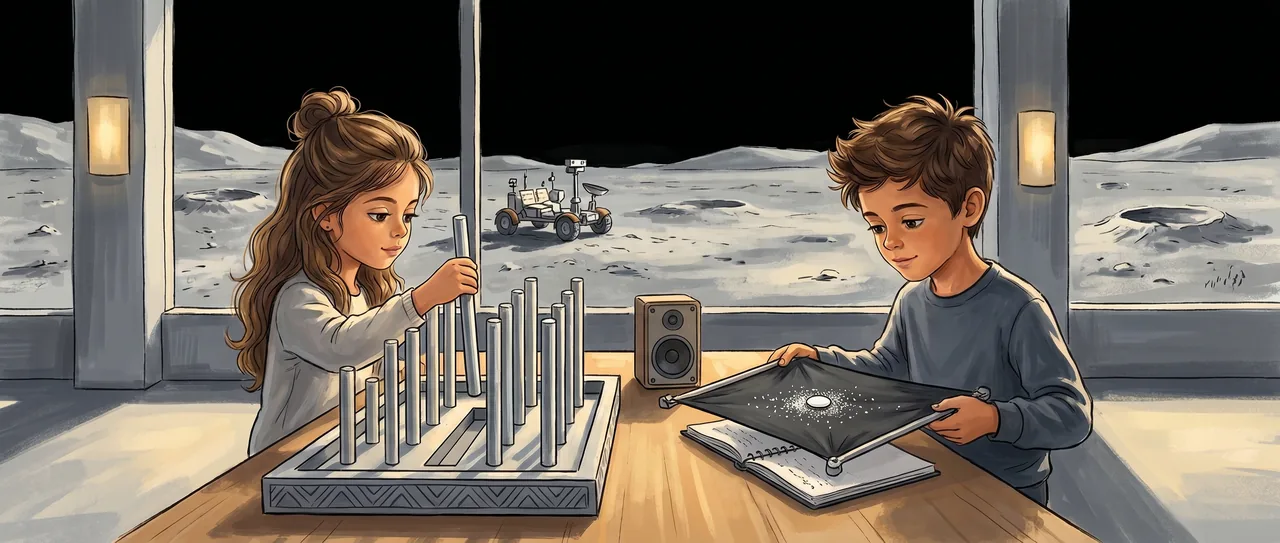
Maya stared at the silver frame on the table. It was filled with little vertical rods, each one as thick as her thumb, arranged in neat rows. Behind it, a speaker was supposed to send a bright, clean beep through the rods. On the far side, a stretched black membrane sprinkled with salt was supposed to jump only at one small spot.
Instead, the whole membrane shivered sadly.
Bloop.
Soren looked down at the paper notebook balanced on his knee. The museum scanners hated paper. They had made him turn every page at the entrance to prove it was not ancient contraband or a folded solar sail.
“That is not focusing,” he said.
“It is sulking,” Maya said.
The curator crossed the gallery carrying a crate of model satellites against her hip. She had silver dust on one sleeve and the expression of a person who had already answered too many questions before breakfast.
“Can we use the backup recording?” she asked. “Children like rocket sounds.”
“Rockets outside don’t make rocket sounds,” Maya said.
“They make vibrations in the rocket,” the curator said. “Then recordings. Then speakers. It is close enough for a morning group.”
Soren looked through the window. The rover’s drill touched a rock. A thin puff of powder rose and fell in the hard sunlight. Nothing reached them except light.
“It is not close,” he said.
The curator shifted the crate. “Then make your invisible lens visible in seven minutes.”
She hurried away before either of them could ask where the spare rods were.
Maya pressed the speaker button again.
Bloop.
The salt trembled everywhere.
“This is the wrong answer,” Maya said.
Soren wrote that down.
Maya leaned over. “Not as a title.”
“It is a good title.”
“It is a symptom.”
He drew the frame. Rows of circles for rods. Empty spaces between them. The rods were set in a honeycomb pattern, except the center rows pinched inward, making the whole thing slightly curved without having a curved surface.
The curator had called it a phononic crystal. She had said the word quickly, as if long words became shorter when you outran them.
Maya tapped the frame. “It is pretending to be glass.”
“Sound is not light,” Soren said.
“No,” Maya said. “But waves are bossy in the same ways sometimes.”
He nodded once. That was true enough to test.
On the wall behind them, the unfinished exhibit showed a simple picture. Sunlight crossed empty space from the Sun to the Moon. Sound waves stopped at the edge of an astronaut’s helmet because outside the helmet there was no air to squeeze and unsqueeze. Light could cross the vacuum. Sound needed something to push.
Inside the museum there was air.
Inside the silver frame there was a pattern.
Maya walked around the table and crouched until her eyes were level with the rods. “Some rows look wrong.”
Soren turned the notebook sideways. “They are regular.”
“Too regular.”
“That is what crystals do.”
“Crystals do not use almost.”
He checked the printed label taped to the frame. “Designed for four thousand hertz.”
Maya pointed at the speaker control. “What is it playing?”
Soren pressed the small status square. “Demonstration tone two.”
“That is not a number.”
He opened the settings. The screen showed eight hundred hertz.
Maya smiled without showing her teeth.
Soren did not smile yet. He liked being right after the test, not before. He changed the tone to four thousand hertz.
The speaker gave a thin beep that made Maya’s front teeth feel cold.
The salt jumped.
Not in one spot.
In three.
“Better sulking,” Maya said.
Soren marked three dots on his drawing. “It is focusing, but badly.”
Maya was already pulling the small rod case from under the table. Half the sockets in the lens were filled. Half were empty. The spare rods lay in foam slots, shiny and accusing.
“The curator thought empty sockets were missing pieces,” Maya said.
Soren looked at the frame again.
The empty places were not random. They made narrow lanes through the rods. Some lanes were straight. Some bent. Some widened and narrowed as if the air had been given invisible walls.
He put his pencil through one of the empty lanes without touching metal. “These are measured too.”
Maya stopped with a rod in her hand.
Outside the window, sunlight traveled from the rover’s mirror to the ceiling, making a white patch that moved as the rover moved. Glass bent light because light changed speed inside it. Lenses worked by making different parts of a wave arrive at different times.
Soren slid his pencil through another gap. “The air spaces are part of the lens.”
Maya set the rod back into its foam slot. Very carefully.
“Then filling every hole wrecks it,” she said.
“Leaving the wrong hole wrecks it too.”
The adult voice from across the gallery called, “Five minutes.”
Maya called back, “We need less adulting near the holes.”
No answer came, which was probably permission.
Soren compared the frame with the small diagram printed on the shipping card. The diagram had smudged during unpacking, but not completely. He counted rods by row. Maya counted empty sockets by shape.
“Here,” she said. “This gap is fat.”
Soren checked. “One rod missing.”
Maya dropped it in.
Click.
“And here,” Soren said. “This rod should not exist.”
Maya pulled it out.
Click. The curator returned with the model satellites and a small crowd noise following her from the corridor.
“Please tell me the invisible thing is ready,” she said.
“No,” Soren said.
Maya pressed the speaker button.
A clear, narrow beep passed through the rods.
The salt on the black membrane leaped into a bright little circle no wider than a coin.
The curator’s mouth stayed open.
“Yes,” Soren added.
Maya moved her hand through the space between the frame and the membrane. The beep blurred against her palm, then sharpened again when she moved away. Nothing glowed. Nothing pointed. Air carried the sound, and the pattern told the air where to send it.
The curator put the satellites down very softly.
“Again,” she said.
Soren shook his head. “Not yet.”
Maya was already turning the speaker down. “A beep is easy. Do a whisper.”
“That will have lots of frequencies,” Soren said.
“Some will fit.”
“Some will not.”
“So it will arrive changed.”
He looked at the lens, then at the silent Moon beyond the window. A thing could fail to travel at all. A thing could travel everywhere. A thing could be shaped by holes.
The morning group entered the gallery behind the curator, but Maya did not look back. She knelt behind the speaker and whispered into the input cup.
“Can you hear this?”
Across the table, at the membrane, the salt made a tiny scratch.
The curator leaned toward it.
“Is that all?” she asked.
“No,” Maya said.
Soren picked up the membrane and carried it farther away, past the marked demonstration line, past the place where the instructions said the focus ended. The wire from the speaker did not reach there. No wire needed to.
Maya adjusted the frame by one socket width. Soren held the membrane still.
She whispered again.
The salt gathered itself, grain by grain, into one trembling white spot.
Soren lowered the membrane onto the far table.
Maya looked at the rods. “What else can be a lens?”
Outside, the rover turned soundlessly in the sun.
Maya lowered the last loose rod into an empty socket, and across the room the white spot of salt began to hop.
Read the interactive version, listen to the narration, and earn a gold star →
A science-verified short story for curious kids · Curiosity Land