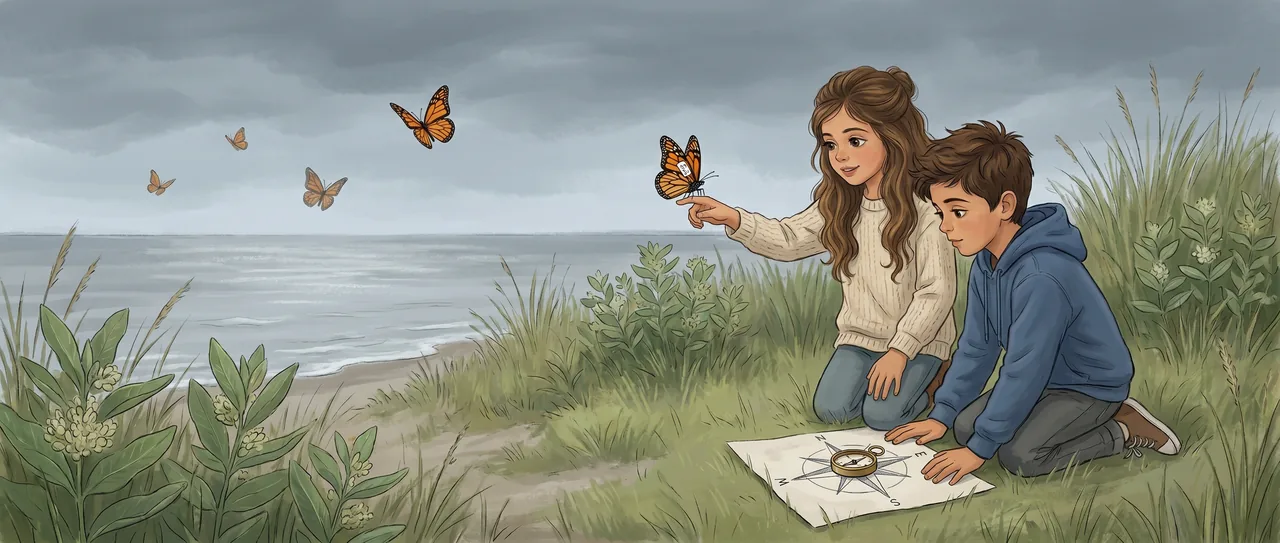
The Direction Under the Clouds
By noon, the monarchs were already trying to leave.
They hung from the mesh walls of the tagging tent, opening and closing their orange wings like tiny doors. Beyond the tent, Lake Erie flashed silver under a hard blue sky. Canada was behind them. Mexico was somewhere beyond the roofs, beyond the lake, beyond more distance than Maya could hold in one picture.
Dr. Lidia Vega had a radio clipped to her vest, a tablet under one arm, and a strip of tiny numbered stickers stuck accidentally to her sleeve.
"No one open the north flap," she said. "No one breathe too dramatically. The news crew comes at two. The release happens at two-fifteen. The children’s migration game is supposed to happen at one, and it currently sends everyone to Detroit."
Maya looked at Soren.
Soren said, "Detroit is not Mexico."
"Exactly," Dr. Vega said. She pointed with her tablet toward a folding table under a maple tree. On it sat a map of North America, a yellow foam ball on a stick, a paper compass rose, and a cardboard monarch with a clothespin body. "Fix it. Make it simple. Please do not use glitter. I am already wearing one hundred identification stickers."
Then she was gone, walking backward while talking into the radio.
The game was called Fly Like a Monarch. Someone had written the title in bubble letters. The instructions said: Keep the sun on your left and fly south.
Maya picked up the cardboard monarch and put it over Ontario. She held the yellow sun in the morning position, low in the east.
"Left," she said.
She flew the monarch south-west across the map.
Soren moved the sun to where it would be in the afternoon.
Maya kept the sun on the butterfly’s left again. This time the monarch went south-east, straight into the Atlantic Ocean.
"Bad instructions," Maya said.
Soren opened his notebook, not to write a final answer, but because the table was too crowded inside his head. He drew a circle for the horizon, then another circle for time.
"The sun moves," he said.
"Everybody knows that."
"The butterfly has to know that while flying. If it only follows the sun angle, it changes direction all day."
Maya held the cardboard monarch in the air and turned slowly in place. Morning sun. Noon sun. Afternoon sun. Same destination, different sun.
"So it is not following the sun," she said.
"It is following the sun plus time."
Soren tapped the poster taped to the tent pole. It showed a monarch head, huge and fuzzy, with labels for eyes and antennae. One sentence near the bottom said that monarchs use an internal clock to correct the sun’s position as the day changes.
Maya stared at the antennae on the poster. They looked too thin to hold anything as large as a journey.
"Their clock is in there?"
"Part of it," Soren said. "That is what it says."
"That is rude," Maya said.
"To whom?"
"To maps."
They rebuilt the game.
Soren drew three suns around the compass rose, one for morning, one for noon, one for afternoon. Maya cut a small window in a paper disk so only one sun showed at a time. They fastened the disk to the map with a brass clip from Dr. Vega’s supply box. Now the player had to turn the clock disk first, then choose the direction that kept Mexico in the same place even while the sun moved.
A boy in a blue jacket tried it and flew into the Gulf of Mexico.
"You forgot the time," Soren said.
The boy turned the disk to afternoon and tried again. This time he crossed the line of mountains drawn in brown and landed the cardboard monarch on a green patch labeled Oyamel Fir Forest.
"They know the time?" the boy asked.
Maya held up the poster corner so the antennae showed. "Inside."
The boy looked at the real monarchs in the mesh tent. "That is too much for a bug."
One monarch let go of the wall and fluttered to the roof of the tent. It clung upside down, feet on nothing much, body pointed south-west.
"Tell it," Maya said.
At one-thirty, the sky changed.
Clouds rolled over the lake, low and thick. The hard blue disappeared. The sun became a pale spot, then no spot at all. The air cooled. The monarchs closed their wings.
Dr. Vega came fast across the grass, stickers still on her sleeve, radio hissing.
"We can tag," she said, "but the orientation demonstration is canceled. They need sun. The camera can film the release if the rain holds. Where is my list? Why are there two suns on the ground?"
"Three," Soren said.
"Three is worse."
Maya was looking at the poster again. Not the antennae this time. Lower.
There was one line under a photograph of a cloudy sky: On overcast days, monarchs can use Earth’s magnetic field to help maintain their migratory direction. Dr. Vega was already answering the radio. "No, I cannot ask the butterflies to look more dramatic. They are not actors."
Maya picked up the compass rose from the game table. It had been taped to a metal folding chair.
The needle on Soren’s small compass swung toward the chair leg and stuck there.
"Not there," he said.
They carried the compass rose to the grass, away from the chairs, away from the speaker cart, away from the table with metal legs. Soren set his compass in the center. The needle settled, quivering north.
Maya turned the paper rose until north matched north.
"South-west is there," Soren said, pointing toward the far corner of the garden, where milkweed pods stood like little green lanterns.
Dr. Vega lowered her radio. "What are you doing?"
"Trying cloudy," Maya said.
"The sun is gone."
"Maybe not all the directions are."
Dr. Vega opened her mouth, then shut it because three people called her name at once from three different places. "Do not lose a butterfly," she said, and hurried off toward the news crew.
Maya and Soren did not take a butterfly from the tent. They waited at the south flap where the tagged monarchs were being placed in small resting envelopes, one by one, before release. Soren checked the compass again. Maya put the compass rose flat on the grass.
The first envelope held a female monarch with a white tag on her wing. Number XJ three seven nine. Soren read the number softly. Maya opened the envelope with both hands.
The monarch stepped onto Maya’s finger.
For a moment, nothing happened.
There was no sun patch on the grass. No yellow ball. No bright thing to follow. Only cloud, lake wind, and an insect lighter than a paper clip standing on Maya’s skin.
The monarch opened her wings. Closed them. Opened them again.
She turned.
Not north. Not toward the lake. Not toward the maple tree or the voices or the camera.
South-west.
Soren looked from the butterfly to the compass. He moved the compass a little farther away from the metal zipper on his jacket and checked again.
"Still," he said.
Maya’s hand stayed very still. The butterfly’s feet prickled against her finger.
Another tagged monarch was released beside them. It rose, circled once, and slid into the same gray corner of sky.
Then another.
The children from the game table came closer without speaking. Dr. Vega arrived with the camera crew behind her, out of breath and covered in more stickers than before. She looked at the compass rose on the grass. She looked at the clouded sky. She looked at the line of monarchs lifting one after another toward the same invisible road.
"Oh," she said, very quietly.
Maya lowered her hand to the next envelope. Soren held the compass rose steady against the wind.
The monarch climbed onto Maya’s finger, opened her orange wings, and tipped into the gray.
Read the interactive version, listen to the narration, and earn a gold star →
A science-verified short story for curious kids · Curiosity Land