The Atom That Would Not Share
The Moon museum had a room called STAR SQUEEZE, and Maya had been waiting all morning to put her hands inside it.
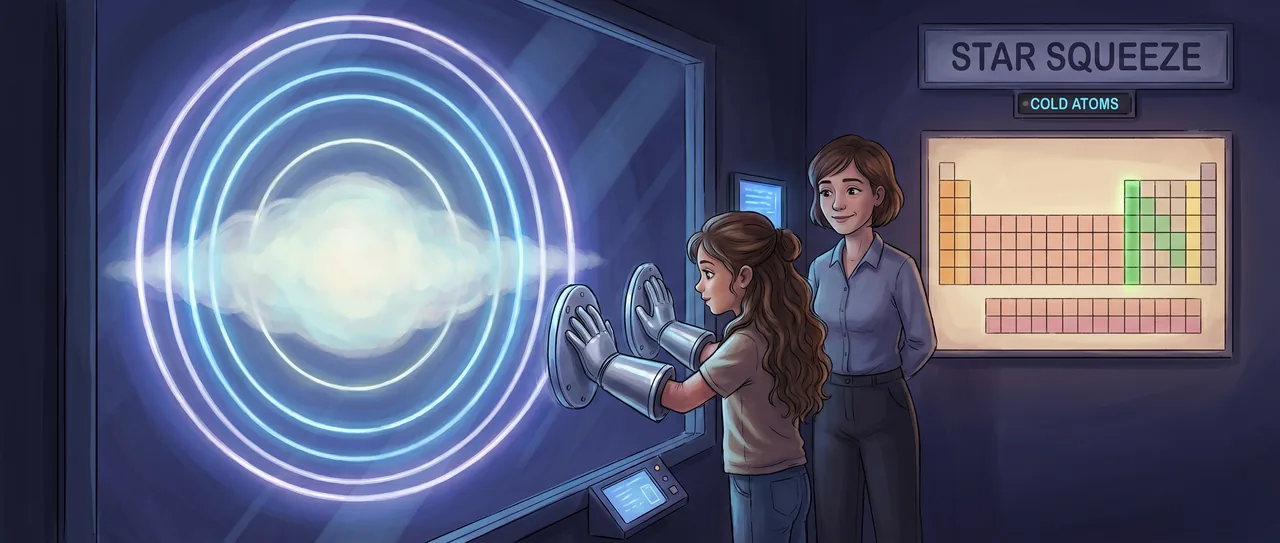
Not really inside a star. Inside two silver gloves bolted to a clear wall. Behind the wall floated a bead of light smaller than a pea. Above it, a sign said: COLD ATOMS, HOT QUESTIONS.
The museum engineer was trying to make the sign blink in time with his speech. It kept blinking one word late.
“Welcome,” he said, while the sign blinked QUESTIONS. “Today you will feel the pressure that helps hold up a white dwarf star.”
Maya leaned close to the glass.
The bead was not a bead. It was a tiny cloud, blue at the edges, white in the center. It quivered without moving anywhere, like a held breath.
The engineer tapped his wrist screen. “We trap atoms with lasers, cool them almost as cold as nature allows, and let the gloves translate the measurements into force. You squeeze. The cloud pushes back. Simple.”
Maya disliked simple when it was placed at the end of a sentence.
She put her hands in the gloves.
They were too big. Her fingers did not reach the ends. She curled them anyway.
“Ready?” the engineer asked.
Maya pressed inward.
The bead shrank.
It shrank more.
It became a bright dot.
The gloves gave almost no push at all.
The engineer frowned. “Again.”
Maya squeezed harder.
The dot became brighter and smaller. The gloves trembled like tired spoons, then went soft.
“That is not holding up a star,” Maya said.
The engineer laughed too loudly. “The haptics are being dramatic.”
“They are being absent.”
He tapped his wrist screen three times. “It worked during rehearsal.”
Maya kept her hands in the gloves. The dot hung there, obedient and tiny.
“Maybe I broke it,” she said.
“You did not break a quantum exhibit by being eleven.”
“That was not my question.”
The engineer looked at the small crowd waiting outside the room, then at the late-blinking sign, then at the dot. “We will reset.”
The room dimmed. The lasers shifted from blue-white to violet-white. The dot loosened back into a cloud.
Maya watched the reset numbers scroll along the bottom of the glass.
Sample: lithium seven.
She stared until the words disappeared.
The engineer was saying, “White dwarfs are what stars can become after they use up their fuel. Gravity squeezes them, but the particles refuse to be packed too tightly.”
“Which particles?” Maya asked.
“In the star? Electrons, mostly.”
“In there?”
He waved at the glass. “This is an analogy. Cold atoms are easier than keeping a dead star in a museum.”
“What kind of atoms?”
“Lithium.”
“Which lithium?”
The engineer paused. “Lithium.”
Maya pulled her hands out of the gloves. They made rubbery sighing sounds.
On the wall beside the chamber were six sealed cartridges in a rack. Each was no longer than her thumb, with a colored stripe and a printed label so small it seemed designed to be ignored.
Maya did not ignore labels that seemed designed to be ignored.
The cartridge clicked into the machine was marked Li-seven.
Two slots down, behind a clear cover, another cartridge was marked Li-six.
Maya said, “Your atom is too sharey.”
The engineer blinked. “Too what?”
“It goes in the same place.”
He came to the rack. “The cartridges are both lithium. The mass difference does not matter for this demonstration.”
Maya looked at the bright dot in the chamber. It had behaved exactly like something pleased to be piled on itself.
“There are three protons,” she said. “Lithium always has three.”
“Yes.”
“Lithium seven has four neutrons.”
“Yes.”
“Lithium six has three.”
The engineer’s mouth opened. It stayed open long enough for the sign above him to blink COLD twice.
Maya touched the glass cover over the cartridges. “One of them is even. One of them is odd.”
The engineer closed his mouth.
The crowd outside had gone quiet in the way people go quiet when they want to hear but do not want to look like they are listening.
The engineer said, “The atoms in lithium six act like fermions. Lithium seven acts like a boson.”
Maya waited.
He rubbed his forehead. “I loaded the fountain cartridge, not the star cartridge.”
“Can I change it?”
“No,” he said.
Maya took one step back.
He looked at the crowd, at the sign, at the glowing dot that had refused to be impressive. Then he held out a flat metal key. “You can open the cover. I will not touch the cartridge.”
Maya opened the cover. The machine hissed clean air across her knuckles.
The lithium seven cartridge slid out with a click. She placed it in an empty slot, careful not to turn it upside down. The lithium six cartridge was colder than it should have been, even through the sealed casing. She pushed it into the chamber until the lock flashed green.
The exhibit reset again.
This time the cloud appeared wider. Not brighter. Wider, as if it had elbows.
Maya put her hands back in the gloves.
The engineer said, much more softly, “Try slowly.”
Maya pressed inward.
At first the cloud yielded. Then the gloves pushed back.
Not like a spring. Not like a rubber ball. The push arrived in steps.
Maya pressed. The cloud tightened.
A ring lit around it.
She pressed again. Another ring appeared, farther out.
Again. Another.
The little cloud made room by climbing into invisible rungs.
Maya’s fingers strained inside the oversized gloves. Nothing in the chamber touched her. Nothing had a surface. Still, the gloves would not let her put the cloud into one place.
The engineer whispered, “There.”
Maya did not answer.
She pushed until her shoulders rose. The rings sharpened into shells, one inside another, blue and white and blue again. On the side wall, the periodic table woke up.
Hydrogen glowed. Helium. Lithium. Beryllium.
The light ran across the rows, not in a straight line, but in the old strange shape from classroom walls, the one that had always looked to Maya like a city built by someone following rules they refused to explain.
The rings around the cloud pulsed in time with the table.
Maya relaxed one finger. One ring softened. One row dimmed.
She pressed the finger back. The row returned.
The engineer’s voice came from somewhere behind her. “Electrons are fermions too. They fill states. That filling gives the table its shape.”
Maya moved her left thumb by a millimeter.
A column of elements answered in green.
The table was not a chart. It was a footprint.
She squeezed both hands at once.
The glove motors hummed. The cold cloud refused. Not angrily. Not stubbornly. It simply did not have the kind of sameness that could be stacked into one sameness.
Maya thought of the dot from before, bright and tidy and wrong for this room. The engineer said, “May I show the others?”
Maya pulled her hands from the gloves.
The room noise rushed back. A child outside laughed. The sign blinked HOT QUESTIONS, finally in the right order.
The engineer took one glove, then stopped. “Actually,” he said, “would you run it once? The way you did it.”
Maya looked at him.
He looked embarrassed, but not in a bad way. “I keep squeezing too fast.”
Maya put her hands back in.
She did not give a speech. She pressed slowly, waiting at each step until the ring appeared. The watching faces moved closer to the glass.
When the periodic table lit, someone outside said, “Whoa.”
Maya smiled without turning around.
The engineer leaned near the side panel. “The next room is not usually open during regular tours.”
Maya followed his glance.
Past the STAR SQUEEZE chamber stood a black door with silver letters: NEUTRON STAR TEST. Under the words was a smaller sign: AUTHORIZED DEMONSTRATIONS ONLY.
The engineer set the flat metal key on the ledge beside Maya’s glove.
The green light on the black door changed to blue, and the handle slid out toward her hand.
Read the interactive version, listen to the narration, and earn a gold star →
A science-verified short story for curious kids · Curiosity Land