Return Address
The wall was wrong before it was even standing.
Maya knew it from the arrows.
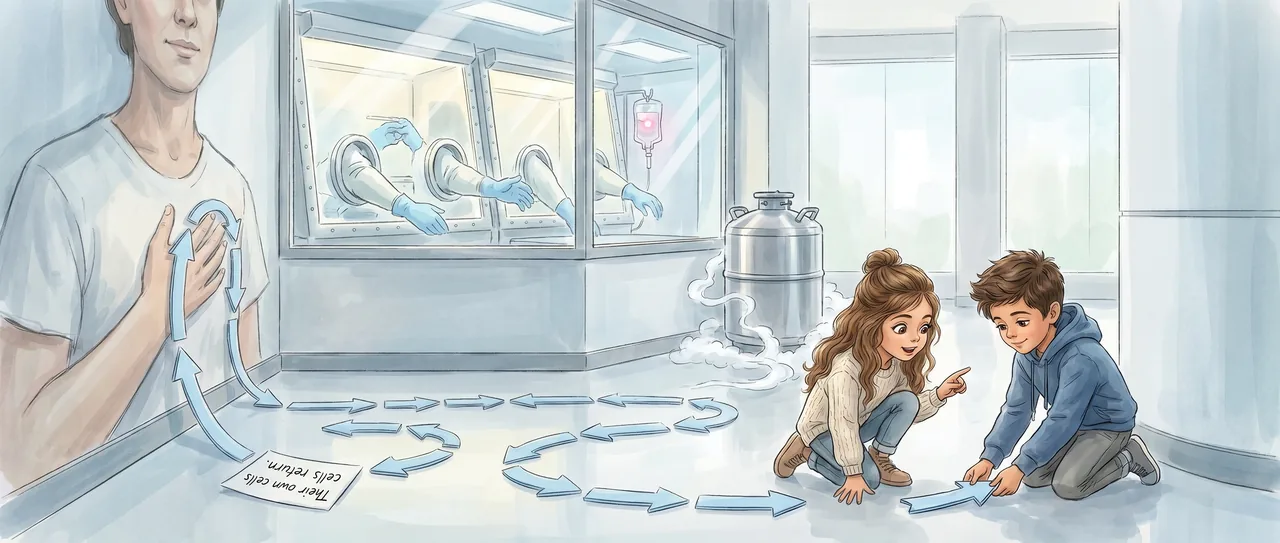
There were eight of them, blue plastic with sticky backs, spread across the floor of the hospital atrium like fallen pieces of sky. The display designer had asked Maya and Soren to arrange them under the big title before the families arrived.
FIRST APPROVED CRISPR MEDICINE FOR SICKLE CELL DISEASE.
Under the title was a painted person, a painted machine, and a painted smiling doctor. The arrows went from the person, to the machine, to the doctor, back to the person.
Maya crouched, head tilted.
“No,” she said.
Soren looked up from the stack of caption cards. “No what?”
“This arrow is lying.”
The display designer stood on a ladder, trying to make a strand of paper DNA hang in a graceful twist. It kept sagging in the middle. “The arrows are temporary,” she said. “Families need the simple path.”
“That is not simple,” Maya said. “It is wrong.”
The designer sighed, not unkindly, but like a person whose morning had already spilled glue on her sleeve. “If you two can make it better without blocking the entrance, make it better. I have twenty minutes and this DNA refuses to be elegant.”
Soren picked up the first caption card.
“Blood is collected from the patient,” he read.
Maya pointed to the painted machine. “Then edited?”
Soren frowned. “Not the red blood cells.”
“Why?”
“They don’t have nuclei. No DNA inside to cut.”
Maya snapped her fingers once. “So the picture is wrong twice.”
Soren spread the cards in a careful row on the floor. He did not put them in order yet. He liked to see all the pieces before pretending he knew the shape.
One card said: Stem cells are collected.
Another said: CRISPR edits the cells outside the body.
Another said: The edited cells are checked and frozen.
Another said: The patient receives their own edited cells back through an infusion.
The last card had smaller print. The edit helps the body make fetal hemoglobin again, a form of hemoglobin babies make before birth.
Maya tapped that one. “Again?”
Soren read it twice. “Again.”
The glass doors beside the atrium opened with a soft breath. A lab courier came through pushing a silver tank on wheels. White vapor curled from its lid and slid down the sides like cold water. A paper tag swung from the handle.
The designer climbed down from the ladder. “That goes to the cell therapy suite, right?”
The courier nodded toward the hallway with the badge scanner. “Training route first. Real shipment later.”
Even from three steps away, Maya could read the large printed words on the practice tag.
SOURCE: PATIENT.
RECIPIENT: PATIENT.
She stepped closer, but not too close. The tank had a yellow line painted around it on the floor, and the line clearly meant grown-ups only.
“Soren,” she said.
“I see it,” he said.
The designer reached for a caption that said DONOR STEM CELLS ARRIVE.
Maya put her hand flat on the table before the designer could pick it up.
“Not donor,” Maya said.
The designer blinked. “Bone marrow treatments often use donors.”
“This one doesn’t,” Soren said. “The tag says the source and the recipient are the same patient.”
The courier smiled into his collar, but kept walking. The silver tank squeaked softly down the hall.
Maya watched the tag swing until it disappeared through the badge doors. “It has a return address.”
Soren picked up the donor caption and turned it over, blank side up.
The designer looked at the painted wall. “All right. Same patient. But the arrows still have to fit on one wall.”
“They don’t,” Maya said.
Soren was already moving the blue arrows.
He placed the painted person at the start, then an arrow away from the wall, across the floor.
The designer made a small noise. “People will walk there.”
“Good,” Maya said.
Soren set the next card beside the arrow. Stem cells are collected.
He placed another arrow leading to a rolling table near the glass window of the clean lab. Behind the window, gloved arms moved inside sealed boxes. Clear tubes looped from one container to another. Nothing looked dramatic. Nothing flashed. It was mostly labels, careful hands, and machines that hummed like refrigerators.
Maya put the CRISPR card there.
“Outside the body,” she said.
The words changed the room.
Not because they were loud. They were not. But the path now left the painted person entirely. It crossed the real floor. It went near the glass where people in clean suits worked with living cells too small to see. It came back past the silver tank’s tracks.
Soren touched the card about fetal hemoglobin.
“So they are not fixing every cell in the person,” he said.
Maya shook her head. “They are changing the makers.”
“The blood-making stem cells.”
“And then the new blood comes from them.”
Soren placed the next arrow back toward the painted person, but he stopped before sticking it down.
There was still the smiling doctor at the end of the wall, holding up a cartoon syringe like a trophy.
Maya made a face. “Too much doctor.”
The designer folded her arms. “Doctors are important.”
“Yes,” Maya said. “But the cells come back.”
Soren moved the final arrow away from the doctor’s hand and aimed it toward the person’s chest.
The designer studied it.
For a moment nobody spoke.
A hospital bed rolled by in the hallway behind them, pushed by a nurse with quick shoes and a cup of coffee balanced dangerously in one hand. From somewhere deeper in the building came three soft beeps, then a chime, then quiet again.
The designer reached for the blank back of the donor card. “What should this say instead?”
Soren looked at Maya.
Maya looked at the silver tracks on the floor.
Soren said, “Their own cells return.”
The designer wrote it in thick black marker. Her paper DNA sagged lower behind her, completely unelegant.
Families began to gather at the entrance. A small child tried to step on every blue arrow. A grown-up read the title out loud and stopped at CRISPR as if it were a word with too many corners.
Maya and Soren stood to the side, not part of the exhibit and not separate from it either.
Through the glass, a technician lifted a small bag from a water bath and dried it with a cloth. The bag was clear, with a pale pink cloud inside. It did not look like a cure. It looked like almost nothing.
The display designer followed their gaze. “That one is still training material,” she said softly. “The real infusion is later.”
Maya did not answer.
Soren did not write anything down. A boy at the front of the gathered families raised his hand. “If the sickle cell mistake is still in them, how can it help?”
The designer opened her mouth.
Maya was faster, but only by a breath.
“Some genes are like switches,” she said. “This edit changes a switch in the stem cells. Then their new red blood cells can make a different kind of hemoglobin too.”
Soren added, “The kind babies make before they are born. Fetal hemoglobin.”
The boy looked through the glass at the careful hands in the sealed box. “So their body knew how already?”
Maya’s fingers curled around the edge of the table.
Soren looked at the final arrow, the one pointing back.
“Yes,” he said.
The designer did not add anything.
Behind the glass, the technician hung the clear bag on a metal pole. A drop formed at the bottom of the bag, trembled, and fell into the tube.
Read the interactive version, listen to the narration, and earn a gold star →
A science-verified short story for curious kids · Curiosity Land