Fainter Than Expected
The planetarium was supposed to open in forty minutes, and the universe was misbehaving.
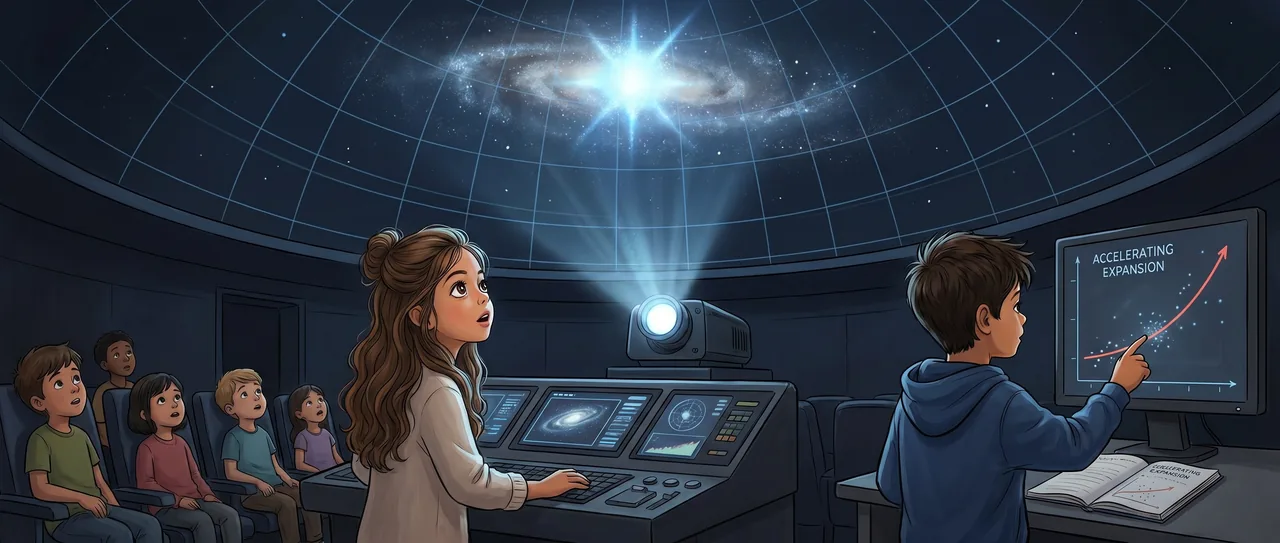
Across the dome, galaxies drifted away from one another in blue-white silence. A red line crawled up a graph. Little starbursts appeared where supernovae had exploded long before anyone in the room was born.
Then the farthest starbursts dimmed too much.
Dr. Ortega groaned from the control desk. She had one hand in a bag of cough drops and the other on three different keyboards. Her hair had escaped its clip in a gray cloud.
“No,” she said. “Not again. Those last ones look wrong.”
“They look sad,” said Maya.
“They look faint,” said Soren.
“They are not allowed to be faint in that direction,” Dr. Ortega said. “The mayor is coming. The mayor believes graphs should go where graphs are told.”
Maya sat cross-legged in the front row, where the dome filled nearly all of her sight. Soren sat beside her with his paper notebook open on his knees. The notebook had already earned three looks from the planetarium interns, the kind of looks people gave a fossil that had asked for a pencil.
Dr. Ortega pointed at the dome with a cough drop. “This is a rehearsal of the nineteen ninety-eight supernova result. Type Ia supernovae. Standard candles. Faintness tells distance. Redshift tells how much the universe stretched while the light traveled. It won a Nobel Prize in two thousand eleven, and right now it looks like a broken lamp.”
“What do you want us to do?” Soren asked.
“Find out whether the projector is lying,” she said. “Do not rewrite the universe. I have already tried that, and the universe filed a complaint.”
Then someone in the lobby shouted about missing name tags, and Dr. Ortega rolled away in her chair without looking where she was going.
Maya stood at once.
Soren did not. He wrote: farthest too faint.
“Projector first?” he asked.
“Projector first,” Maya said, already walking.
They climbed the narrow stairs to the booth behind the dome. The projector sat in the dark like a giant black insect with one bright eye. Maya opened the calibration panel. Soren brought up the test pattern, a grid of equal dots.
Every dot shone evenly.
Maya lowered the brightness. Every dot dimmed.
She raised it. Every dot brightened.
“Not the projector,” she said.
“Unless the projector hates only old light,” Soren said.
Maya turned her head slowly.
“It doesn’t,” he said. “Probably.”
They went back down.
On the dome, the supernova points waited. Near ones sat close to the line. Middle ones wandered a little. The farthest ones fell below it, as if they were shy of the graph everyone expected them to make.
Soren opened the data table. Each supernova had a redshift, a brightness, a color, and a date. The names looked like secret codes. SN nineteen ninety-seven something. SN nineteen ninety-eight something. Maya leaned over his shoulder.
“That one,” she said.
“Which one?”
“That clump. They’re not random wrong. They’re wrong together.”
Soren drew the graph in his notebook, not because the computer could not draw it better, but because his hand needed to feel where the points bent away.
“Could be dust,” he said. “Dust makes things fainter.”
Maya made a face. “Space dust?”
“Galaxy dust. Between us and them. If the light goes through dust, it loses some blue. It gets redder.”
He sorted the table by color. Maya watched the points change size on the dome.
The faintest faraway supernovae did not blush enough.
“Not enough dust,” Maya said.
“Not enough dust,” Soren said, and crossed out dust.
A group of early visitors entered below them. Their voices bounced around the dome.
“Is the show broken?” someone asked.
“Yes,” said a smaller voice hopefully.
Maya smiled.
Soren opened the model controls. There were sliders for matter density, expansion rate, and something labeled vacuum energy. At the bottom, a button said expected brightness.
“The old expectation was slowing down,” Soren said. “Gravity pulls. Expansion should get slower.”
Maya moved the matter slider higher. The model line bent the wrong way. The far points dropped farther below it.
“No,” she said.
She moved it lower. Better, but not enough.
Soren tapped the screen. “Try the other one.”
“Vacuum energy?”
“That’s the thing they named because they didn’t know what it was.”
Maya liked that. A label with a hole inside it.
She slid it slowly.
The graph line lifted, then curved. The far supernovae, the troublesome ones, the ones that had made Dr. Ortega groan into a cough drop, began to land where the model said they should.
On the dome above them, the picture changed.
The galaxies did not fly through space like sparks from a fire. Space itself stretched between them. The gridlines widened. A supernova flashed in a galaxy, sent out its light, and while the light crossed the darkness, the darkness grew. By the time the light arrived at the little drawing of Earth, the place it had come from was farther than the old model had allowed.
The supernova had not been weak.
It had been farther away than a slowing universe would have made it.
Maya stepped backward until the seat caught her knees.
“Again,” she said.
Soren reset the run.
Again the star exploded. Again its light began the long crossing. Again the universe stretched while the light was still on its way. The dome did not feel like a ceiling now. It felt like the inside of a question that had not finished getting bigger.
Soren looked down at his notebook, then up at the graph.
“The wrong points are the answer,” he said.
Maya pointed to the faint cluster. “Those ones broke the smaller universe.”
Dr. Ortega hurried in carrying name tags, a roll of tape, and a cup of coffee that had given up being hot.
“Please tell me the projector is guilty,” she said.
“No,” Maya said.
Dr. Ortega shut her eyes. “I was afraid of that.”
Soren turned the screen toward her. “The calibration is fine. The dust check does not fit. The far supernovae match if the expansion speeds up.”
Dr. Ortega looked at the dome.
For once, she did not touch any keyboard.
“Oh,” she said softly. “There you are.”
The lobby doors opened. More visitors came in, shaking rain from umbrellas. The mayor’s voice arrived before the mayor did.
Dr. Ortega looked at Maya and Soren. “Can you run it?”
Maya was already at the controls.
Soren moved to the side screen, where the data table waited. He did not close his notebook. He put one finger beside the farthest points, holding their place.
The lights dimmed.
People settled into seats. Someone unwrapped candy very slowly. The dome filled with black.
Maya started the show without the polished narration.
A nearby supernova bloomed, bright and certain. Then another, farther away. Then the far ones came, faint as pinholes, each one carrying its tiny refusal to fit the old line.
Soren heard whispers behind him.
“Why are those dimmer?”
“Are they dying out?”
He turned the model on. The grid appeared, pale and enormous. Galaxies rode it outward. The light from the far explosions crossed and crossed and crossed, and the grid kept widening under it.
No one whispered for a while.
When the run ended, the dome did not return to the lobby announcements. It stayed on the data. The faint points glowed at the edge of the graph.
Dr. Ortega cleared her throat from the back of the room.
“In nineteen ninety-eight,” she said, “two teams found something almost nobody expected.”
Maya glanced at Soren. He was not looking at Dr. Ortega. He was looking at the side monitor.
A small alert had appeared from an automated sky survey. New transient candidate. Possible supernova. Follow-up needed.
Soren touched Maya’s sleeve and pointed.
On the screen, a new white point blinked at the edge of a red galaxy, waiting for its first measurement.
Read the interactive version, listen to the narration, and earn a gold star →
A science-verified short story for curious kids · Curiosity Land