Depends
The first wrong thing was the sign.
It hung above the makerspace table in neat blue letters: SOLID METALS.
Under it sat a row of little clear capsules. Iron filings. Copper wire. Zinc pellets. A shiny bead of gallium about the size of a pea.
Maya stopped so suddenly that Soren bumped her shoulder.
“What?” he asked.
“That one doesn’t belong under that sign.”
Soren leaned close. His paper notebook was already open because Future Materials Night had too many tables and too many things with tiny labels. He read the card under the capsule.
“Gallium. Metal. Melting point, twenty-nine point eight degrees Celsius.”
Maya held out her hand. “Exactly.”
The librarian came around the end of the table carrying a stack of laminated arrows. She had a pencil behind one ear, two marker smudges on her wrist, and the fierce expression of someone who had measured every tablecloth in the room.
“Please do not rearrange the elements,” she said. “The doors open in eleven minutes.”
“It says solid metals,” Maya said.
“It is solid,” the librarian said. “And it is a metal. And I have no more hooks for another sign.”
Soren tapped the card. “At room temperature, yes. But hands are warmer than that.”
The librarian looked at the ceiling as if the ceiling might have extra minutes hidden in it. “It’s in a sealed capsule. Visitors can hold it. They will see it melt. That is the whole point.”
Maya picked up the capsule.
At first nothing happened.
The gallium sat there, a bright silver bead with a wrinkled skin, heavier-looking than it had any right to be. Maya curled her fingers around the plastic. Soren watched the second hand of the wall clock. The makerspace hummed around them. A printer clicked. Someone in the lobby dragged a chair across the floor.
The bead slumped.
It did not splash. It did not run like water. It softened as if it had been pretending to be hard and was tired of pretending. A dimple opened in its side. Then the whole bead gave way into a shining puddle inside the capsule.
Maya opened her hand.
Soren did not write anything down. He just stared.
“It’s still metal,” Maya said.
“It’s not solid,” Soren said.
“Both.”
“Not at the same time.”
Maya tilted the capsule. The liquid gallium slid slowly, thick and bright, catching the overhead lights. Above the table, a small blue LED lamp shone on the labels.
The librarian set down her arrows with a slap. “This is why I put the melting point on the card.”
“No one reads the card first,” Maya said.
“I read the card first,” Soren said.
Maya gave him a look.
“I know,” he said. “That is not normal visitor behavior.”
The librarian’s mouth twitched, but she checked the lobby again. “I need this table ready. Put it back under solid metals.”
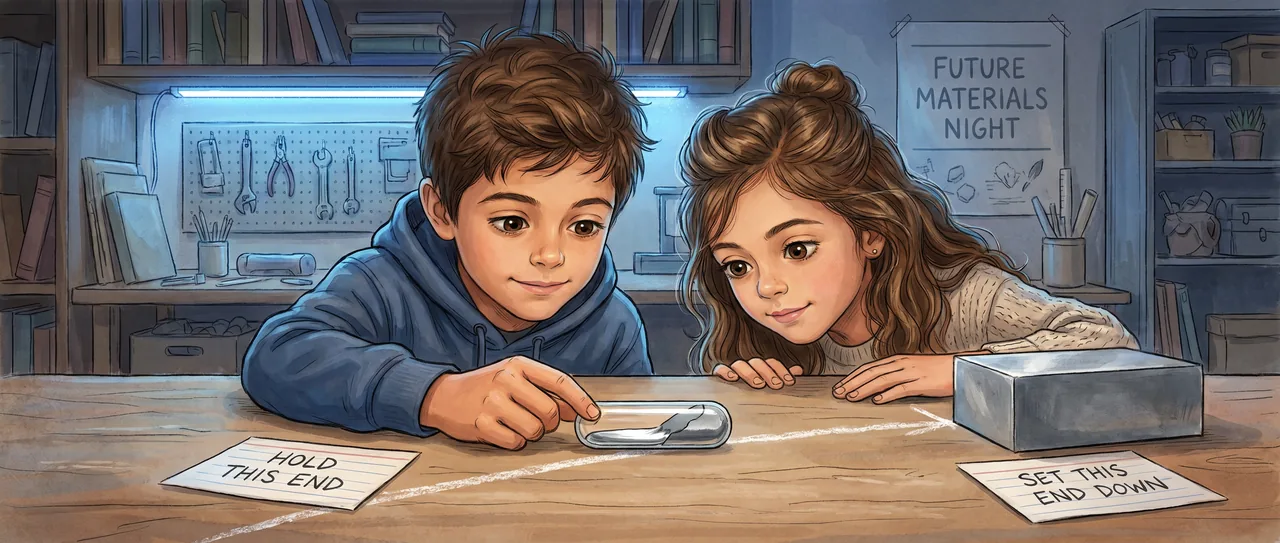
Soren took the capsule from Maya and laid it on the steel block at the edge of the table. The block was there for the magnet station. It was room-cool and heavy, with rounded corners from years of being dropped.
The gallium stopped sliding.
A silver crust crept from one end of the puddle. It grew like frost on a window, except it was metal. In three breaths the puddle had a skin. In five it was a lumpy bead again, pressed flat on the bottom of the capsule.
Maya whispered, “Again.”
Soren picked it up, but this time he held only one end of the capsule between finger and thumb. “If my hand warms only this side...”
The side near his fingers softened. The far side stayed sharp-edged against the plastic.
Maya bent until her nose was almost on the table. “It has a border.”
The border moved.
Not a line drawn in ink. A place where one kind of being turned into another kind of being because one side was a little warmer than the other. Solid on the steel end. Liquid on the hand end. Same element. Same capsule. Same minute.
Soren’s pencil hovered over his notebook, then stopped. There was not enough room on the page for what the thing was doing.
The librarian said, “Children, I appreciate your enthusiasm, but I have a table labeled solid metals and a table labeled liquids, and gallium cannot sit on both.”
Maya straightened. Her eyes had gone narrow, which meant the list in her head had found a pattern with one piece missing.
“Why does it have to sit?” she asked.
The librarian blinked. “Because displays sit on tables.”
“No. Why does the answer have to sit?”
Soren turned the capsule over in his hand. The gallium slid toward his warm fingers. “The sign is the broken part.”
“The signs are laminated,” the librarian said.
“That is also a kind of broken,” Maya said.
Soren looked around the makerspace. The robotics table had red tape for paths. The sewing table had chalk. The magnet station had the steel block and a ceramic tile. The electronics table had a strip of blue LEDs, the same cold blue as the lamp above them.
He picked up two blank cards.
“No extra hooks,” the librarian warned.
“No hooks,” Soren said.
Maya grabbed the chalk and drew a line down the tablecloth, crooked and quick. On the left she drew a handprint shape. On the right Soren placed the steel block and the white ceramic tile. He set the capsule across the chalk line.
Maya wrote on one card: HOLD THIS END.
Soren wrote on the other: SET THIS END DOWN.
The librarian made a small, pained sound. “That is not a category.”
“Good,” Maya said.
Soren took the thermometer from the plant-growing station and laid it beside the capsule. The makerspace air read twenty-one degrees Celsius. He held the bulb gently in his palm until the number climbed past thirty.
Maya watched the gallium soften again. “The room says one thing. A hand says another.”
Soren put the thermometer between the two cards. “So the exhibit asks before it answers.”
The librarian’s face changed. Not all at once. First her eyebrows gave up being annoyed. Then her mouth forgot the speech it had prepared about schedules. She looked from the handprint to the steel block to the bead that was half puddle now, half bright little cliff.
In the lobby, the first visitors pressed against the glass doors.
The librarian took down the SOLID METALS sign.
For a moment the hook above the table held nothing.
Then she picked up one of her laminated arrows and wrote on the back with a marker. Her handwriting was not as neat as the printed sign. It said: WHAT DOES YOUR HAND CHANGE?
She taped it crookedly above the gallium.
Read the interactive version, listen to the narration, and earn a gold star →
A science-verified short story for curious kids · Curiosity Land