The Window Before the Window
Soren was sure the window was the eye.
That was the problem, he thought. A cloudy window. A scratched window. A window with frost on it. At the clinic, they could print a clear one thinner than onion skin, slide it where the cloudy lens had been, and the world would come through.
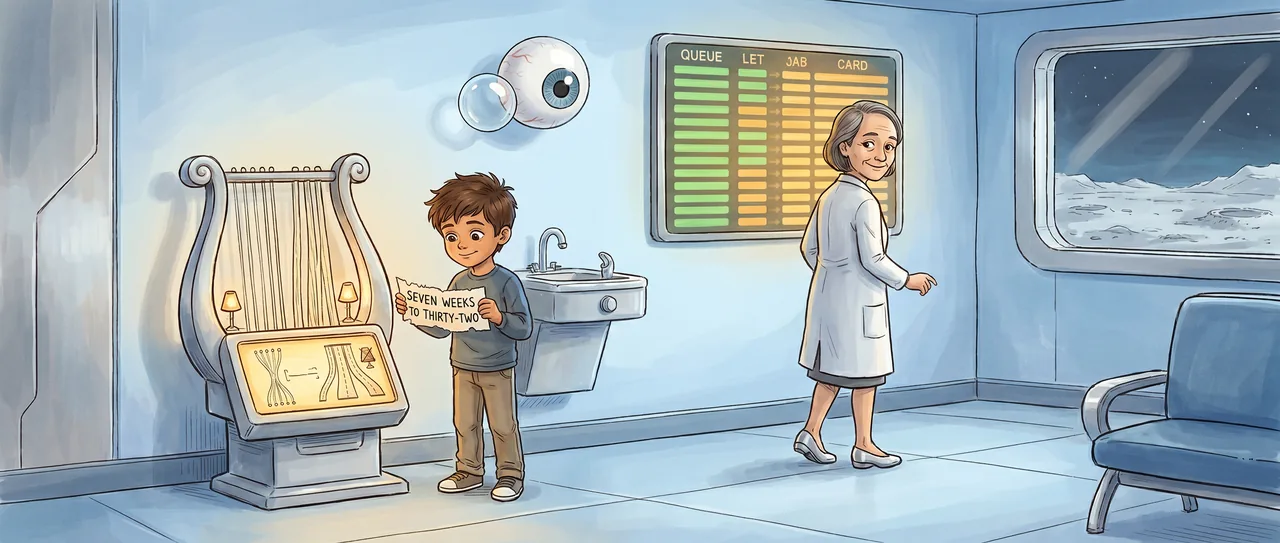
The waiting room made that seem obvious. It had wall screens full of babies blinking at lights, printers humming behind glass, and a model eyeball floating in a tank of blue gel. Every few minutes, a finished lens rose out of a bath on a silver loop, trembling like a soap bubble that had learned to behave.
Soren’s mother was under the queue board with half her arm inside an open panel.
“Do not touch anything that is plugged in,” she said.
“I wasn’t going to.”
“You were looking at the plugged-in things.”
“That’s not touching.”
She made the sound adults made when they agreed and did not have time to say so. She was a station scheduler, not a doctor, but the clinic’s board had lost its departure feeds, and ships did not wait because babies had appointments. Her hair kept floating out of its clip in the low lunar gravity. She pushed it back with her wrist and frowned at a knot of wires.
A doctor swept past with three visitors behind her. She had silver shoes and the brisk smile of someone who loved machines and expected them to love her back.
“No child with a cloudy lens needs to grow up in blur,” the doctor said. “We replace, we focus, we follow. The age of waiting in darkness is over.”
Soren liked that sentence. He liked it so much that he wrote down, replace, focus, follow.
The notebook made one of the visitors look twice. People always looked twice. Paper was strange on stations. Paper took space. Paper had corners. Paper did not update itself.
Soren turned the page anyway.
Beside the water fountain stood a machine shaped like a small silver harp. A sign above it said, Teach the Cortex Loom to See.
Soren read all the instructions before touching it. The loom had two little lamps, left eye and right eye. It had a screen filled with pale threads. If both lamps shone striped light, the threads braided into neat roads. If one lamp was covered, the roads from the uncovered lamp widened.
There was a slider marked early months.
There was another marked later.
Soren covered the left lamp and pushed early months.
The right-side threads spread across the screen.
He uncovered the left lamp.
Nothing much happened.
“That’s broken,” he said.
His mother’s voice came from under the board. “If it’s plugged in, don’t fix it.”
“I’m not fixing it. I’m disagreeing with it.”
He reset the loom. Both lamps. Stripes. Threads braided.
He covered the left lamp again, but this time he pushed later.
The right-side threads thickened a little. When he uncovered the left lamp, the left threads brightened and found their roads again.
Soren bent closer.
He did it again.
Early. Cover. Uncover.
The left threads stayed thin.
Later. Cover. Uncover.
The left threads came back.
Again.
Again.
The loom did not care that the lamp was working now. During early months, the covered side lost its place. The open side did not politely share when the cover came off. It had already spread.
Soren looked across the room at the floating model eye. A clear lens was only a window if someone inside still had a place to put the light.
The queue board above his mother blinked. Rows of appointments rolled into order.
Red rows first. Retinal tears. Corneal burns. Emergency pressure.
Green rows next. Lens replacements.
White rows last. Newborn screenings.
One green row pulsed at the bottom of the green group.
Dense left cataract. Seven weeks. Outbound family. Repair simple. Next available surgical bay after transit, thirty-two weeks.
Soren stared at the words until the letters stopped being words and became the loom’s thin left threads.
Thirty-two weeks was not a scratch on a window. Thirty-two weeks was early months sliding past with one lamp covered.
He tore a strip from the back of his notebook. His mother glanced out from under the board.
“Soren.”
“It’s the back page.”
“That was not the problem I was naming.”
He wrote seven weeks on the left end of the strip and thirty-two weeks far to the right. Then he made a dark block between them. He drew two tiny lamps. One open. One covered.
The doctor came back through the waiting room, still talking.
“Our printers can match a baby’s eye curvature before the baby can hold up their own head,” she said.
Soren stepped into her path.
She stopped fast. The visitors bumped gently into one another behind her.
“I need to show you the loom,” Soren said.
The doctor’s smile stayed on, but it thinned. “I’m in the middle of a tour.”
“Your board is sorting eyes,” Soren said. “Not brains.”
His mother slid out from under the panel. “Soren.”
The doctor looked at the queue board. “The board sorts by surgical complexity and departure time.”
“That baby leaves before the surgery.”
“Lens replacement after arrival is still lens replacement.”
Soren held up the paper strip. It shook because his fingers were gripping too hard.
“Not to the loom.”
The visitors were quiet now.
The doctor looked at the strip, then at Soren, then at the silver harp beside the fountain.
“Show me,” she said.
Soren did not explain first. Explanations could run ahead and trip over themselves. He set the loom with both lamps shining. The pale threads braided.
He covered the left lamp.
He pushed early months.
The right threads widened. The left threads shrank back like paths no one walked anymore.
He uncovered the left lamp.
The lamp shone. The screen stayed mostly right-thread road.
The doctor’s face changed in a small way, not surprised, exactly. More like someone hearing her own name called from a room she had forgotten was there.
Soren reset the loom.
He covered the left lamp and pushed later.
This time, when he uncovered it, the left threads found their way back into the braid.
“Seven weeks to thirty-two,” Soren said, and tapped the paper strip.
His mother stood very still.
The doctor took one step toward the queue board. Then another.
“That case should not be green,” she said.
Her fingers moved through the air controls. The row jumped. Green became gold. Gold rose above red, not because the eye was harder to mend, but because the waiting was doing something no printer could undo.
A chime sounded in the hall.
The doctor spoke into her wrist. “Hold Surgical Bay Two. Move the calibration lens to noon. I need the infant team now.”
His mother let out a breath and looked at Soren’s torn paper strip.
“You made a timeline,” she said.
“It made a deadline.”
The doctor turned from the board. The tour had scattered into whispers. “How many times did you run the model?” she asked.
“Six.”
“Why six?”
“Because the first time I thought it was broken.”
The doctor nodded once, not like an adult being kind to a child, but like a person accepting a measurement.
The gold row opened a door on the far side of the waiting room. Nurses moved through it with a warming cradle and a tray sealed in glass. Inside the tray lay a new lens, clear and curved and almost too small to be real.
Soren watched it pass.
The lens was beautiful. It was also late unless people hurried. The thought did not arrive in words. It arrived as the loom’s pale roads, spreading where light had been allowed to go.
On the wall screens, the clinic’s welcome film began again. A newborn blinked. A black-and-white card moved slowly from side to side. The baby’s eyes followed it in tiny jumps.
Soren had always thought babies were mostly waiting to become people who could do things. But the smallest ones in the film were already working. Their eyes were sending brightness and edges and stripes inward. Their brains were answering by building roads. Not later. Not when they could talk about it. Now.
He looked at the waiting room differently then. Every mobile. Every face leaning over a cradle. Every patch of light. Every shadow. The room was not a room. It was weather for brains.
His mother touched the torn edge of his notebook page.
“I can print you another back cover,” she said.
Soren shook his head. “I need that one missing.”
The surgical door closed. Above it, the gold row changed from waiting to preparing.
Soren went to the Cortex Loom and set both lamps shining. He did not run the lesson again. He only stood there while the threads braided themselves into roads.
In Room Six, the baby slept under a paper mobile. One circle was black. One circle was white. Soren clipped his striped card to the cradle rail, and the cloudy pupil caught the stripes in a tiny, wavering square.
Read the interactive version, listen to the narration, and earn a gold star →
A science-verified short story for curious kids · Curiosity Land