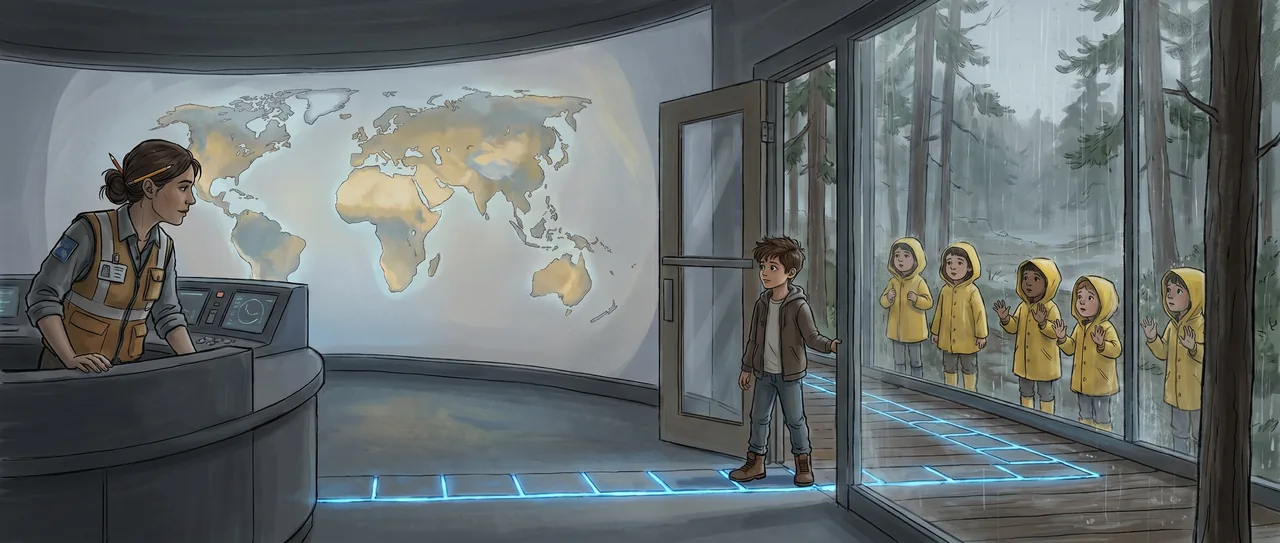
The Volcano Without a Mountain
The volcano on the floor was wrong.
It had a perfect red cone, a glowing orange throat, and neat little cracks that crawled down its sides like lightning in a hurry. Every few seconds it puffed a harmless cloud toward the ceiling of the visitor station dome.
Soren stood on the edge of the projection with his paper notebook tucked under one arm.
"Children like to recognize things," the exhibit engineer said. She had a pencil in her hair, two sensor badges on her vest, and the expression of someone who had not eaten lunch. "Mountain. Lava. Boom. They understand that. Then we tell them this is Yellowstone."
"But it isn't," Soren said.
The engineer rubbed both hands down her face. "It opens in forty minutes. Please tell me which color is less wrong. Red-orange or orange-red."
Soren looked past the cone, through the wide glass wall. Outside were wet boardwalks, steam lifting from pale mineral pools, and lodgepole pines standing in ordinary dirt. A raven hopped along the rail and stabbed at a dropped cracker.
No mountain. No point. No obvious middle.
That was the problem with Yellowstone. It did not look like what people meant when they said volcano.
The floor cone puffed again.
"Turn it off," Soren said.
The engineer blinked. "That is not one of the choices."
"If the first thing is wrong, the colors do not matter."
She stared at him for three seconds, then jabbed the wall control. The cone vanished. The floor became plain gray tiles.
The room felt larger without it.
The new exhibit was called Stand On A Supervolcano. Soren's mother had helped install the listening posts around the park, small buried instruments that felt tiny earthquakes, measured slow ground swelling with satellite signals, and sniffed the gases that came up with steam. She was outside repairing a frozen relay and had left Soren in the dome because he was, in her words, less likely to fall into a hot spring than her toolbox.
The engineer had found him measuring the room with his shoes.
Now she pointed at the control wall. "Here is what we have. Seismic maps. Heat maps. Gas maps. Old ash maps. Visitor attention span. Very short."
"How short?" Soren asked.
"A minute if there is motion. Ten seconds if there is reading."
Soren opened his notebook to the page where he had already copied the numbers from the exhibit script.
Magma reservoir, about ninety kilometers long.
Last full eruption, about six hundred forty thousand years ago.
Ash across much of North America.
Global temperatures cooler for years.
He knew the numbers. He had known them before breakfast. Knowing them had not helped when the floor made a cartoon mountain.
"Can the floor show ninety kilometers?" he asked.
"At this scale?" The engineer tapped quickly. A red oval appeared on the floor, squeezed from wall to wall. It looked like a giant tongue. "There."
"That is only the room."
"Scaled down."
"Scaled down until it feels small."
The engineer sighed. "Everything is scaled down. That is what models do."
Soren crouched and placed his palm on one gray tile. The tile was warm from the projector, not from the earth. Beneath the real building, beneath the pipes and concrete and frozen soil, the hidden hot rock did not care about the room.
"Show the ash," he said.
The engineer gave him a look, but she touched the control.
A map of North America spread across the floor. Yellowstone became a bright dot near Soren's left shoe. Pale ash fanned outward, over plains and rivers and places children in the room might have homes. The dot was so small he almost lost it.
"Now the volcano disappears," the engineer said. "See the problem?"
Soren did see it.
When they made the chamber fit, the continent vanished. When they made the continent fit, the chamber vanished.
The exhibit was failing because Yellowstone was too large in two different ways.
The engineer's wristband chirped. "The kindergarten group is early. Of course it is early."
Through the glass, a line of small children in yellow rain hoods came bobbing up the path. Their teacher was counting heads with the panic of someone counting ducklings in wind.
"We can use the cone," the engineer said. "Then fix it later."
"No," Soren said.
It came out sharper than he meant. The engineer stopped with her hand over the control.
Soren swallowed. He was used to people thinking his pauses meant he had no answer. He was used to people thinking his notebook meant he was finished thinking, when really it meant the opposite.
He looked at the empty floor, the ash map fading, the glass wall, the path, the pines, the steam.
"Do not make it fit in here," he said. "Make here one piece."
The engineer narrowed her eyes. "That sounds expensive."
"The listening posts already work, right?"
"Most of them. When bison do not chew the antenna covers."
"Can the floor talk to them?"
"It can receive public data from the network. Slow signals, not live emergency anything. Educational only."
"Good. Use slow."
Soren went to the control wall. He did not know the engineer's program, but he knew the menu labels. Map. Scale. Audio. Route. He tapped Route.
A blue line appeared from the center of the dome to the door.
"That is for fire exits," the engineer said.
"It is for walking."
He dragged the line across the path outside, along the boardwalk, past the geyser basin, out toward the road map at the edge of the display. The system refused to go farther. He zoomed out. The line shrank. He zoomed in. The end ran off the screen.
"Ninety kilometers will not fit on the visitor path," the engineer said.
"Exactly."
For the first time, she did not sigh.
Soren opened Audio. Each monitoring station had a public tone. Tiny earthquakes clicked. Slow ground motion became a low note. Heat flow became a soft hiss. Gas measurements made small chimes, He assigned the nearest station to the first floor tile. Click. Hiss. Chime.
Then he assigned the next station to the door speaker.
Then the porch speaker.
Then the boardwalk posts.
The engineer leaned over him. "If we chain the stations by distance from the dome, visitors can walk the length until the route leaves the safe path. The sound keeps going through speakers after that."
"Do not say length," Soren said. "Let them run out of room."
She gave him a quick sideways look.
"That is very inconvenient," she said.
"Yes."
The kindergarten group arrived in a squeak of wet shoes.
"Is it going to explode?" one child asked immediately.
The engineer opened her mouth.
Soren stepped onto the first blue tile.
The room gave a soft click from beneath his shoe.
The children went quiet.
He stepped to the next tile. A second click answered, lower than the first. Then a hiss joined it, like steam breathing through stone.
"This is one edge," Soren said.
He walked slowly, because if he hurried, they would think the walking was the point. The blue tiles lit under him one by one. Clicks moved across the floor. Low notes followed. A chime trembled from the wall.
At the door, he stopped.
"Where is the volcano?" a child in a yellow hood asked.
Soren pointed down.
The child looked at his boots.
Soren pointed out the glass wall, across the path, past the steaming pools.
The child turned.
The engineer touched the control for the ash layer.
Above the blue walking line, pale light spread across the wall map of the continent. It did not burst. It drifted. It crossed mountains, plains, rivers, and future cities printed in silver. The room temperature did not change, but the lights cooled from gold to blue as the years after the ancient eruption appeared.
"That happened?" the child asked.
"A long time ago," Soren said. "Six hundred forty thousand years."
"How long is that?"
Soren looked at the blue line ending at the door, and the wall map where ash had traveled farther than any person in the room had ever gone.
He said, "Too long for the room."
The engineer did not add anything.
Outside, the porch speaker clicked. Farther away, another speaker answered with a lower sound. Then another, faintly, from beyond the bend in the boardwalk.
The children pressed toward the glass.
"It is still going," one of them said.
Soren opened the east door.
The blue line crossed the porch, stepped off into the grass, and vanished between the lodgepole pines.
Read the interactive version, listen to the narration, and earn a gold star →
A science-verified short story for curious kids · Curiosity Land