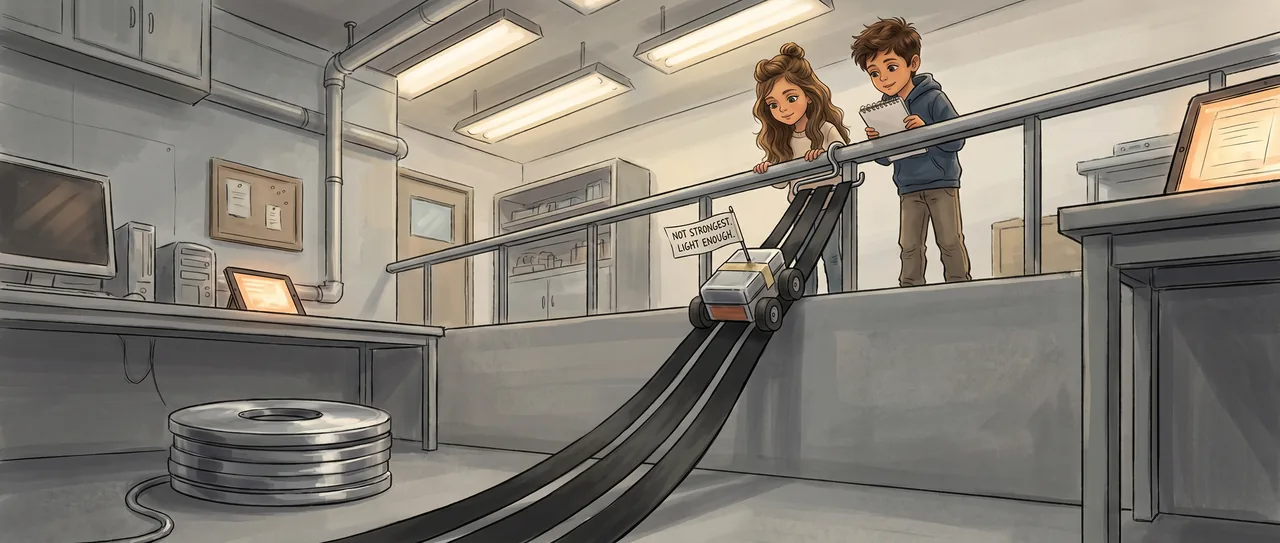
The Thread That Could Not Be Heavy
The first thing Maya and Soren built was wrong in a way that looked perfect.
It shone.
The steel cable ran from the lab floor to the balcony rail five meters above them, straight and silver, with no sag that Maya could see. Soren tugged it twice, then wrote a number in his paper notebook while everyone else tapped on glass tablets.
Dr. Ren hurried past with a coil of extension cords around one shoulder and a microphone clipped sideways to his collar. He had the sort of hair that looked as if he had been arguing with electricity.
"Excellent," he said, without stopping. "Steel looks strong. The cameras understand steel. Make the climber go up before the visitors come in. Four minutes. Maybe three. Where is my safety badge?"
He vanished behind a display board that said ELEVATOR TO ORBIT? in letters taller than Maya.
Maya looked at the board, then at the cable.
"Wrong," she said.
Soren did not ask if she was sure. He had known Maya long enough not to waste that question.
"What part?" he asked.
"It looks too sure of itself."
The climber was the size of a lunchbox, with two rubber wheels that pinched the cable and a little motor that made a hopeful mosquito sound. Soren switched it on.
The wheels grabbed. The steel cable hummed. The climber rose the width of Maya’s thumb, stopped, and slid back down.
Soren turned it off before the motor burned out.
"It did not break," he said.
"It lost anyway," Maya said.
That went onto the list in her head, under things that did not make sense yet. A cable could be too strong in the wrong way.
On the table were three spools Dr. Ren had dumped there before running away. One was the steel cable. One was a pale yellow cord labeled aramid fiber. One was a flat black ribbon so thin it looked like a shadow peeled off the table.
Soren picked up the label beside it.
"Carbon nanotube fiber," he read. "Lab sample. Handle gently. Do not kink."
"That one looks like it already gave up," Maya said.
Soren touched it with one finger. The black ribbon clung to his skin, then let go.
"Maybe it is not for looking strong," he said.
From behind the display board, Dr. Ren called, "Do not use the expensive one unless the steel fails. Also, do not let the steel fail. Also, has anyone seen my safety badge?"
"The steel failed," Maya called back.
There was a pause.
"Did it snap?"
"No."
"Then it did not fail," Dr. Ren said.
Maya and Soren looked at the lunchbox climber sitting on the floor.
"Adult definition," Maya said.
Soren took the steel cable off the hook and carried it to the scale. The coil dragged at his wrist. He weighed one meter of it. Then he hung a small bucket from it and added metal washers until the hook groaned.
"Strong," he said.
"Heavy," Maya said.
He weighed the aramid cord. Lighter. It held fewer washers, but not that many fewer.
The black carbon ribbon hardly moved the scale at all. Soren frowned and breathed out through his nose, the way he did when a measurement was being rude.
"Again," he said.
Maya held her breath this time so the air from her face would not stir it. The number still barely appeared.
"It weighs almost nothing," she said.
"Nothing is not a number," Soren said, but he was smiling.
They did not have time to break the expensive sample, and the label had asked them not to. So Soren made a different test. He looped each material over the balcony hook and clipped the empty climber to it, not to climb, just to hang. The steel pulled hard enough that the hook creaked. The aramid pulled less. The carbon ribbon hung down like a black line drawn in the air and seemed embarrassed to be involved.
Maya turned back to the enormous display board.
It showed Earth, a tiny blue circle, and a line rising from it into space. At the far end was a dot labeled counterweight. Near the middle, a ring labeled geostationary orbit. Someone had drawn a little elevator car climbing the line, which made it look easy, as if space were just the upstairs of Earth.
Under the picture, smaller words read: A space elevator tether must support its own weight over tens of thousands of kilometers. Ordinary materials tear under themselves. Perfect carbon nanotubes have a theoretical tensile strength about a hundred times that of steel, with very low weight. Real fibers are not perfect yet.
Maya read it twice, not because the words were hard, but because the room changed shape around them.
The cable was not supposed to be a tower.
It was supposed to be a thing so light that Earth could spin it taut.
She looked up at the balcony. Five meters was suddenly not five meters. It was a question wearing a ceiling.
Soren had stopped writing. His pencil hovered over the notebook.
"The climber is not fighting the cable breaking," he said. "It is fighting the cable being there."
Maya grabbed the steel coil with both hands and lifted it. It made her arms complain.
"So strongest loses if it brings too much of itself," she said.
Soren drew three columns on a scrap of cardboard because Dr. Ren’s tablets had all gone to sleep. Material. Holds. Weighs. He added a fourth column after staring at the first three.
"Holds compared to weighs," he said.
The numbers made a different race.
Steel won the first column. It lost the fourth.
The aramid cord did better. The carbon ribbon, with almost no weight to divide by, became strange on the cardboard. Not magical. Not finished. Strange.
Maya held the black ribbon up to the light. It did not shine. It swallowed shine.
"Why does it get to be like that?" she asked.
Soren checked the small card beside the spool. "Tubes of carbon atoms. Very tiny. Mostly lined up along the fiber. The pull goes along the bonds. If the tubes are perfect and lined up, they can be incredibly strong. If they are messy, they are not."
Maya pinched one end between two pieces of smooth tape so the climber wheels would not chew it.
"Then do not ask one thread to be heroic," she said.
Soren looked at her.
Maya was already laying three lengths of carbon ribbon side by side on the table, not twisted, not braided, just parallel. She taped the ends into a flat strip. A ribbon, not a rope.
"If twisting makes some of them pull crooked," she said, "make them agree."
Soren tested the strip between his fingers, gently first, then harder. His face went careful.
"All of them sharing," he said.
They hung the strip from the balcony hook. It made almost no sound. The climber’s wheels pinched the taped edge and began to turn.
The lunchbox rose.
Slowly, at first. Then steadily.
The carbon ribbon did not gleam for the cameras. It did not look brave. It was a black mark running upward through the air, and the machine climbed it as if the mark had always been a road.
Dr. Ren came out from behind the board wearing his safety badge on his sleeve.
"Oh," he said.
The climber reached the balcony rail and tapped the stop switch with a neat plastic click.
Visitors had begun to gather at the glass doors. Some of them pointed at the shiny steel coil on the floor. No one pointed at the black ribbon until the climber came down again, carrying a tiny paper flag Soren had taped to its side.
The flag said NOT STRONGEST. LIGHT ENOUGH.
Dr. Ren read it and blinked. Then he laughed so hard the sideways microphone crackled.
"That," he said, "is better than my sign."
Maya was not looking at the visitors. She was looking at the leftover carbon ribbon on the spool. There was only a little, not enough for anything important and therefore exactly enough for a question.
Near the door, a silver helium balloon bumped softly against a chair. "We are not building an elevator," Soren said.
"No," Maya said. "We are asking the smallest possible version."
He held the spool while she taped the end of the black ribbon to the balloon string. Dr. Ren opened his mouth, closed it, and moved the visitors back with both arms.
Maya let go.
The balloon rose until the spare carbon ribbon lifted from the floor in a black, trembling line.
Read the interactive version, listen to the narration, and earn a gold star →
A science-verified short story for curious kids · Curiosity Land