The Slice That Was Not Toast
The slice was beautiful and wrong.
It had the right color. The kitchen printer had painted it gold at the corners and chestnut along the ridges. It had the right stripes, too, three tidy grill marks across a square of wheat-and-chickpea breakfast tile.
Maya bit one corner and stopped chewing.
Soren watched her face. “Candle?” he asked.
“Fancy candle,” Maya said. “From a hotel bathroom.”
Soren took a bite. The tile cracked like toast. It smelled, for one second, like toast. Then it became vanilla smoke and cardboard.
He wrote three words in his notebook, then scratched out one of them so hard the paper fuzzed.
The food lab was empty except for the soft fans in the ceiling and the row of small ovens blinking blue. On the counter, the printer’s flavor rack held tiny silver capsules labeled caramel, roasted nut, butter, smoke, malt, browned bread, and coffee edge.
Maya leaned close to the rack. “It has browned bread. Why doesn’t browned bread taste like browned bread?”
Soren turned the empty capsule between his fingers. “Because the label is lying politely.”
They had one afternoon to make a breakfast tile for the habitat menu. The tiles had to survive months in sealed packets. They had to be made from ingredients the greenhouse club could grow or store, wheat, chickpeas, oil, sugar, powdered milk. The easy part was making them nutritious. The hard part was making someone want to eat the second bite.
The printer offered six hundred flavors. It could put strawberry onto algae crackers. It could make oat paste smell like cinnamon rolls. Maya had believed it could make toast.
Maya did not like being almost right.
She picked up an unpainted tile. It was pale and dull, like a cracker that had heard a joke too late. She held it beside the printed one.
“The color is on top,” she said.
“That is where color goes,” Soren said.
“No. Toast color is not on top. It is the top.”
Soren looked at the printed tile again. The brown had settled into the surface like makeup. Where his tooth had broken it, the inside was still the same pale paste.
He opened the printer’s recipe file. The screen showed a neat list of flavor compounds with check boxes beside them. Maltol. Furfural. Pyrazines. Diacetyl.
At the bottom, in smaller letters, it said: Full toasted crust mixture not available. Generated by Maillard reaction. Hundreds of linked reactions. Thousands of compounds.
Maya read it once. “Then why did it let us print toast?”
“Because it can print some of the loud parts,” Soren said. “Not the whole crowd.”
Maya slid the failed tile toward the little induction pan. “So we invite the crowd.”
The pan chimed when it warmed. Soren set out four blank tiles. He put one on the pan exactly as it was. On the second he brushed sugar water. On the third he brushed a thin paste of powdered milk and water. On the fourth he brushed both.
Maya stood with her nose level with the counter, which was not allowed when the pan was on, so she moved back exactly one shoe length.
The first tile dried and curled. It smelled like hot dust.
The sugar tile went shiny, then sticky, then brown in freckles. It smelled like lollipop pans after a fair.
The milk-powder tile yellowed slowly. A soft, warm smell came up, almost bread, almost not.
The fourth tile stayed quiet for so long that Maya began tapping one finger against her leg. Then the edge darkened.
Soren’s pencil stopped.
The smell rose in pieces.
Not one smell. Pieces.
Warm crust first. Then peanuts. Then something like popcorn hiding under a blanket. Then a tiny sharpness like the brown edge of a pancake. Then, gone before either of them could name it, the smell of the kitchen on the morning after a sleepover, when everyone else was still asleep and the toaster had just clicked.
Maya’s mouth opened.
Soren bent over his notebook and wrote too fast. Toast. Nuts. Pancake edge. Almost coffee. Warm paper bag. He paused, then added, not lonely.
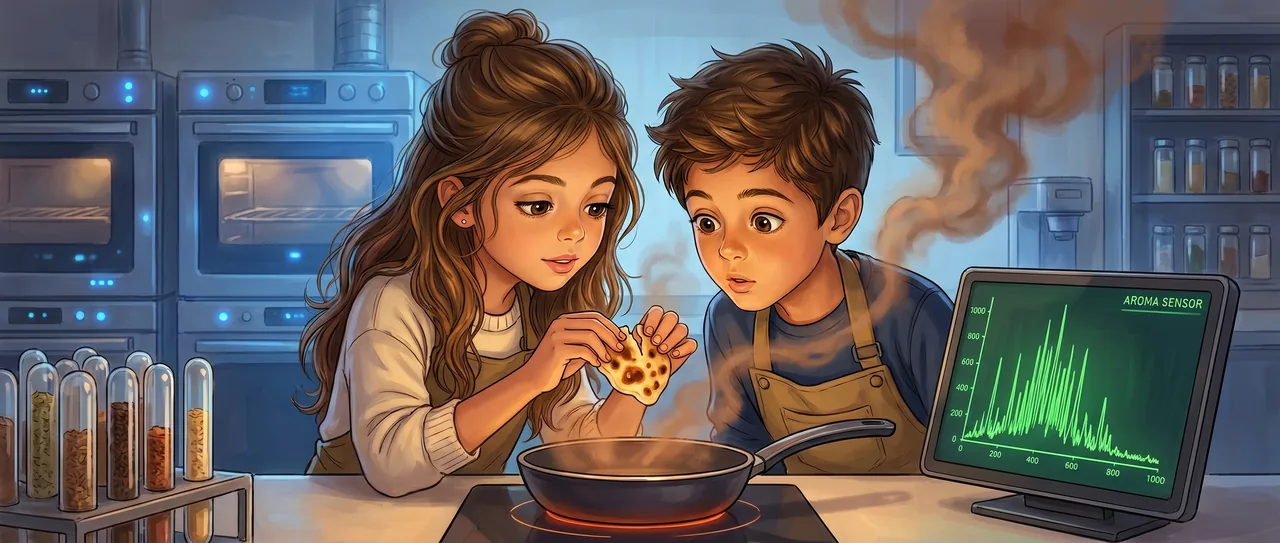
The lab sensor above the pan woke with a beep. Its little screen filled with peaks, thin green mountains crowding one another.
Analyzing aroma mixture, it displayed.
The green mountains multiplied.
Unresolved compounds detected.
Maya laughed once, under her breath. “It can’t keep up.”
The screen tried again. Estimated volatile compounds: many.
“That is not a number,” Soren said.
The tile began to smoke.
Maya snatched the tongs and flipped it onto the cool ceramic plate. The underside was too dark at the corners, but the center had gone golden brown all the way into its tiny cracks.
Soren broke it open. The sound was different from the printed tile. Smaller. Sharper. Alive in the hand.
They each took one piece.
This time Maya kept chewing.
Soren did too.
The flavor did not arrive in a straight line. It came sideways. It changed while they tasted it, as if the bite had rooms and they were walking through them too quickly to look at the wallpaper.
Maya pointed at the printer rack. “Those are postcards.”
Soren swallowed. “This is the city.”
They made another batch, but the second one burned.
The third steamed and turned rubbery because Maya had brushed on too much water.
The fourth looked perfect and tasted flat because Soren had turned the heat down to be safe.
“Dry heat,” he said.
“Fast enough to brown,” Maya said.
“Not so fast it burns.”
“Sugar and amino acids both there.”
“Milk powder has proteins.”
“Chickpeas too.”
Soren cut the tiles thinner. Maya spread them on the warm rack for a minute before they touched the pan. They stopped brushing the surface and mixed a little powdered milk and sugar into the dough itself. Soren made a row on the pan, pulling one tile off after thirty seconds, one after forty, one after fifty, one after sixty.
Maya did not watch the timer. She watched the edges.
“Now,” she said.
Soren lifted the fifty-second tile.
The forty-second tile was pale. The sixty-second tile was bitter at the corners. The fifty-second tile crackled between their teeth and left a brown taste that kept unfolding after the bite was gone.
The sensor beeped again. More green mountains crowded the screen than before. The names appeared where the machine could guess them, nutty, roasted, caramel-like, bready. Between the named peaks were gaps and question marks and tiny signals too close together to separate.
Soren looked from the screen to his notebook. His strange words were not worse than the machine’s words. They were handles for things too crowded to hold.
Maya took his pencil and circled not lonely.
“That one stays,” she said.
He did not take the pencil back right away.
They tried rye flour. It went darker and sharper.
They tried oat flour. It smelled round and sweet.
They tried chickpea-heavy dough. It made a roasted smell that reminded Maya of the hot stones beside the playground in August. Maya lined up the best three tiles on a white plate. Soren placed the printed one beside them. The printed tile looked prettier. The real ones looked uneven, freckled, a little blistered, darker on one side than the other.
Maya broke the printed tile in half. No smell came from the middle.
Soren broke the fifty-second tile. A warm brown breath rose from the crack.
For a moment neither of them moved.
Then Maya reached for the bowl of unused dough.
Soren reached for the powdered milk, then stopped and picked up the chickpea flour instead.
“How many kinds of brown do you think there are?” he asked.
Maya set the pan to heat again. “Don’t count yet.”
On the steel tray, twelve pale squares began to freckle at their edges.
Read the interactive version, listen to the narration, and earn a gold star →
A science-verified short story for curious kids · Curiosity Land