The Shape That Let Go
The trouble with Dr. Vale's hemoglobin was that it was too good.
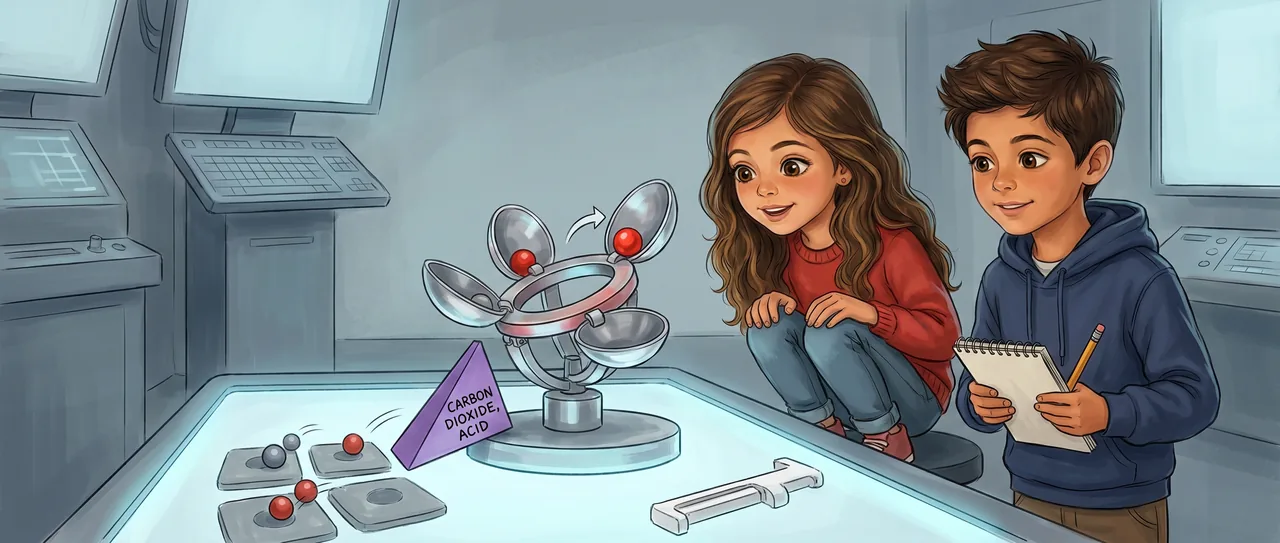
It sat in the middle of the hospital makerspace inside a clear plastic case, all polished hinges and red oxygen beads. Above it, a sign said FROM GENE TO BREATH. A slot on the side waited for a gene card. A tray on the left was labeled LUNG. A tray on the right was labeled TISSUE.
Dr. Vale slapped the case with the heel of her hand. Nothing happened. The four red beads stayed clamped in their little silver cups.
She had a pencil behind each ear and a third pencil in her hand. Her hair looked as if it had been argued with.
"It worked yesterday," she said. "Then I improved it. Stronger magnets. Cleaner message. Oxygen in, oxygen out. Very simple. Very public. Very soon."
Maya crouched until her eyes were level with the case. The beads were perfect, too perfect. Each one sat like it had been nailed to the world.
Soren opened his paper notebook. The makerspace had wall screens, wrist screens, and one table that could project a molecule into the air. Soren still used a notebook with a bent corner and a pencil sharpened down to a thumb.
"What is it supposed to do?" he asked.
Dr. Vale pushed the whole case from the LUNG tray to the TISSUE tray. "Pick up oxygen here. Drop it there. The tour starts in nine minutes. I have to find a missing cable and convince a donor that children do not bite. Please make it less stuck."
"Stronger magnets made it worse," Maya said.
"Stronger usually helps," Dr. Vale said, already walking backward. "Unless it does not. Do not take apart the gene reader. Do not spill the bead reservoir. If something smokes, unplug the orange cord, not the blue one."
She vanished behind a curtain of hanging lab coats.
Maya tapped the clear case. "It wins at holding."
"And loses at carrying," Soren said.
He wrote that down.
The model had four silver cups arranged like petals around a central hinge. A red bead from the LUNG tray rolled into a cup and snapped there. Another bead snapped into the next cup. Another. Another. Then nothing could persuade them to leave.
Maya lifted the TISSUE tray and tilted it. The beads did not move.
Soren found a drawer labeled WEAK MAGNETS. He swapped one cup, then another, keeping the screws in a line. With weak magnets, the beads rolled past the cups in the LUNG tray and collected in the corner like spilled candy.
"Too weak," he said.
"Too strong," Maya said.
"There should be a middle."
"There isn't." Maya pushed the strong and weak drawers closed with her knee. "That's the problem."
Soren looked at the model. "A middle magnet?"
Maya shook her head. She had gone still, which meant she was moving very fast somewhere inside. "Not a magnet. A before and after."
Soren did not ask her to slow down. He turned the case around and found four tiny screws under the base. "What made you think that?"
"The cups are all the same," Maya said. "But the sign says gene to breath. Genes do not make cups. They make things that fold. Folding things are never just cups."
Soren removed the base.
Inside, the model was not simple at all. There were springs under the cups. A ring in the center. A white locking bar that held the four petals flat.
Soren touched the locking bar. "This keeps it in one shape."
"Dr. Vale improved it," Maya said.
"By stopping it from moving."
They both looked at the red beads, stuck in their perfect cups.
Soren pulled out the lock. The four petals sagged at odd angles. Now the model looked less like a machine and more like a hand half opening in sleep.
Maya smiled. "Ugly. Better."
Soren tested one cup with a bead. It caught, but weakly. When the bead settled, its weight tugged a spring. The central ring shifted. The next cup tilted upward, just a little.
"Do that again," Maya said.
Soren reset it. One bead clicked in. The ring moved. The second bead clicked in more easily. The third almost jumped. The fourth snapped so hard that Maya flinched and laughed.
The whole model had changed shape around the beads.
For a moment, the makerspace seemed to grow quiet around them. Maya had seen diagrams of blood before, red circles in blue veins. This was not a red circle. This was a thing with moods. A thing that became better at holding oxygen because it had already begun.
Soren turned the model toward the TISSUE tray. "Now let go."
It did not.
Maya's smile disappeared. "Still too good."
Soren checked the tray. The TISSUE side had small gray pads labeled CELL and a purple plastic wedge labeled CARBON DIOXIDE, ACID. He slid the wedge into the case where the instructions showed.
The central ring shifted back. One cup tipped. A bead rolled out and landed on a gray pad.
Maya held her breath.
The second bead rolled. The third. The fourth.
They did not fall like broken pieces. They left in order, each one making the next cup a little worse at holding on.
"Again," Maya said.
Soren reset the model in the LUNG tray. One bead made the next easier. Four beads changed the shape. The TISSUE wedge changed it back. Four beads left for the gray pads.
Again.
Again.
Each time, the model looked wrong at the start. Crooked. Ready. The straight locking bar lay on the table, smooth and useless.
Dr. Vale burst through the lab-coat curtain with a cable around her neck and a tablet under her arm. "Please tell me the donor likes smoke."
"No smoke," Soren said.
Maya pushed the case into the LUNG tray. The first red bead clicked in. Then the second, quicker. Then the third and fourth.
Dr. Vale stopped moving.
Maya pushed the case into the TISSUE tray. Soren slid in the purple wedge. The beads rolled out onto the gray pads.
Dr. Vale took one pencil from behind her ear and used it to point at the empty place where the locking bar had been.
"I put that in so it would be easier to understand," she said.
"It made it stop being hemoglobin," Maya said.
Dr. Vale stared at the model, then at the hallway, where voices were gathering. "That is extremely inconvenient and probably the best possible sentence for the tour."
She scooped up the locking bar and dropped it into a drawer labeled DO NOT SIMPLIFY THIS MUCH.
Soren noticed a blue box beside the gene reader. It held extra cards, each printed with rows of A, T, C, and G. Adult beta globin. Fetal gamma globin. Sickle variant, demonstration only. High altitude variant, demonstration only.
"Are these real?" he asked.
"Real sequences, simplified output," Dr. Vale said. She was tightening the case screws as fast as she could. "Hemoglobin is a family of almost-the-same machines. Tiny changes matter. Which genes are on matters too. That is why half my lab is trying to help cells make the right hemoglobin at the right time. Do not start a new run unless you want to miss the tour."
Maya had already picked up the blue card.
Soren read the label over her shoulder. "Fetal gamma globin. Higher oxygen grip. Used before birth."
Maya looked toward the LUNG tray.
Then she looked at the third tray they had ignored, the one tucked behind the case and labeled PLACENTA.
The hallway voices grew louder.
"Before lungs," Maya said.
Soren slid the adult card out of the reader.
Dr. Vale opened her mouth, looked at the blue card in Maya's hand, and closed it again.
Maya set the small blue frame beside the larger red one in the placenta tray. One by one, red beads left the adult cups and clicked into the smaller blue frame.
Read the interactive version, listen to the narration, and earn a gold star →
A science-verified short story for curious kids · Curiosity Land