The Room That Could Not Count
At noon, the museum took the sun away.
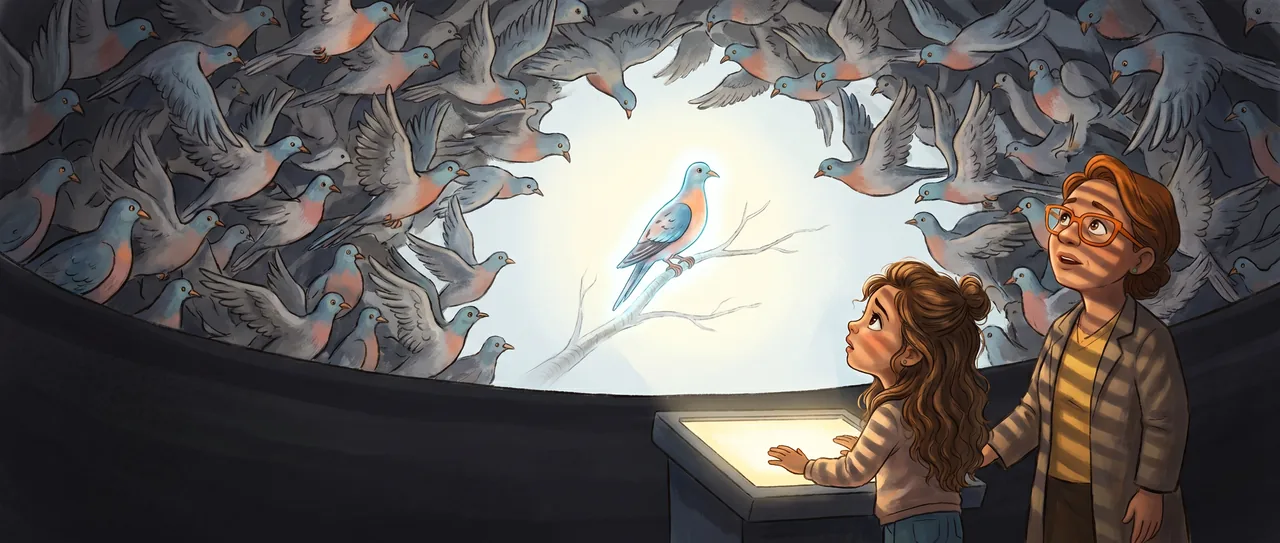
Maya had been standing in the Vanished Skies Dome with both hands in her pockets, trying not to look impatient while Dr. Belrose adjusted the feathers on a single holographic bird. The bird perched on a virtual branch in the center of the room. It had a blue-gray head, a rose-colored chest, and a tail like a long pointed brush.
Then the dome went dark.
Not night-dark. Moving-dark.
The ceiling filled with wings. They came in layers, gray over gray over gray, until the lights on the floor faded and every face in Maya’s class turned upward. The sound arrived a breath later. A storm made of feathers. A million pages being shaken by enormous hands. The floor trembled through the soles of Maya’s shoes.
Someone laughed once, then stopped.
Dr. Belrose clapped her hands in delight. “Full flock test! I did not mean to trigger that yet.”
“How many?” Maya asked.
“In the largest historical reports?” Dr. Belrose looked up with everyone else. “Billions. Passenger pigeons were probably the most abundant birds in North America. Some flocks took days to pass.”
The word billions did not fit inside Maya’s head. It bounced off the walls and came back smaller.
On the dome, the sun flickered through bodies that kept coming. Not a flock like geese, not a V, not a tidy arrow in the sky. This was weather. This was a river overhead. If one bird tilted, the rest did not care. If a thousand birds tilted, the sky changed shape.
Maya opened her mouth.
The dome snapped bright again.
Everyone blinked. The single passenger pigeon sat on its single branch, neat and perfect.
Dr. Belrose hurried to a console. “Sorry. The full version makes people miss the important part.”
Maya stared at the bird.
It looked wrong now.
Not the feathers. Not the eye. The wrongness was around it, in all the clean air.
Dr. Belrose smiled at the class. “This is Martha. She died at the Cincinnati Zoo in nineteen fourteen. The last known passenger pigeon.”
A boy near the door whispered, “It’s just a pigeon.”
Maya turned before she meant to.
“It’s not,” she said.
The boy shrugged. “Looks like one.”
Dr. Belrose did not hear him. She was already talking to the wall, where dates appeared in a tidy line. “For our exhibit opening tonight, we lead with Martha. One bird. One life. Children connect to one life.”
Maya’s pockets suddenly felt too small for her hands.
“No,” she said.
Dr. Belrose looked over her orange glasses. “No?”
“The room is lying.”
The class went quiet in the way classes go quiet when someone has stepped on the wrong square.
Dr. Belrose’s eyebrows climbed. “Every feather is based on preserved specimens. The colors are cross-checked with museum skins. Even the tail length is accurate.”
“Not the bird,” Maya said. “The room.”
Dr. Belrose pressed her lips together. Behind her, the lonely hologram scratched its beak against a branch that had never held weight.
“We have trustees arriving in twenty-six minutes,” Dr. Belrose said. “If you can make billions of birds fit in this dome without crashing my system, you may try.”
She meant it as the end of the conversation.
Maya heard it as permission.
The class moved toward the exit for lunch. Maya did not. She walked to the console.
“You cannot access the renderer,” Dr. Belrose said, already kneeling beside a projector panel with a tool in her teeth. “It freezes after sixty million models. Very embarrassing. Very expensive.”
“I don’t need the birds,” Maya said.
Dr. Belrose took the tool out of her mouth. “That is an unusual plan for a bird exhibit.”
Maya dragged one finger through the menu. The dome had layers. Light. Sound. Airflow. Ground vibration. Scent, locked for safety. Historical map. Population curve. Rail lines. Hunting records.
The list in Maya’s head started clicking.
Things that didn’t fit yet: One bird. Billions. Days of darkness. Last bird. Fifty years.
She opened Light.
The dome showed a blue afternoon sky.
She lowered the sun by ten percent. Then thirty. Then seventy. The room dimmed, but too evenly.
“No,” Maya said.
She made the shadow move. Bands of darkness swept across the floor, fast at first, then layered, then broken by flashing gaps. The ceiling stayed almost empty. Only a few hundred bird shapes crossed it, repeating in different sizes and heights.
Dr. Belrose came closer despite herself.
“That is not billions,” she said.
“It’s what billions do to the light.”
Maya opened Sound.
The first wing noise was too pretty, like applause in a theater. She added distance. Then more distance. Then a low rush underneath that made the benches hum. She took away the clean edges so the sound became too many sounds to separate.
A paper cup rolled off a bench.
Dr. Belrose caught it with her foot.
Maya opened Ground.
There were old reports in the exhibit files. Branches breaking under nesting colonies. Hunters firing into masses of birds. Nets. Barrels. Rail cars carrying bodies to cities. Nestlings knocked from trees and packed for market. Numbers so large they had become easy for people to stop seeing.
Maya did not put hunters in the dome. She did not put blood on the floor. She set the dates along the wall and made the flock-shadow thin each time a year passed.
Eighteen sixty.
The room darkened for a long time.
Eighteen seventy.
The rushing sound lost one layer.
Eighteen eighty.
The sun showed through in wide pieces.
Eighteen ninety.
The floor stopped trembling.
Nineteen hundred.
A few birds crossed the ceiling, small as thrown seeds.
Nineteen fourteen.
Martha stood on the branch.
The room was bright enough to hurt.
Dr. Belrose did not speak.
Maya moved Martha’s branch to the very center. Then she changed the branch. Not a forest branch. A zoo perch.
The holographic bird settled on it alone.
From the doorway, the class had come back without making noise. The boy who had said it was just a pigeon stood with his lunch unopened in both hands.
Dr. Belrose’s voice was lower now. “People used to say there were too many to ever run out.”
Maya looked at the empty ceiling. Too many was not a number. Too many was what people said when they had stopped counting.
The trustees arrived in polished shoes and careful smiles. Dr. Belrose began to greet them, then stopped. She looked at Maya.
“Run it,” she said.
Maya pressed Start.
The dome took the sun away again.
This time nobody laughed.
The shadows crossed their faces. The rushing wings filled their ears. The dates walked along the wall with the rail lines and market numbers, not loud, not hidden. The flock thinned. The room brightened. The sound drained out until the last wingbeat was not a bang or a cry, just a small mechanical flutter from the projector cooling fan.
Martha stood alone on the zoo perch.
One trustee wiped his glasses for a long time.
Dr. Belrose bent over the console. “We can add a second program,” she said. “Living Skies. Counts from radar, microphones, migration watches. Not vanished. Not yet.”
Maya’s finger hovered above the menu.
A new blank button appeared beside the passenger pigeon file.
Begin Count.
Maya pressed her thumb to the glass.
Read the interactive version, listen to the narration, and earn a gold star →
A science-verified short story for curious kids · Curiosity Land