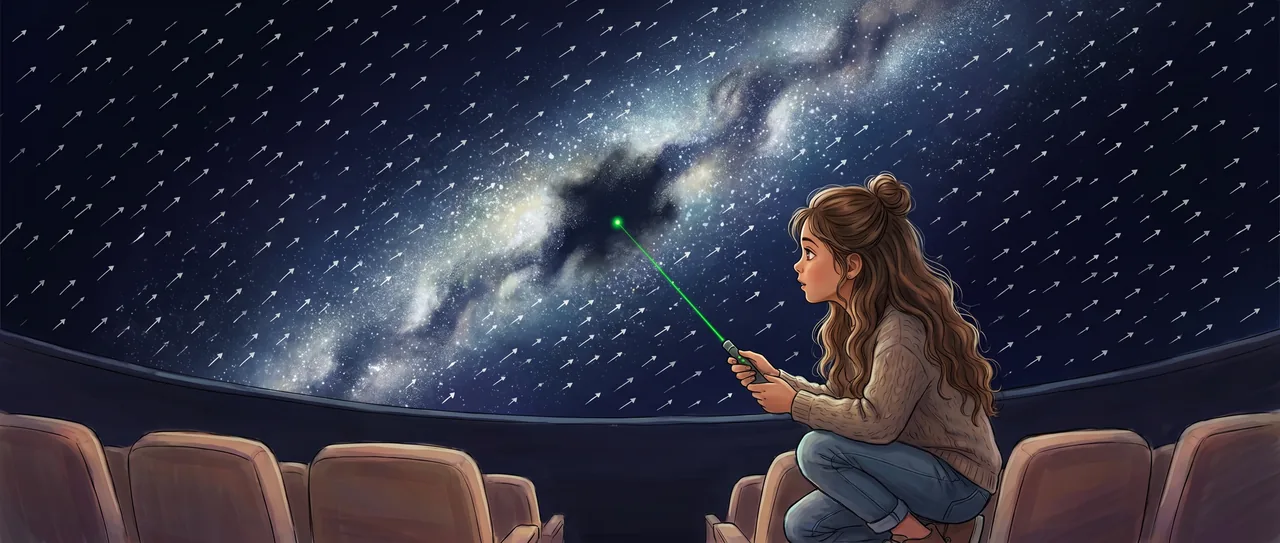
The Place the Arrows Bent
Maya was given a broom, a wireless clicker, and one instruction: make the universe less messy.
The planetarium director said it while walking backward down the aisle, holding three cables, a water bottle, and a paper cup of cold tea.
"Family night starts in forty minutes," she said. "The expansion scene is beautiful. The extra arrows are confusing. Turn them off when I say cue four. Please do not improve anything. Please do not ask whether the word beautiful is scientifically measurable. It is not. I checked."
Maya had not been going to ask that.
She had been going to ask why the galaxy arrows were bent.
The dome above her was gray and sleeping. A few stars glowed faintly where the projector had not quite gone dark. Maya swept popcorn salt from under the front row and kept glancing up at the frozen map.
Every galaxy was a speck. Every speck had an arrow.
Most arrows pointed outward, as if the whole dome had taken a breath. That part made sense. Space stretching. Distant galaxies carried away from one another. No center. No edge you could stand on and point from.
But near the bottom of the dome, in the direction the director had labeled Centaurus, the arrows had begun to lean.
Not all the same amount. Not neatly. That was the part that bothered Maya. A tidy mistake was probably a mistake. A messy pattern was usually something else.
The director climbed into the control booth and spoke through the crackling microphone.
"All right. Cue one. Early universe glow. Cue two. Galaxies. Cue three. Expansion. Cue four, remove peculiar velocities."
The word peculiar hit the dome and stayed there.
Maya looked at the clicker. It had six square buttons, each with a strip of tape beside it. Cue four said CLEAN ARROWS.
She pressed it.
The leaning arrows vanished.
The dome became calm. Too calm.
Thousands of galaxies drifted apart in perfect silence. The arrows were straight and polite. The picture was easy to understand and almost certainly missing something.
"Good," the director said. "Much better."
Maya pressed cue three again.
The bent arrows returned.
"Maya."
"It looks wrong without them," Maya said.
"It looks simple without them. Simple gets people to the cookies afterward. Wrong gets people to the refund desk."
Maya walked to the center circle where presenters stood during shows. A tiny sticker on the floor said YOU ARE HERE, which was not true in several ways.
She pointed the clicker upward and pressed a button labeled LOCK MILKY WAY.
The stars shifted.
The whole map turned until one pale river of light crossed the dome, the projected dust and crowded stars of the Milky Way itself. It ran like a bright scarf across the sky, hiding what lay behind it.
The director made a small sound into the microphone.
"That layer is for school groups," she said. "Older school groups. Preferably ones with teachers who enjoy pain."
Maya did not answer. She pressed cue three, then cue five, which said SUBTRACT EXPANSION.
The outward drift stopped.
For one second the galaxies hung still.
Then the arrows appeared again, not exploding away, not tidy, not polite.
They streamed.
Across the dome, thousands of little white arrows leaned toward one dark, blocked patch behind the Milky Way's bright band. Some came from above. Some from below. Some were short and some were long, but they had the same secret slant, as if an invisible hand had combed them through space.
Maya lowered the clicker.
The planetarium floor was solid under her shoes. The seats were solid. The city outside was full of buses and pigeons and people deciding what to eat for dinner.
Above her, the Milky Way was falling sideways at six hundred kilometers every second.
Not falling like a dropped cup. Not falling toward Earth. The whole galaxy, with the Sun in one of its spiral arms and Earth circling the Sun and Maya standing on a sticker that lied, was moving with a crowd of galaxies toward something two hundred fifty million light years away.
The microphone clicked.
"That," the director said, quieter, "is why I wanted the arrows off. Someone always asks what is there."
Maya looked at the hidden patch. It was not empty. It was covered. That was different.
"What is there?" Maya asked.
The director sighed, but not angrily. More like a person whose tea had gone cold because the universe refused to stay in one paragraph.
"A lot of mass," she said. "Clusters of galaxies. The region people call the Great Attractor. Part of it is hard to see because our own galaxy is in the way. Radio and infrared surveys help. The full story is still being mapped. Also, if you say all of that in the show, three parents will check their phones."
Maya kept looking up.
Peculiar velocities. The leftover motion after the smooth expansion had been taken away. The part that did not fit was the part that pointed.
At school, peculiar meant someone staring when Maya asked why the classroom clock's second hand twitched backward before moving forward. Peculiar meant the teacher saying, "Later," and never meaning it. Peculiar meant other people closing a box just when the interesting thing crawled to the edge.
On the dome, peculiar meant gravity had left fingerprints across millions of light years.
Maya pressed cue four again.
Clean arrows.
The fingerprints disappeared.
She pressed cue five.
The dome went still, then slanted toward the dark.
Clean. Peculiar.
Clean. Peculiar.
The director came down the aisle. She had untangled the cables but now wore one over her shoulder like a defeated snake.
"We have eighteen minutes," she said.
"We can do both," Maya said.
"Both is twice as long as one. That is a property of both."
Maya stepped off the center sticker and walked to the front row, where the youngest kids usually sat because they liked to be swallowed by the dome. She crouched until her eyes were at the height of a seat cushion.
From there, the outward arrows filled the sky like sparks.
She pressed cue five.
The sparks stopped being sparks. They became tracks. The hidden patch sat just above the seat backs, dark behind the bright wash of the Milky Way.
"First we show them the stretch," Maya said. "Everything getting carried apart. Then we take the stretch away. Not because it wasn't real. Because we want to see what else is moving."
The director rubbed her forehead with the water bottle.
"That sentence has too many ideas."
"Then don't say it," Maya said. "Let the arrows do it."
The director opened her mouth.
The lobby doors banged. Families began to arrive. A little voice echoed, asking if black holes could eat popcorn. Someone laughed. Someone dropped a coat. The director looked at the control booth, then at the dome, then at Maya.
"No improvising after the galaxies," she said.
"This is before the galaxies finish," Maya said.
"That is exactly the kind of sentence that worries me."
But she handed Maya the second laser pointer.
The show began with darkness.
Maya stood beside the front row while the director spoke about ancient light and patient telescopes and the fact that every seat in the planetarium was attached to a planet attached to a star attached to a galaxy, which was a lot of attachments for one folding chair.
The children leaned back. Parents leaned back too, but more carefully.
Cue three filled the dome with galaxies sailing apart.
The director said, "On the largest scales, space itself stretches, carrying galaxies away from one another. There is no middle seat in the universe."
A small boy in the second row whispered, "Not even mine?"
Maya smiled and pressed cue five.
The expansion faded out.
For a breath, the dome held still.
Then the arrows returned, all those leftover motions, all those peculiar slants, thousands of galaxies leaning toward the hidden place behind the Milky Way.
No one spoke.
Even the projector seemed quieter.
The director did not explain right away.
Maya lifted the laser. The green dot trembled slightly because her hand was not as still as the floor pretended to be. She placed the dot on the bright band of the Milky Way, then moved it to the dark patch behind it.
"That way," the director said softly into the microphone, "our galaxy is moving too."
A parent whispered, "Toward what?"
The director looked at Maya.
Maya did not take the microphone. She pressed the button once more.
The clean outward arrows flashed back across the dome. Then the peculiar arrows returned, slanting through them, both motions laid over the same sky.
The green dot rested on the dark place where the arrows bent.
Read the interactive version, listen to the narration, and earn a gold star →
A science-verified short story for curious kids · Curiosity Land