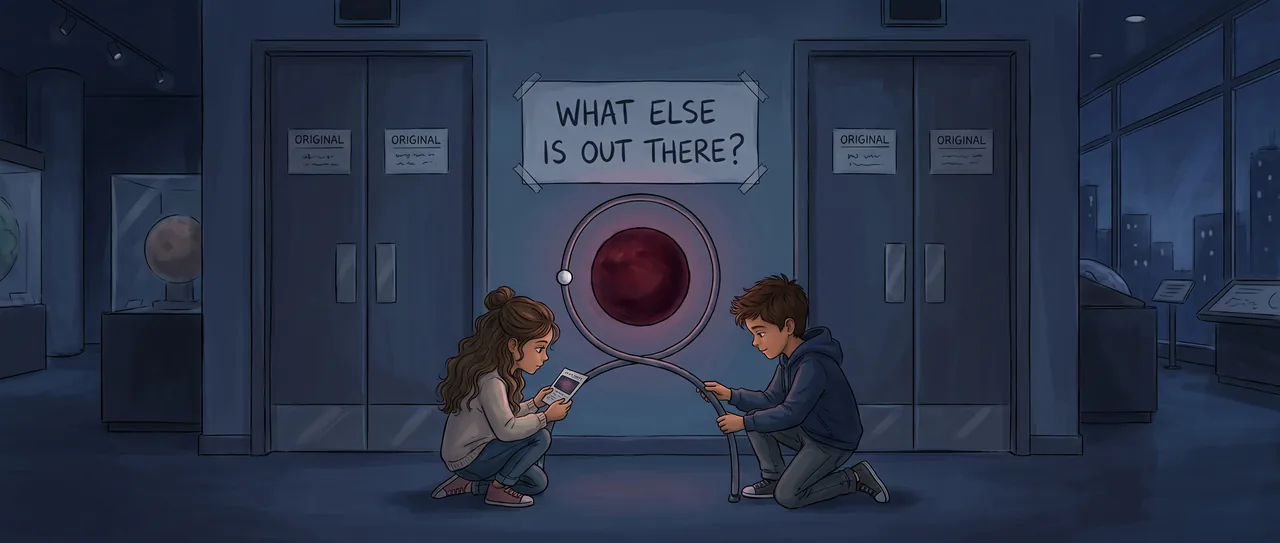
The Place Between
The museum had two doors painted on the wall.
One said STAR.
One said PLANET.
Between them, on the floor, sat three crates of magnetic spheres, labels, wires, hooks, and one very annoyed projector that kept making Saturn look square.
Ms. Calder stood on a ladder with a screwdriver in her mouth. She was the exhibit designer, and she had silver paint in her hair because she had tried to fix the Milky Way by leaning into it.
“Simple,” she said around the screwdriver. Then she took it out. “Children like simple. Visitors choose a space object, decide if it is a star or a planet, and hang it under the correct door. Maya, Soren, test it fast. We open tomorrow.”
Maya looked at the doors. “Only two?”
“Only two is the point,” said Ms. Calder. “Otherwise people wander.”
Soren opened the first crate. The spheres were beautiful. The Sun was warm yellow and too big for his hand. Jupiter had painted storms. Neptune was blue enough to look cold. There were tiny labels with tidy facts printed under glass.
Maya moved quickly. Sun to STAR. Jupiter to PLANET. Earth to PLANET. Proxima Centauri to STAR.
Soren checked the backs of the labels before hanging them. He did not trust tidy facts until he had turned them over.
Then Maya stopped.
She was holding a dark red sphere, almost black unless the light caught it. Its label read: BROWN DWARF.
Under that, smaller words said: Too massive to be a planet. Too small to sustain hydrogen fusion like a star. Glows mostly in infrared.
Maya looked at the STAR door. Then the PLANET door.
“No,” she said.
Ms. Calder climbed down two rungs. “What is no?”
“This one.” Maya held it up. “It bites both signs.”
Soren took the sphere. It was heavier than Jupiter, or it felt heavier because someone had put a metal core inside. “If the rule is hydrogen fusion, it is not a star,” he said.
“Then planet,” said Ms. Calder.
Soren turned the label over. “It says too massive to be a planet.”
Ms. Calder blinked. “Put it with stars for now. Astronomers call them failed stars sometimes.”
Maya’s face changed at the word failed. Not angry exactly. Sharper.
“It didn’t fail at being itself,” she said.
Ms. Calder looked at her watch. “I agree in spirit. In paint, I have two doors.”
The projector made Saturn square again. Ms. Calder groaned and hurried to the control booth, carrying the screwdriver like a tiny sword.
Maya set the brown dwarf on the floor between the two doors.
Soren sat cross-legged beside it. “Maybe the exhibit is asking the wrong question.”
“It is,” Maya said.
“You answered fast.”
“It was already wrong.”
Soren liked when Maya said things like that. They sounded impossible until they were not.
He dug through the crate. There were more dark spheres. Some had names that sounded like passwords: Gliese two-two-nine B. Luhman sixteen. WISE zero-eight-five-five. One label showed a rainbow strip with black gaps bitten out of it.
“What is that?” Maya asked.
“Spectrum,” Soren said. “Light spread out. The gaps show what is in the atmosphere. Methane. Water vapor. Stuff like that.”
“An atmosphere?”
“For some brown dwarfs, yes.” He read another label. “Clouds too. Not water clouds like Earth. Hot mineral clouds in some.”
Maya crouched lower. The sphere on the floor no longer looked like a mistake from the paint department. It looked like someone had dropped a coal from a secret fireplace.
Soren found a small card with an image printed on it. Mostly black, with a faint red dot and a smaller dot near it.
He read carefully. “Two M one-two-oh-seven. A brown dwarf with a planetary-mass companion orbiting it.”
Maya took the card from him.
“Wait,” she said.
She said it softly. That meant the running list in her head had just rearranged itself.
“What?” Soren asked.
“This one is not a star,” Maya said. “Not a planet.”
“Right.”
“But something can go around it.”
“Right.”
“Like it is the middle.”
The museum seemed to get quieter. Not silent, because museums at night are never silent. Air hissed through vents. The square Saturn clicked. Somewhere, a cleaning robot bumped a wall and apologized in a cheerful voice.
Maya held the little card with both hands.
Soren looked from the red dot to the smaller dot beside it. He had known brown dwarfs were between categories. He had read that sentence before. It had sat in his head like a dry bean.
Now it split open.
A thing could live between the doors and still have something circling it. A thing could be too small for one fire and too large for one name, and still be a place other worlds knew as center.
Soren reached into the crate and found a tiny white bead meant for Pluto. He held it near the brown dwarf sphere.
Maya grinned. “Yes.”
“The track won’t hold it,” Soren said.
“Then we change the track.”
They pulled the magnetic rail from under PLANET and unhooked the one under STAR. The rails had been made to run straight down from each painted door. Maya turned one sideways. Soren fetched two curved pieces from a drawer labeled COMETS, DO NOT BEND, and bent nothing. He only reversed the joints.
The rail clicked into a loop around the place between the doors.
Maya pressed the brown dwarf sphere to the wall at the loop’s center. It held.
Soren added the tiny bead to the track. It slid halfway around, then stuck at a seam.
“Not smooth,” Maya said.
“Because the joint is upside down.”
He took it apart. Fixed it. Tried again.
The bead made a clean circle.
From the control booth, Ms. Calder called, “Why do I hear tools?”
“No bending,” Maya called back.
“That is not an answer.”
“It is a true part,” Soren said.
Ms. Calder came out with the projector remote in one hand and a strip of tape stuck to her sleeve. She saw the two empty doors. She saw the brown dwarf between them. She saw the bead circling it.
Her mouth opened.
Maya pointed before Ms. Calder could speak. “The question cannot be star or planet.”
Soren held up the label. “The facts already say it. Too massive for a planet. Too small for hydrogen fusion like a star. Infrared glow. Some have companions.”
“Planetary-mass companions,” Ms. Calder said automatically.
“Orbiting,” Maya said.
Ms. Calder looked at the loop.
“We open tomorrow,” she said.
Maya waited.
Ms. Calder rubbed the silver paint in her hair and made it worse. “Visitors understand doors.”
Soren picked up the STAR sign and the PLANET sign. “Then give them a place where the doors do not work.”
Ms. Calder was quiet for a long time.
The cleaning robot bumped the wall again. “Pardon me,” it said.
At last Ms. Calder took a roll of black tape from her pocket. “I am not repainting the galaxy tonight.”
Maya smiled.
“But,” Ms. Calder said, “I can add another question.”
She tore off a strip of tape and covered the word STAR. Then she covered PLANET. On a blank panel between the doors, she wrote in thick white marker: WHAT ELSE IS OUT THERE?
The next morning, the first group through the exhibit was a class of fourth graders wearing matching green badges.
They sorted quickly at first. Sun. Earth. Mars. Sirius. Jupiter. Easy things made easy sounds as they clicked into place.
Then a boy with one shoelace untied picked up the dark red sphere.
He read the label. His lips moved over hydrogen fusion. He looked at STAR. He looked at PLANET. He looked at the new question in the middle.
“This one doesn’t fit,” he said.
His teacher stepped forward, but Ms. Calder raised one hand. She had tape on her other sleeve now.
Maya and Soren stood by the crate, not speaking.
The boy placed the brown dwarf in the middle.
Soren gave him the tiny white bead.
“What’s this?” the boy asked.
“Try it,” Maya said.
The boy set the bead on the loop. It began to travel around the dark red sphere.
Three children leaned closer. Then five. Then the whole green-badged class pressed toward the place between the doors.
Read the interactive version, listen to the narration, and earn a gold star →
A science-verified short story for curious kids · Curiosity Land