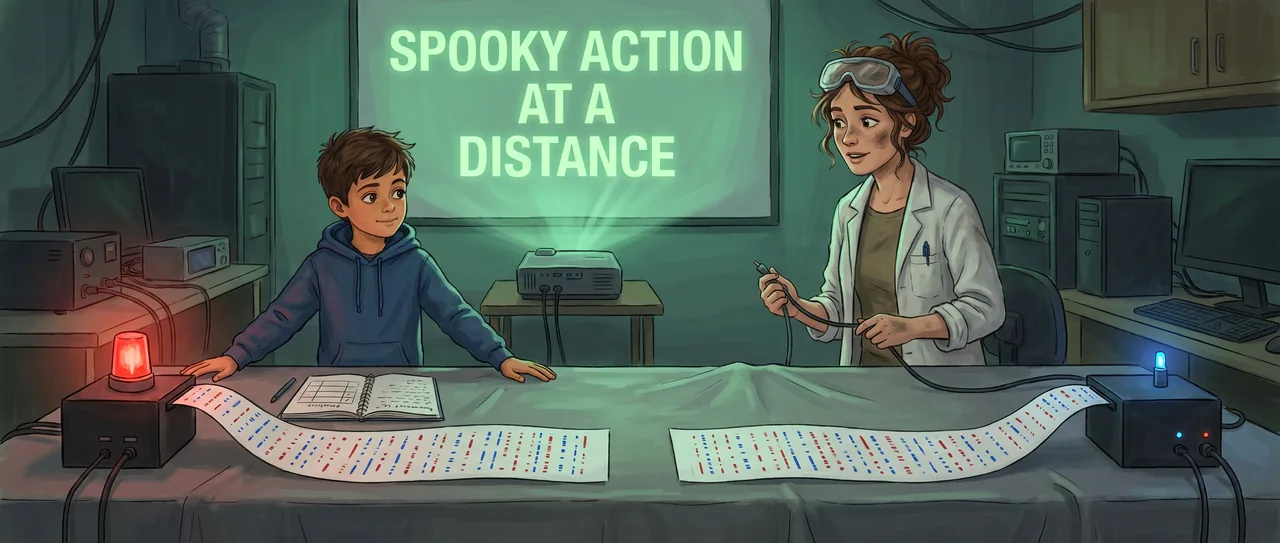
The Part That Would Not Send
The machine refused to say hello.
Soren had typed the word carefully, one letter at a time, on the left computer. The right computer sat across the lab beside a black detector box and a coil of optical fiber as wide as a bicycle wheel. Its screen filled with nonsense.
red blue blue red red red blue
Not H.
Not E.
Not anything.
The physicist came down from a stepladder with a wrench in one hand and a paper cup of coffee in the other. Her safety goggles were pushed into her hair. The lab was full of visitors, and she kept looking over Soren’s shoulder at the projector, which had frozen on a slide that said SPOOKY ACTION AT A DISTANCE in green letters.
“It isn’t a telephone,” she said.
“The poster says instantly connected,” Soren said.
“It says correlated.”
“That is a smaller word pretending to be a bigger word.”
The physicist smiled, but only halfway. The projector made a sad chirp and went black. A line of parents near the door made disappointed noises.
“Einstein would have liked you,” she said. “He hated this, too.”
“I don’t hate it. It’s just not doing the thing.”
She looked at the dead projector, the visitors, the laser warning sign, and the coffee that was trying to spill over her thumb. “It is doing the thing. The thing is just terrible on a poster.”
Then someone called, “The screen is out again,” and she hurried away.
Soren stayed by the two computers.
All week he had thought about the poster in the school hallway. Two particles, separated by any distance, could have linked states. Einstein had called it spooky action at a distance and spent years trying to prove it could not be real. Soren had drawn plans for messages that would cross space without waiting for light. He had made an alphabet out of red and blue detector clicks. He had imagined a rover on Mars answering before the question had finished leaving Earth.
Now the universe had replied with garbage.
The left detector clicked again. The right detector clicked almost at the same time. The two computers printed another pair of words.
left, blue
right, red
Soren wrote them down because not writing them down made the inside of his head feel crowded. Then he wrote down the next pair. Then the next.
Nothing spelled anything.
The black boxes were not impressive. Each was smaller than a lunchbox. The wonderful part, according to the wall labels, happened inside the covered table between them. An ultraviolet laser shone into a special crystal. Sometimes one photon went in and two photons came out, paired in a way ordinary objects were not paired. One photon went left. One went right. Each met a measuring device that asked a question about polarization.
The answer was red or blue.
The physicist came back carrying a cable. “Please tell me you haven’t opened anything.”
“I didn’t.”
“Good. The laser is not friendly to eyeballs.”
“I tried to send hello.”
“I saw.”
“It failed.”
“Yes.”
“So the particles don’t obey.”
“That depends what you think the order was.” She crawled under the projector cart. Her voice came out muffled. “Each side looks random by itself. You cannot choose the result on the left to force a message on the right. No faster-than-light texting. Nature is strict about that.”
“Then what was Einstein worried about?”
A spark popped inside the cart. The physicist bumped her head.
“Ow. He thought maybe the particles carried hidden instructions from the start. Like tiny sealed envelopes. If asked this, say red. If asked that, say blue. Sensible. Local. Not spooky.”
“Maybe they do.”
“That’s what he hoped.”
“Do they?”
The physicist slid out with dust on one cheek. “Bell found a way to check. The projector was going to make it beautiful.” She stood, saw the waiting crowd, and winced. “Raw data is ugly.”
“Ugly is okay,” Soren said.
She pointed at a gray printer under the table. “Button on the left prints the last run. Do not touch the laser. Do not let anyone touch the laser. If you solve the universe before I fix the projector, shout.”
She hurried off again.
Soren pressed the button.
The printer woke with a rattling cough. Paper slid out, covered in rows.
trial, left question, left answer, right question, right answer
The questions were not words. They were zero and one. The answers were red and blue. Soren frowned at the numbers until the lab noise thinned around him.
Each detector got one of two possible questions. The choice changed too late for a message from the other detector to help. That was printed on the label in small letters, the kind most visitors ignored because the glowing crystal was prettier.
Soren put his notebook on the floor and made a rule table.
The game, the label said, was simple.
If the questions were zero and zero, the colors should match.
If the questions were zero and one, the colors should match.
If the questions were one and zero, the colors should match.
If the questions were one and one, the colors should differ.
A hidden instruction pair would need answers ready for every possible question before the detectors asked them.
Soren tried to make one.
Left zero, red.
To win zero and zero, right zero had to be red.
To win zero and one, right one had to be red.
To win one and zero, left one had to be red.
Then came one and one. Left one and right one were both red. They were supposed to differ.
Soren stared at the four lines.
He changed the first answer to blue. The trap stayed. He switched right zero. The trap moved. He made little cards with all the possible instruction sets, red red, red blue, blue red, blue blue. Every stack lost somewhere. Not because he had made a mistake. Because the four promises bit their own tail.
A hidden instruction could win three kinds of rounds out of four. Not all four.
The printer kept breathing out paper.
Soren took the lab scissors and cut the run into strips. He did not count the first ten. Ten could lie. He counted the first hundred. Then another hundred. Then another. His finger moved down the paper, faster now.
The answers were still garbage on the left. Garbage on the right.
Together they kept winning too often.
Not always. That would have been a code, and codes could be carried in envelopes. They won in a messier way, a little over eight times in ten. The label said real Bell tests used many more trials, careful timing, and long distances, from laboratories across cities to photons sent between ground stations and satellites. Again and again, the winning climbed past the best hidden envelopes could do.
Soren’s pencil stopped halfway through a tally mark. On one side alone, there was only noise. On the other side alone, only noise. The part everyone wanted to throw away was the part that had to be kept.
The physicist returned with a new cable over her shoulder. “Any luck?”
Soren held up the notebook, then shook his head and held up the printout instead.
She leaned over the strips. Her eyebrows lifted.
“You counted by hand?”
“The screen was broken.”
“The screen is decorative.”
“It said hello wrong.”
“It will always say hello wrong.”
“I know.”
The physicist looked at him more carefully than before. Around them, the visitors had drifted toward the robotics table, where a small wheeled rover was politely bumping into chair legs.
Soren tapped the four promise lines in his notebook. “If the answers were packed in before, they cannot keep all four promises. But the photons keep more than three.”
“Not every time,” she said.
“If it were every time, it would be less strange.”
The physicist’s mouth opened. Then she closed it.
The projector suddenly flashed back to life behind her. The green words returned to the wall, enormous and bright.
Soren looked at them. SPOOKY ACTION AT A DISTANCE.
“That sounds like a ghost story,” he said.
“It is a measurement story,” the physicist said.
“That is worse.”
This time she laughed properly.
She turned toward the visitors and raised her voice. “Projector is optional. We have the raw universe over here.”
People began to come back. A few at first. Then more.
Soren did not move away from the table. He lined up the cut strips so the left answers and right answers faced each other across a narrow gap. The latest run started printing beside his elbow.
Soren laid his palms on the two ends of the table, one near each black box. The laser hummed inside its cover. On the left, a red lamp flashed. Across the room, the right detector clicked, and the tiny blue lamp blinked.
Read the interactive version, listen to the narration, and earn a gold star →
A science-verified short story for curious kids · Curiosity Land