The Number That Wouldn't Stay Put
By four o'clock, Maya had banned every circle from Room Twelve.
She took down the paper planets. She covered the round clock with a square of cardboard. She made Soren trade the roll of tape for a box of square labels, because the inside of the tape roll was a circle and that felt like cheating.
Soren stood in the middle of the room with his paper notebook open against his chest.
"The trash can is round," he said.
Maya pointed to the hall.
Soren carried it out.
Ms. Vale came in backward, balancing two trays of little fruit pies shaped like suns. She had flour on one elbow and a pencil in her hair.
"Wonderful," she said. "So clean. So severe. Where are your circles?"
"Gone," Maya said.
"For Pi Night?"
"Especially for Pi Night."
Ms. Vale looked at the covered clock, the square labels, the pendulum clamp on the ceiling, and Soren's three jars of number cards. Her smile became the smile adults used when they were trying not to rearrange you.
"Parents like a hook," she said. "Circles are a hook. Pies are a hook."
"Hooks are curved," Maya said.
Soren added, "We are testing whether pi behaves when circles are removed."
Ms. Vale blinked once. From the cafeteria, someone shouted that the whipped cream had collapsed.
"You have until the doors open," she said. "If people look confused, I am bringing in the pies."
She left with both trays, muttering, "No circles at Pi Night. Of course."
Soren crossed out three words in his notebook. He did not close it.
"First station," Maya said.
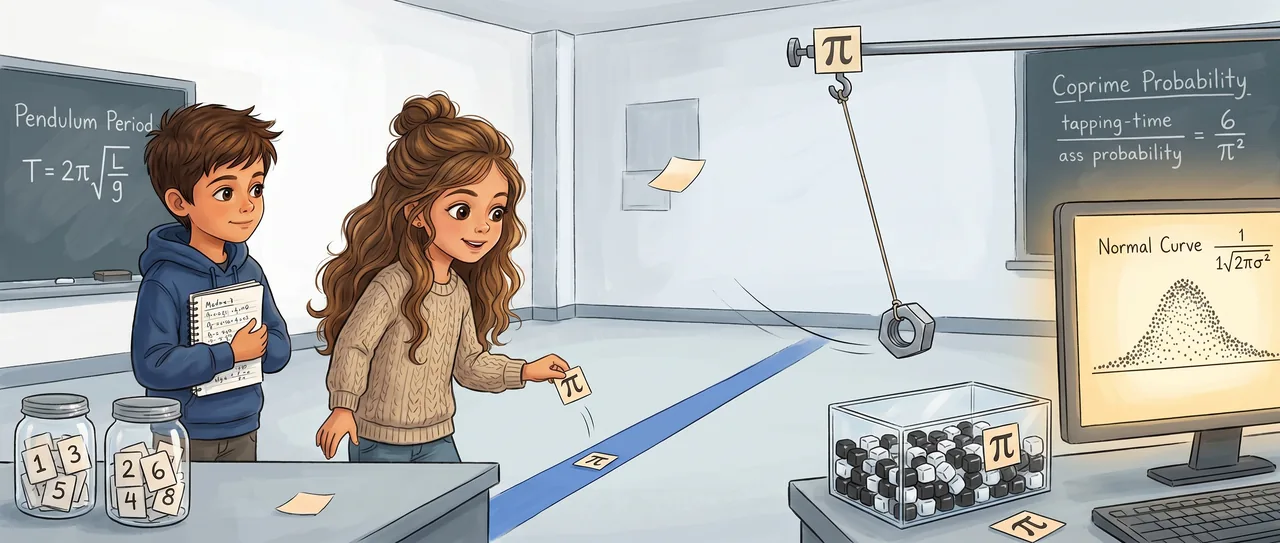
The first station was supposed to be a pendulum. Soren had rejected the metal washer because it had a hole in it. He had rejected a fishing weight because it was too round. He had finally tied the string around a hexagonal steel nut from the maintenance closet.
It hung from the ceiling clamp, still and serious.
Maya looked at it.
"No circles," she said.
"Mostly," Soren said. "The nut has corners. The string is straight. The swing path is an arc, but we are not drawing it."
"Don’t draw it."
"I won’t."
He measured from the clamp to the center of the nut. A little less than one meter. He adjusted the knot, measured again, and tugged it tight.
Maya set a digital metronome on a square stool. It clicked once each second.
"Try it," Soren said.
Maya pulled the nut a small distance to one side and let go.
The pendulum crossed the strip of blue tape on the floor.
Click.
It reached the other side, came back, crossed again.
Click.
Soren's mouth opened slightly. He made a mark in his notebook.
"The back-and-forth time is about two seconds," he said. "For small swings. Like the formula said."
"Say the bad part," Maya said.
"Two pi times the square root of length divided by gravity."
The nut swung through empty air.
Click.
Maya did not touch it. The room had been scrubbed clean of circles, and still the circle number was keeping time from the ceiling.
Click.
"Second station," she said quickly.
The second station had two jars. Each jar held square cards with numbers from one to one hundred. The rule was simple. Pick one card from each jar. If the two numbers shared no factor bigger than one, drop a white bead in the clear box. If they did share a factor, drop a black bead.
"Coprime," Soren said, placing the sign carefully. "Co means together. Prime here means no shared factor except one."
"Like thirty-five and forty-eight," Maya said. "No common factor."
"Like twelve and eighteen, not coprime. They share six. Also three. Also two."
"Crowded numbers," Maya said.
Soren gave her a look, then nodded because it was not wrong.
They tested ten pairs. Then twenty. The white beads began to outnumber the black beads, but not by too much.
Soren had made another sign:
For very large random positive integers, the chance of being coprime is six over pi squared.
Maya stared at it longer than she meant to.
"No swinging," she said.
"No measuring round things," Soren said.
"Just numbers bumping into numbers."
"And not bumping," Soren said. "Mostly not sharing."
Maya picked two cards. Seventeen and sixty-four. She smiled and dropped a white bead.
The bead struck the others with a clean glass tick.
By five o'clock, the third station was a mess.
It was supposed to be the easiest one. People would listen to a beep, try to tap a key exactly one second later, and the computer would mark how early or late they were. Lots of tiny human misses would pile into a hill, high in the middle and low on both ends.
But the first graph looked like a porcupine.
"Too few taps," Soren said.
Maya watched the dots spread across the screen. Some early. Some late. Some very late, from when Soren sneezed and missed the key entirely.
"We need more mistakes," Maya said.
Soren looked offended for half a second, then wrote it down.
They ran it again. Maya tapped. Soren tapped. Maya used her left hand. Soren closed one eye. They tapped while facing away from the screen. They tapped while saying the alphabet. They tapped until the dots thickened into a mound with ragged shoulders.
Soren taped the formula beside it, written in words because Maya said symbols made parents flee.
A normal curve includes one over the square root of two pi.
"Only if the errors act like lots of small independent things added together," he said.
"Fine. Put that. Smaller."
He put it smaller.
Maya backed up until all three stations fit into her eyes at once.
A nut on a string, counting time.
Pairs of numbers, deciding whether they shared anything.
Mistakes, piling into a hill.
The cardboard over the clock slipped on one corner. Soren reached up and fixed it before the round face could show.
The door opened.
Families came in with paper programs and crumbs on their sleeves. A little kid pointed at the pendulum and said, "That is not pie."
"Correct," Maya said.
A tall student from the robotics club read the first sign and laughed.
"Pi without circles?" he asked.
"We tried to make it leave," Soren said.
Maya pulled the hex nut aside.
"Small swing," Soren warned.
"Small swing," she said, and let go.
Click.
The nut crossed the tape.
Click.
A parent leaned closer to the formula. "That pi is from circles, though, right? Somewhere underneath?"
Soren considered this in the serious way he considered every trap.
"Sometimes underneath is very far underneath," he said.
At the jars, the little kid drew forty-nine and fifty. Maya crouched beside him.
"Do they share anything bigger than one?"
He whispered the multiplication table under his breath. "No."
"White bead."
He dropped it in.
Tick.
"Why does pi care?" he asked.
Maya looked at Soren.
Soren looked at the beads, the swinging nut, the lumpy graph of mistakes.
"We don’t know how to say all of it yet," he said.
Maya grinned. "But it keeps showing up."
More people came. Someone made a pair of ninety-one and one hundred. Someone else tapped the key so late the dot landed far out on the edge of the graph, and everyone laughed except Soren, who said, "No, keep it. Tails matter."
Ms. Vale appeared in the doorway with a tray of pies. She watched the pendulum for three clicks. She watched a grandmother and a kindergartener argue cheerfully over whether twenty-seven and thirty-two shared a factor. She watched Maya explain that a pile of mistakes could have a shape. The tall robotics student came back with two friends. One of them had written the pendulum formula on her palm. The little kid took a square label from the table and drew pi on it, shaky and large.
"Where do I put it?" he asked.
Maya handed him the sheet of labels.
"Not on a circle," she said.
He stuck one on the pendulum clamp. Another on the bead box. Another beside the ragged bell of tapping errors.
Then he looked out into the hallway, where the pies waited on their tray, and beyond them the lockers stood in two long rows.
"Is it out there too?" he asked.
Soren did not write anything down.
Maya peeled one square pi sticker from the sheet. She held it above the hallway floor, lowered it, raised it again, and left it hovering in the air.
Read the interactive version, listen to the narration, and earn a gold star →
A science-verified short story for curious kids · Curiosity Land