The Long Runway
The choice machine was losing to a room full of eleven-year-olds.
That was what the tall screen looked like to Soren, anyway. On one side it said LEFT. On the other it said RIGHT. Between them, a blue bar wobbled like it could not make up its mind.
A boy in the chair pressed the right-hand button and shouted, "Ha!"
The screen had guessed left.
Dr. Imani laughed too loudly. She wore yellow shoes and had a pencil stuck sideways in her hair, as if she had put it there during one thought and walked away into another.
"Again," she said. "The brain is noisy. Science is patient. Visitors, sadly, are not. Next volunteer. Quickly, please. The scanner room is booked after lunch."
Soren stood at the back with his paper notebook held against his chest. Several people had already looked at it like he had brought a sandwich made of leaves. The lab had glass walls, smooth tablets, ceiling lights like flat moons, and a machine that could watch blood move through a brain. Soren had brought lined paper and a pencil.
He wrote: If the test is about deciding whenever, why is everyone waiting for everyone to watch?
Dr. Imani clapped once. "Who wants to defeat the machine?"
Every hand went up except Soren's.
He looked at the screen. The blue bar was not truly wrong. It was unsure. It had leaned left, then right, then left again while the boy grinned at it, holding both thumbs stiff above the buttons.
"It is not a defeating machine," Soren said.
Dr. Imani turned. "What was that?"
Soren wished his voice had stayed inside his mouth, where it had been safe.
He said, "You told them to beat it. So they are choosing against it, not choosing."
A few people looked at him. The boy in the chair said, "That is still choosing."
"Maybe," Soren said. "But it is choosing with an audience attached."
Dr. Imani blinked. Then she pulled the pencil from her hair and pointed it at him.
"You," she said. "Notebook. Come here."
Soren came.
Up close, the screen had more than LEFT and RIGHT. It had little gray waves, a clock face with a dot sweeping around it, and a row of marks where volunteers had said they first felt the decision arrive.
"This is not mind reading," Dr. Imani said, talking fast now. "No thoughts, no secrets, no favorite sandwich fillings. The task is tiny. Press left or right whenever you feel like it. Afterward, tell us where the dot was when you first became aware of deciding. In some experiments, patterns in brain activity predict a simple movement several seconds before people report the decision. Sometimes almost ten seconds. Not perfectly. Better than guessing. That is the important part. Better than guessing."
"Then you put the prediction on a giant screen," Soren said.
Dr. Imani looked at the giant screen.
"Ah," she said.
The pencil went back into her hair, eraser first.
"How would you fix my terrible public demonstration, Notebook?"
Soren did not like being called Notebook. He liked even less that he had an answer.
"Turn the screen around," he said. "Do not tell me when a trial starts, except at the beginning. Do not ask me to be random. Let me watch the dot."
"Anything else?"
"No cheering."
Dr. Imani looked through the glass at the waiting visitors. One of them was making claws at a rubber brain model.
"That may be the hardest condition," she said.
The scanner was in the next room, white and round with a bed that slid into its middle. Soren had to remove his belt, his shoes, and the pencil from his pocket. Dr. Imani checked twice for metal and once for panic.
"You can stop at any time," she said. "The machine is loud, but it is not angry. It is just very, very expensive."
"I am not afraid of loud," Soren said.
This was mostly true.
They put soft plugs in his ears and pads beside his head so he would not move. A mirror above his eyes showed a screen. On the screen, a pale dot moved around a circle, again and again, steady as a second hand.
In his left hand was a button. In his right hand was another button.
Dr. Imani's voice came through the speaker, flattened by electronics.
"Remember. When you feel the urge, press either button. Afterward, move the dot back to where it was when you first knew. Ready?"
Soren almost said, Ready for what kind of ready?
Instead he said, "Ready."
The scanner began.
It knocked and thumped and hammered in patterns that were almost music until they were not. The dot went around. Soren held his thumbs still.
Left, he thought.
No. That was planning.
Right, then.
No. That was planning against planning.
The dot went around again.
His nose itched.
He thought about not thinking, which was worse than thinking. His left thumb floated above its button like a guilty insect.
The dot passed the top. It passed the side. It passed the bottom.
His right thumb pressed.
The click was tiny inside the thunder.
The screen asked him to place the dot where he had first known. Soren moved it back, not to the click, but to the strange small before-click, the place where the rightness of right had appeared without words.
They did it again.
Sometimes nothing happened for so long that Soren wondered if he had used up all his decisions. Sometimes a thumb moved before he caught the urge properly, and he had to chase the feeling backward. Once he laughed, and the pads held his head still while the scanner banged on, completely unimpressed.
After a while, he stopped trying to be a fair test. He watched the dot. He let the buttons be there.
Left.
Right.
Right.
Left.
Each one arrived like a bubble reaching the surface of a pond.
When the bed slid out, the room felt too still. Dr. Imani helped him sit up, but she did not say anything wise. She was staring through the glass at her computer with the look of a person who had lost her keys and found a doorway.
"Come see," she said.
Soren put his shoes back on without tying them.
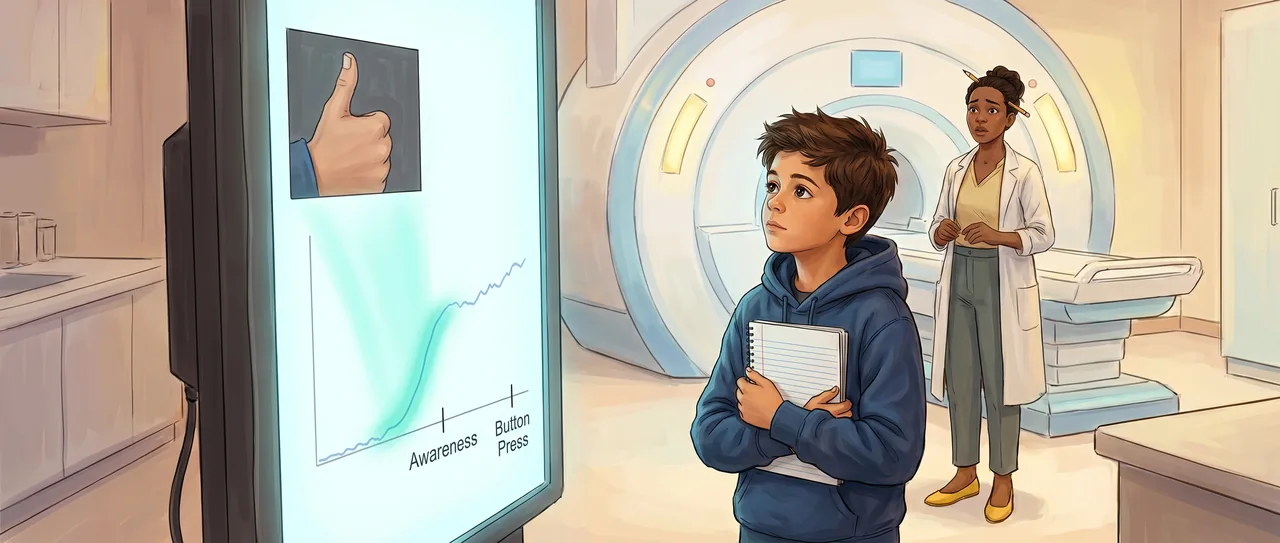
The visitors crowded behind a tape line while Dr. Imani opened the replay. The giant screen no longer showed a game. It showed Soren's trials as thin trails of color. A small video box showed his hands lying still with the button pads. Under it were tick marks: reported awareness, button press.
"This is the classifier," Dr. Imani said. "It was trained to look for patterns. It is not certain. It leans. Watch the lean."
On the first trial, the blue line wandered. It rose toward RIGHT, fell, rose again, then crossed a faint mark.
"That mark is when you said you first knew," Dr. Imani said.
The line had started rising before the mark.
Not a little before.
Soren counted silently along the time scale.
One second. Two. Three. Four. Five. Six.
In the video box, his right thumb lay flat and still.
"That cannot be the decision," he said.
Dr. Imani did not answer quickly. Soren liked that.
"It may be part of the preparation," she said. "It may be a bias forming. It may be the brain getting ready before the story of deciding reaches speech. Different experiments measure it different ways. The mystery is not finished."
The second trial leaned left early and was wrong. The third leaned right and was right. The fourth stayed muddled until almost the press. The fifth began to tilt so early that a small sound moved through the visitors, not quite a gasp.
The boy who had shouted at the machine earlier said, "I thought when I pick, I just pick."
Soren watched the colored line crawl before his own hand moved.
"Maybe picking has a runway," he said.
The boy did not laugh.
Dr. Imani ran the summary. Not perfect. Not magic. But better than guessing. Enough better that the room became quiet in a new way.
Soren thought of all the times someone had said, just choose, as if choosing were a coin dropping through empty air. He looked at the traces on the screen. They did not look like coins. Dr. Imani rubbed her forehead, leaving a gray smudge from the pencil.
"Your condition helped," she said. "No audience. No contest. Less performance. Better science."
"Can it predict if I decide to decide early?" Soren asked.
Dr. Imani opened her mouth.
Closed it.
The pencil fell out of her hair and bounced once on the floor.
"That," she said, "is a very annoying question."
Soren smiled.
"Good annoying or bad annoying?"
"Grant proposal annoying," she said.
The visitors laughed, but Soren kept looking at the screen. One trace had begun to bend almost ten seconds before the button press. At the far left of the graph, before the report, before the click, before the part he could point to, the line was already lifting.
"Could I try one more?" he asked.
Dr. Imani looked at the clock on the wall. Then she looked at the empty scanner room. Then she turned the giant screen away from the visitors.
"One," she said.
Soren put his right thumb on the button again.
On the monitor behind the glass, a pale line began to climb.
Read the interactive version, listen to the narration, and earn a gold star →
A science-verified short story for curious kids · Curiosity Land