The Line That Laughed Back
Soren had a private theory that laughter was a leak.
Other people seemed to laugh on purpose, bright and round, like bells. Soren's laugh escaped in parts. First a squeak. Then a cough. Then one high note that sounded like a crow discovering a window.
At school, when something was funny, he pressed his lips together until the funny thing turned sharp inside him. If the laugh got out anyway, heads turned. Someone always laughed again, not with him exactly. Near him.
So in his notebook, under Things Bodies Do Without Asking, he had written: Laughter is steam from a cracked pipe.
The human biology museum had an exhibit called Before Words. The class guide wore orange glasses and walked as if every floor tile had an appointment.
"We are already six minutes behind," she said. "You may touch the touchable things, not the glass things, and if you must giggle, do it while moving. The lunch room will not wait for us."
Soren stopped at the first wall.
There were photographs of chimpanzees with open mouths, babies laughing before they could talk, and two adults in a scanner with lines of color crossing their heads.
The label said: Laughter is older than words. It uses breath, voice, face, and body. When people hear laughter, parts of their brains can fall into rhythm with the laugher's brain. Scientists think laughter helped groups signal safety and belonging before human language.
Soren read it twice.
A leak did not need a museum wall.
"No lingering," the guide called. "This next station is quick. Mostly for fun."
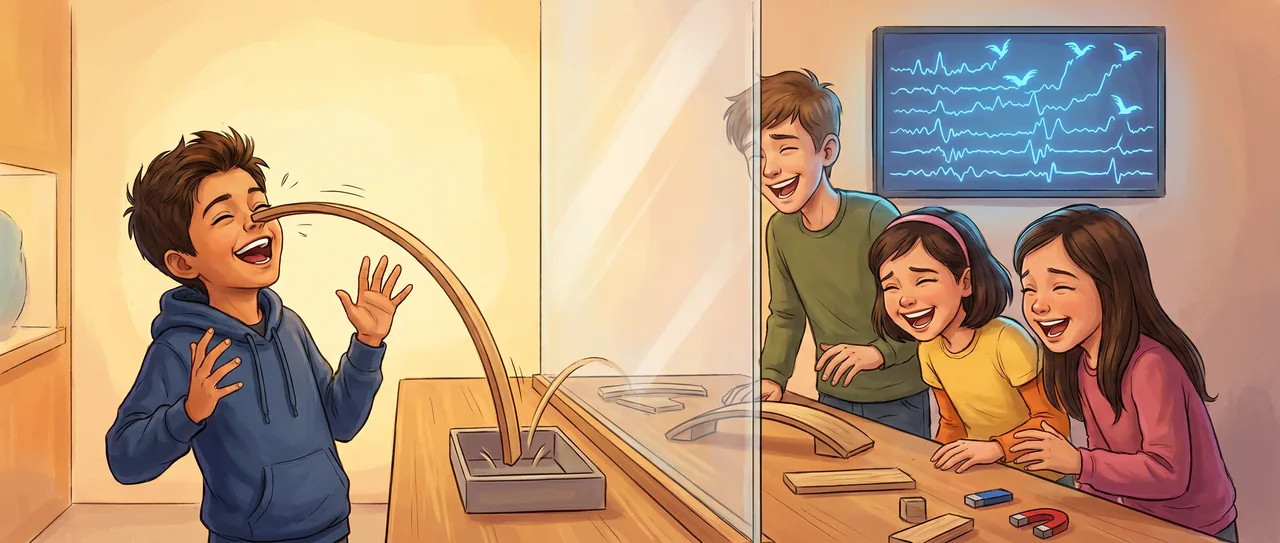
The next station was shaped like two half-rooms with a clear wall between them. A sign above it said: Build Without Words.
Soren was put on one side with a bin of soft blocks, magnets, and bent rods. On the other side, three classmates had the matching pieces. The goal was to build two halves of the same bridge so the magnets would meet through the clear wall. No speaking. No writing. No drawing. Only faces, hands, and sounds that were not words.
"The point," said the guide, checking her tablet, "is that human cooperation did not begin with sentences. Begin when the green light comes on."
She handed Soren a stretchy headband with a small sensor at the forehead. The others put theirs on too. A screen above the clear wall filled with thin blue lines.
"Not medical equipment," the guide said quickly. "Not thought-reading. Just a simple activity display. Please do not lick the sensors."
The green light came on.
Everyone froze.
Soren picked up a curved rod and pointed to the matching rod on the other side. The tallest kid held up a square block.
Soren shook his head.
The tallest kid shrugged with his whole body and attached the square block to the wrong place.
Soren made a flat hand for stop. The girl across the wall thought he meant press down, so she pressed down. A magnet snapped sideways and stuck to the wall with a loud clack.
The blue lines on the screen jittered separately, like worms in different puddles.
Soren's face got hot under the headband. He pointed to the rod again, then to his own eye, then to the rod, then to the place it belonged.
The boy across from him pointed to his own eye and made a circle around it, asking, What is wrong with your eye?
Soren almost said, No, not my eye, the rod.
The red light flashed. A soft museum voice said, "Words detected. Please begin again."
"I did not say anything," Soren said.
The red light flashed harder.
The guide sighed. "Everyone step back. We can skip this one. It gets silly."
But Soren was looking at the sign on the side of the station. It showed an infant, mouth wide, eyes squeezed shut. Beside the baby was a diagram of breath pulsing out in bursts.
He put the curved rod on top of his head like antlers.
Across the clear wall, the tallest kid stared.
Soren lifted both hands slowly, wiggled his fingers, and crossed his eyes.
Nothing.
He lowered the rod. It slipped from his hair, bounced off his nose, and landed in the bin with a soft plastic bonk.
Pain sparked in his eyes.
Then the laugh got out.
It came exactly wrong. Squeak. Cough. Crow.
The girl on the other side slapped both hands over her mouth. Her shoulders jumped. The tallest kid bent in half. Another laugh burst through the wall speaker, lower than Soren's and breathier, and then another.
The blue lines on the screen rose together.
Not perfectly. Not like copies. More like several birds startled from different branches at the same time.
Soren touched his nose. It had stopped stinging so much. His cheeks hurt instead, but in a good way, as if small muscles had woken up there and were pleased to be useful.
The guide looked up from her tablet.
"Nonverbal sounds are allowed," she said, surprised. "Technically."
Soren picked up the curved rod again. He did not try to make his hands explain everything. He pointed to the wrong square block and let out one tiny breath of a laugh, not mocking, just warm at the edges.
The tallest kid pulled the square block off and grinned.
Soren pointed to the curve. Across the wall, the girl lifted her matching curve.
He nodded hard.
She placed it correctly.
The screen's blue lines dipped, then lifted again when the others laughed in relief.
Now the station was not quiet, but it had no words. A wrong piece got a small puff of laughter and a shake of the head. A right piece got a grin, a clap, and sometimes a laugh that made everyone move faster instead of messier.
Soren's body seemed to know before his plan did. When the group tightened up, his shoulders rose, and the bridge got worse. When somebody laughed, hands loosened. Faces opened. The next gesture landed.
The second magnet clicked through the clear wall.
Then the third.
The two halves of the bridge held.
The green light flashed all around the booth.
From the ceiling, the museum voice said, "Cooperation complete."
The class made the kind of noise a class makes when it has been told not to make noise and has found a legal loophole.
The guide hurried over, orange glasses crooked. "That was actually very good timing," she said. "Your group corrected faster after shared laughter. I should tell the education coordinator. We usually present this as a warm-up."
Soren looked past her at the screen.
A replay had begun. The blue lines crawled from left to right, separate at first. Then the rod bounced, his mouth opened on the small video, and the lines lifted together.
The guide kept talking about schedules and lunch and how the next group needed the headbands.
Soren took his off carefully. His hair crackled with static.
At the exit of the exhibit was a small booth with a curtain. The sign said: Leave a Laugh. Visitors could record a laugh for the next person to hear while their own headband showed how their body answered.
Soren stood outside it while the class moved toward lunch. The guide counted heads, lost count, and began again.
Inside the booth, a speaker played a stranger's laugh. It was wheezy and unstoppable. Not bell-shaped at all.
Soren's ribs answered before his mouth did.
The guide called, "Last chance, then lunch."
Soren stepped into the booth and pulled the curtain behind him.
He put his mouth near the little silver grille and pressed Record. His laugh came out in three pieces, squeak, cough, crow. From the next booth, where he could not see the child behind the curtain, a laugh answered. On the screen, two blue lines lifted at the same time.
Read the interactive version, listen to the narration, and earn a gold star →
A science-verified short story for curious kids · Curiosity Land