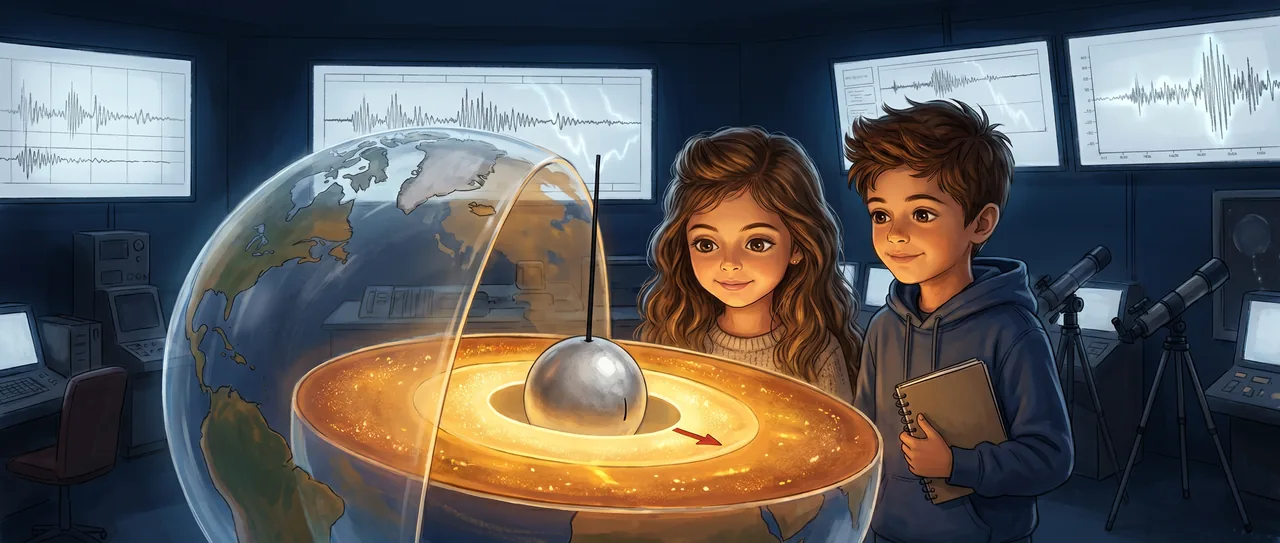
The Four-Hundred-Year Turn
The Earth model was misbehaving in the middle of the lobby.
It was taller than Maya, clear as a soap bubble, with painted continents on the outside and glowing layers nested inside. The crust and mantle turned together. The liquid outer core shimmered amber. At the center, a silver ball no bigger than a grapefruit sat on a thin black spindle.
Every time the model finished its four-minute show, the silver ball pointed the wrong way.
Dr. Rook stood with one hand in her hair and the other holding a half-eaten sandwich. “It is not wrong,” Soren said.
Dr. Rook looked at him over her glasses. “It is wrong for a lobby full of eight-year-olds and donors with name tags. The arrow should end where it began.”
“But the label says four hundred years,” Soren said.
“The label can be changed,” said Dr. Rook. “The motor cannot. I have three news cameras coming in twenty minutes, a printer jammed in the archive, and a volcano cake melting in the staff refrigerator. Please make the little center behave.”
She hurried away before Maya could answer.
Maya crouched by the model’s control box. “It’s behaving.”
Soren opened his notebook, not to write at the end of anything, only because his hands needed somewhere to put the problem. “At the start, the red arrow on the surface and the tiny mark on the inner core line up. At the end, the inner one is ahead by one turn.”
“One extra turn,” Maya said. “In four hundred years.”
“That is what the card says.”
The card had been taped to the base crookedly.
DEEP EARTH: The inner core is a solid iron-nickel sphere inside a liquid outer core. Seismic waves showed its existence in nineteen thirty-six. It rotates slightly faster than the surface, gaining about one extra turn every four hundred years.
Below that, someone had written in pencil, Too much for visitors?
Maya touched the pencil words. “Someone got scared of the truth.”
Soren looked through the transparent Earth. The silver center was still, waiting. “Maybe the model was built to tell the truth, and Dr. Rook wants it to tell the easy version.”
The lobby around them filled with the sounds of opening night. A child asked if earthquakes had bones. Someone dropped a stack of paper cups. The big wall screens showed live seismograms, patient black lines moving across white grids.
Maya pressed the green test button.
The model woke.
The outside Earth turned smoothly. Continents slid past, Africa, ocean, South America, ocean. The amber outer core glittered. Deep inside, the silver ball began turning too, almost with the rest, but not quite.
Soren leaned close. “It is barely faster.”
“Barely,” Maya said. “And still it wins.”
They watched four hundred model years pass in four minutes. Near the end, the surface arrow returned to the front. The inner mark returned too, then continued, just enough to become impossible to ignore.
Click.
The show ended with the two arrows aligned again, except the silver ball had made one more complete rotation than the world around it.
Soren shut his notebook. “That is not a slipped gear. That is the point.”
Maya was already moving.
Behind the model, a service panel hung open. Inside were neat wires, a small motor, and a brass dial marked SYNC. Someone had turned it halfway toward LOCK.
“Don’t,” Soren said.
“I’m not breaking it.”
“That is what you said about the planetarium chair.”
“That chair was already weak.”
“It was bolted to concrete.”
Maya turned the brass dial away from LOCK until it clicked into RUN TRUE.
The model gave a low hum, like a throat clearing.
From the archive doorway, Dr. Rook called, “Please tell me that was the printer.”
“It was honesty,” Maya called back.
Dr. Rook appeared, carrying a cardboard box of old seismograph rolls. Her glasses had slid down her nose. “Honesty is excellent after the donors leave.”
Soren lifted the crooked card from the base. “Who wrote this?”
Dr. Rook glanced at it. Something in her face changed, but only for a second. “Old exhibit designer. Retired. Very precise. Terrible at budgets.”
“The pencil part,” Soren said.
“I did.”
Maya looked at her.
Dr. Rook sighed. “People like the crust. Volcanoes. Plates. Things with edges. The inner core is under five thousand kilometers of rock, hotter than the surface of the Sun, crushed solid by pressure, and no one has ever seen it. We know it from waves. That is a hard sell with cupcakes.”
Soren’s eyes went to the cardboard box. “Are those the waves?”
“These are copies,” Dr. Rook said. “Old paper records. Some are from lessons about Inge Lehmann.”
Maya was already lifting the lid.
“Maya,” said Dr. Rook.
“I’m only seeing.”
“That is usually the first step before touching.”
Soren took one roll carefully. The paper smelled like dust and metal shelves. Across it ran many black wiggles, some tall, some faint, some arriving where the printed teaching labels said they should not.
Dr. Rook set the box down. “Before nineteen thirty-six, scientists knew about the liquid outer core because some earthquake waves would not pass through it the same way. There was a shadow. Then Lehmann studied waves from big earthquakes and found faint arrivals inside that shadow. Something deep was bending waves back.”
Maya put one finger beside a tiny wiggle almost lost between larger marks. “This one?”
“That kind,” Dr. Rook said.
Soren stared at the little wrong arrival.
“If this were in my math homework,” he said, “someone would tell me to erase it.”
Maya did not look away from the paper. “Good thing she didn’t.”
The lobby noise thinned around them. The silver ball in the model caught the ceiling lights and held them in a bright dot. Five thousand kilometers down, under every shoe and chair and city bus and soccer field, there was a metal sphere turning ahead by the smallest stubborn amount.
Maya stood so quickly the seismograph paper curled against her arm. “The show shouldn’t end with the arrows lined up.”
“It does,” Soren said. “After four hundred years.”
“No. That makes it look finished.”
Soren looked at the model. Then at the card. Then at the wall screen with its live black lines. “Start it at nineteen thirty-six.”
Maya smiled.
Dr. Rook blinked. “What?”
“The year scientists confirmed the inner core,” Soren said. “Run the model from nineteen thirty-six to now. Not four hundred years. Then the inner core mark will be partway ahead. Not a full turn. Still moving.”
Maya was already at the controls. “What year is the model set for?”
Dr. Rook came closer despite herself. “The small dial on the left scales years. If you set it to eighty-nine years, it will show the extra rotation since nineteen thirty-six. Roughly. The exhibit motor is calibrated for one extra turn in four hundred years.”
Soren did the division under his breath. “Eighty-nine out of four hundred. A little less than a quarter turn.”
Maya set the dial.
Dr. Rook looked toward the glass doors. Visitors were gathering. The news cameras had arrived. A small child was pressing both hands to the earthquake-proof display case.
“We cannot explain all of that in one minute,” Dr. Rook said.
“Don’t explain it,” Maya said. “Let it be weird first.”
Dr. Rook opened her mouth. Closed it. Then she took the pencil from behind her ear and crossed out Too much for visitors?
The lobby lights dimmed.
People turned toward the clear Earth.
Dr. Rook stepped forward with her microphone. “Tonight,” she said, “we are not going to begin with the part of Earth we stand on. We are going to begin with the part no human eye has seen.”
Maya pressed the green button.
The model started in nineteen thirty-six. The outer Earth turned. The amber layer glowed. The silver inner core moved with them, almost together, almost ordinary.
On the wall behind it, old seismic waves appeared beside the live ones. The faint marks in the shadow zone shivered in black ink. Dr. Rook said Inge Lehmann’s name. Soren watched the silver mark creep ahead, not fast enough for anyone impatient, not slow enough to be still.
A boy near the front whispered, “Why doesn’t the middle match?”
No one answered right away.
Maya grinned at Soren as if the question had been a bell.
The show reached the present. The surface arrow stopped at the front. The inner core mark stopped ahead of it, a bright silver scar a little less than a quarter turn away.
For a moment the whole lobby was quiet.
Then the live seismograph screen chirped.
Dr. Rook turned. “Small earthquake,” she said. “Far away. The first waves are reaching us now.”
Soren set his palm flat on the polished stone floor. Beside him, Maya did the same. On the wall, the new black line lifted into the blank white space.
Read the interactive version, listen to the narration, and earn a gold star →
A science-verified short story for curious kids · Curiosity Land