The Column That Changed Its Mind
The noble gases had the best room in the museum.
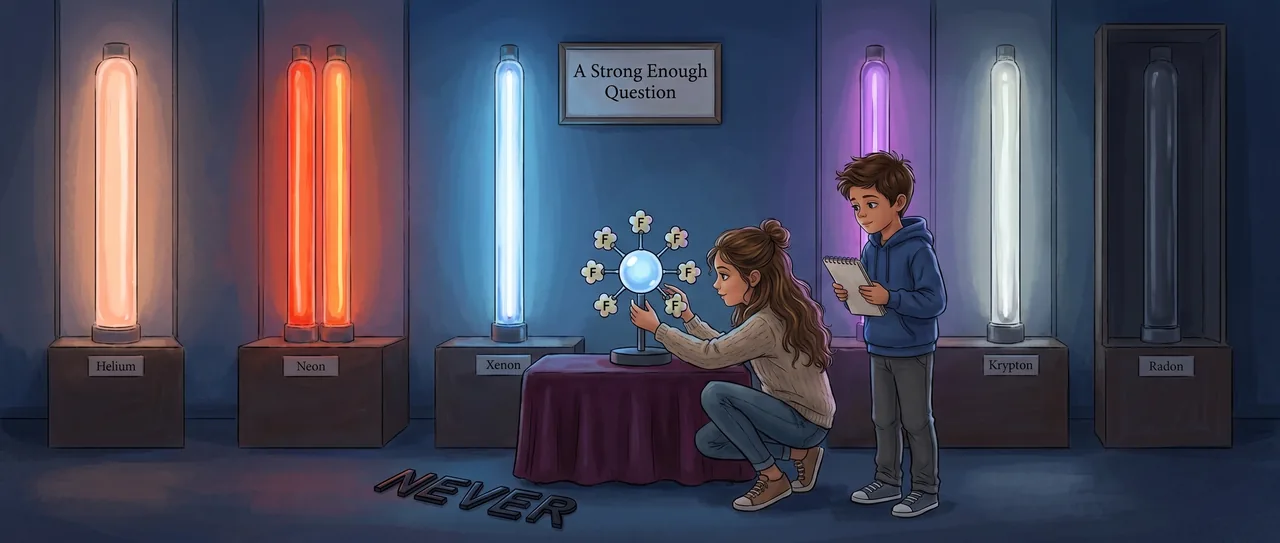
They stood in six glass tubes taller than Maya, each sealed and labeled in black letters. Helium. Neon. Argon. Krypton. Xenon. Radon, represented by an empty lead-lined case because nobody sensible put radon in a children’s exhibit.
When the tubes lit, they did not look noble. They looked like secrets.
Neon burned red-orange. Argon was lavender. Krypton shone pale and ghostly. Xenon flashed blue-white, like lightning had been folded into a bottle and told to behave.
Above them hung the title of the exhibit.
THE ELEMENTS THAT NEVER REACT.
Maya stopped walking.
“No,” she said.
Soren, who had been counting the tubes because the radon case bothered him, looked up. “No what?”
“That word.”
Dr. Vela, the exhibit designer, came around the corner with three rolls of tape hanging from one wrist. Her hair was pinned up with two pencils and one small screwdriver. “Please do not say the word is crooked. The word is definitely crooked, but I have chosen not to know that until tomorrow.”
“Never,” Maya said.
Dr. Vela squinted at the sign. “It’s a strong word. Donors enjoy strong words.”
“It’s wrong,” Maya said.
Soren had already moved to the side display. He read the smaller labels under his breath. “Full outer electron shells. Very stable. Colorless gases at room temperature. Low boiling points. Used in lights, balloons, lasers...”
“See?” Dr. Vela said. “They keep to themselves. Chemists used to call them inert.”
“Used to,” Soren said.
Maya pointed past the glowing tubes to the last pedestal in the room. It had no object yet, only a blank square of velvet and a printed card waiting in a plastic sleeve.
The card said: IN NINETEEN SIXTY-TWO, NEIL BARTLETT MADE A XENON COMPOUND.
Dr. Vela closed her eyes.
“I knew there was a problem in this corner,” she said. “I could feel it making paperwork.”
The museum opened the next morning. The chemistry hall still smelled like fresh paint and warm wiring. Dr. Vela had fourteen other problems, including a solar system mobile with Saturn hanging where Mars belonged.
“I need one title,” she said. “One. Short enough for the glass. True enough that no chemist writes me a letter. Interesting enough that people don’t walk past.”
“Not never,” Maya said.
“Almost never,” Soren said.
Dr. Vela made a face. “Almost Never React is accurate and terrible.”
Maya looked at xenon’s blue-white glow. “What changed?”
“The xenon didn’t change,” Soren said. “We did.”
Dr. Vela stared at him.
“I mean chemistry did,” he said. “Probably.”
Dr. Vela handed them a box of magnetic words, atom models, and old label drafts. “You have twenty minutes. If you save me from a furious professor, I will name a storage closet after you.”
She hurried away, calling, “Do not open anything with a hazard sticker.”
There were many hazard stickers.
Maya dumped the magnetic words onto the floor. Noble. Inert. Rare. Stable. Unreactive. Fluorine. Xenon. Platinum. Surprise.
Soren took out his paper notebook.
“You’re really doing that here?” Maya asked.
“The tables in my head get crowded.”
He drew two columns. On one side he wrote OXYGEN. On the other he wrote XENON.
Maya watched him write numbers from a reference card on the wall.
“Oxygen molecule, ionization energy, about twelve point two electron volts,” Soren said. “Xenon atom, about twelve point one.”
Maya tapped the pencil. “Those are almost the same.”
“That’s what Bartlett noticed.”
On the old label drafts was a black-and-white photo of a man in a lab coat holding a glass apparatus. Beside it was a picture of a small pile of yellow-orange solid.
The caption said that platinum hexafluoride was so good at taking electrons that it had taken one from oxygen. Bartlett knew xenon held its outer electrons only a little more tightly than oxygen did. So he tried xenon.
Maya picked up the xenon magnet.
“They said it wouldn’t,” she said.
“They said it couldn’t,” Soren said.
The difference sat there between them, smaller than a word and sharper than glass.
Maya placed xenon beside the magnet labeled PLATINUM HEXAFLUORIDE. The magnets snapped together too hard and pinched her finger.
“Ow.”
“That is not a chemical demonstration,” Soren said.
“It’s a feeling demonstration.”
He smiled and drew a small arrow from xenon to the platinum compound. “Xenon lost an electron. The platinum hexafluoride accepted it. Then they made a salt, or something close to a salt. The exact mixture was complicated.”
“Good,” Maya said.
“You like complicated?”
“I like that the first answer wasn’t tidy.”
They looked up at the six tubes.
Helium floated at the top of balloons. Neon wrote diner signs across rainy streets. Argon protected hot metal from the air. Krypton flashed in lamps. Xenon flared in spacecraft engines and camera flashes and hospital lights. Radon came from rock and had to be watched carefully because its atoms broke apart on their own.
They were not doing nothing.
They had never been doing nothing.
Maya pulled down the word INERT from the draft board and held it against the light. “It sounds like asleep.”
Soren lined up three model cards from the box. Xenon difluoride. Xenon tetrafluoride. Xenon hexafluoride. Each showed xenon in the center with fluorine atoms around it.
“There are real xenon fluorides,” he said. “Krypton can make krypton difluoride. Radon can form compounds too, but it’s radioactive, so that’s harder to study.”
“Helium?”
“Not stable ordinary molecules like these.”
“Neon?”
“No.”
Maya grinned. “So the column did not all change its mind at once.”
Soren looked at the glowing tubes again. “Maybe the column was never one thing.”
A group of workers rolled a crate past the entrance. Someone dropped a wrench. Far away, Dr. Vela shouted, “Saturn does not have permission to be there.”
Maya sat cross-legged on the floor and began arranging magnets into titles.
THE ELEMENTS THAT ALMOST NEVER REACT.
She made a disgusted sound and swept it apart.
THE QUIET ELEMENTS.
“No,” Soren said. “Too sleepy.”
THE GASES CHEMISTS WERE WRONG ABOUT.
“Too mean,” Maya said, though she hesitated.
THE ELEMENTS THAT NEEDED A STRONG ENOUGH QUESTION.
Soren stopped writing.
Maya saw his face and knew it was almost right.
“Too long,” he said.
“But right.”
“Too long.”
She pulled out words, one by one.
A STRONG ENOUGH QUESTION.
Soren looked at the title, then at the xenon tube, then at the photograph of the orange solid.
“That doesn’t say what they are.”
“No,” Maya said. “It says what happened.”
Dr. Vela returned with a strip of emergency Velcro stuck to her sleeve. “Please tell me you have produced brilliance, because Saturn is now in a box and resents me.”
Maya pointed.
Dr. Vela read the title aloud. “A Strong Enough Question.”
She said it again, softer.
Soren held up the smaller label he had written. “For a long time, chemists thought noble gases would not form compounds. In nineteen sixty-two, Neil Bartlett used platinum hexafluoride to react with xenon. Now chemists know xenon, krypton, and radon can form stable molecules under the right conditions.”
Dr. Vela took the card.
“It needs one more line,” she said.
Maya’s shoulders tightened.
Dr. Vela uncapped a pen with her teeth and wrote carefully at the bottom.
Helium and neon are still very hard to persuade.
Maya laughed once. Soren laughed after her, quieter but longer.
Dr. Vela slid the new title into the frame over the tubes. The old word NEVER lay on the floor, black letters on clear plastic.
The hall lights dimmed for the evening test.
One by one, the gases lit.
Helium glowed peach. Neon flared red-orange. Argon filled with violet. Krypton turned pale white. Xenon flashed blue-white. The empty radon case stayed dark behind thick glass.
Soren placed the xenon compound card on the velvet pedestal. Maya fitted the model beside it, xenon in the center, fluorine atoms around it like a small, impossible flower.
Read the interactive version, listen to the narration, and earn a gold star →
A science-verified short story for curious kids · Curiosity Land