Not Glue
The titanium peg shot out of the fake bone with a wet pop, bounced off the table, and landed in the bowl of warm saltwater.
Maya did not move.
The pull gauge in her hand still said four newtons. Four was not impressive. Four was a toddler tugging on a mitten.
On the wall screen, the demonstration title blinked in cheerful blue letters: HOW METAL STICKS TO BONE.
Under it, Maya’s mother had typed: Stronger than glue!
Maya stared at the peg in the bowl. A silver bubble clung to its side.
“No,” she said.
Her mother was across the lab, half inside a printer cabinet, with one shoe off because she had dropped a calibration pin and was trying to hook it with her toes.
“What no?” her mother asked.
“The title.”
“It is a children’s event, Maya.”
“I’m a child.”
“You are an unusually suspicious child.”
Maya liked that better than unusually difficult, which was what adults usually meant.
Her mother’s hair clip slid sideways. She blew at a loose curl and missed. “The visitors arrive in forty minutes. The model only has to get the idea across.”
“It gets the wrong idea across.”
“It says stronger than glue.”
“But it shows glue.”
Her mother looked at the bowl, the peg, and the fake bone block. The block was pale plastic foam, drilled with a neat round hole. The peg was a real titanium dental implant, but not sterile and not for anyone’s mouth. Its ridges were tiny and exact, like a screw that had been taught manners.
“Use more adhesive,” her mother said.
Then the printer beeped angrily, and she vanished behind its open panel.
Maya added more adhesive.
She waited the time printed on the label. She blew on it even though she knew that did not help. She put the glued peg back in the foam bone, lowered the whole thing into the warm saltwater, and watched the edge of the glue turn cloudy.
On the pull gauge, the second peg failed at six newtons.
The third failed at three because she had rushed it.
Maya lined up the three loose pegs on a blue towel. One pointed north. One pointed west. One had a bead of glue hanging from its end like snot.
The list in her head added a new item.
If glue is the point, why does water make the model worse, when bodies are mostly water?
Another item moved up the list, one that had been there since the morning, when her mother had said a hip implant could take weeks before it was ready to carry full weight.
If it sticks, why wait?
On the side counter stood the real exhibit pieces. Clear plastic bones. Titanium plates. A hip cup like a silver half moon. A drawer labeled SURFACE SAMPLES. A tablet with a cracked corner, still open to the lab’s image library.
Maya tapped the tablet awake.
Rows of pictures appeared. Some were gray moons taken by microscopes. Some were color stains of cells, green and blue and red, spread like tiny spilled galaxies.
She searched the word from the poster draft because it had felt too large for the sentence around it.
Osseointegration.
The tablet offered a time-lapse.
Maya pressed play.
At first, the screen showed a flat gray disk. Titanium, said the label. The surface was not shiny at this magnification. It looked like stone after rain, covered in rises and pits too small for fingers.
A note along the bottom said: titanium oxide surface.
Maya knew oxide from rust, except this was not rust that flaked and ruined things. Titanium made its oxide skin when it met air or water, a thin, stubborn layer that protected the metal underneath.
The first bone cell entered from the left.
It was not shaped like a bone in cartoons. It was a soft, crawling star. It paused at the edge of the titanium, then flattened. It sent out thin arms. Another cell came near it, then another. They did not pour glue. They did not wrap the metal in a bandage. They touched the surface and stayed.
The time numbers jumped. Hours. More cells. Days. The cells spread until the gray showed through only in islands. Then the image changed to a stain where mineral had begun to appear, bright and hard-looking, laid down by cells that seemed too small to be making anything strong enough to hold a person upright.
Maya leaned closer until her breath fogged the tablet glass.
Inside every healed bone was a construction site with no foreman, no crane, and no one waiting for permission.
The lab around her changed without moving. The titanium pegs on the towel were not little screws anymore. The foam bones were wrong in a new way. Even her own shin, tucked under the stool, felt busy and secret, full of living workers taking away old bone and laying down new bone while she sat still.
Her mother called, “Maya, did the stronger glue work?”
“No.”
“I have epoxy in the upper cabinet.”
“No.”
“That was not a helpful no.”
Maya picked up a clean titanium peg and held it under the magnifier lamp. The threads rose in circles around it. The surface caught light, but not like a mirror. More like frost.
The poster title blinked again.
HOW METAL STICKS TO BONE.
Maya deleted one word.
HOW METAL JOINS BONE.
Still wrong.
She deleted two more.
HOW BONE JOINS METAL.
Better.
The demonstration table had a bin of craft parts for younger visitors. Pipe cleaners. beads. magnets. Velcro dots. Cotton cord. The cord was soft, white, and stringy, packed in loops.
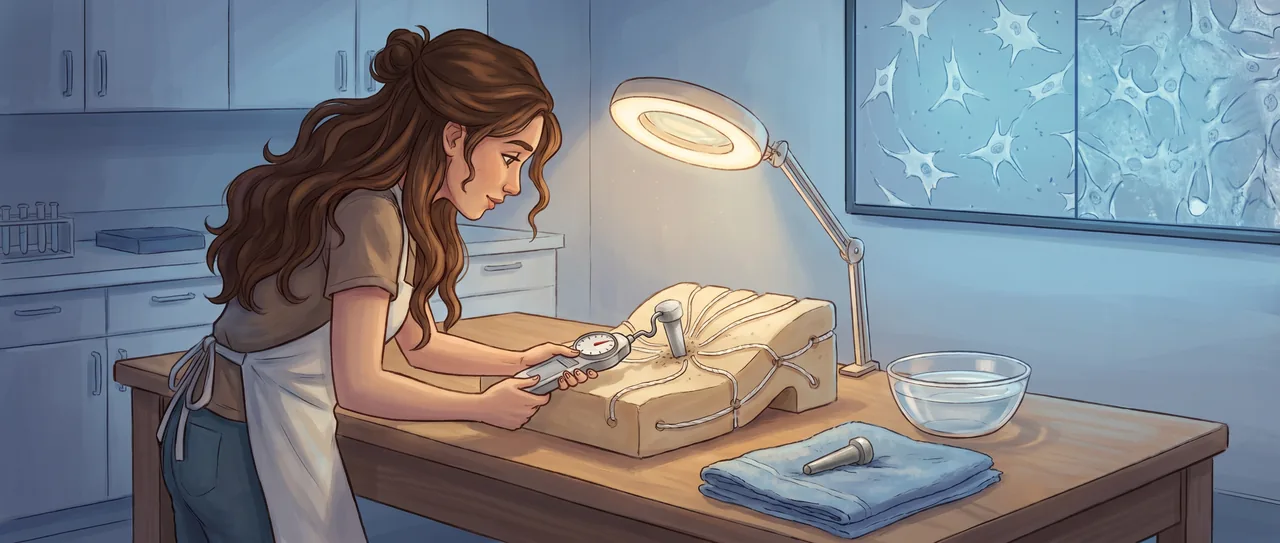
Maya took the foam bone block and cut a larger window in its side with the safety knife. She did not make a neat hole. Bone was not neat inside. It was struts and spaces. She cut channels from the inside of the block to the round implant hole, then threaded white cord through the channels until the loose ends crowded around the titanium peg.
The cord would not pretend to be cells. It would pretend to be what cells made.
She wound nothing around the outside. She used no glue. She pulled each cord end tight against the implant’s ridged surface and anchored the other end deep inside the block, through the channels, across little bridges of foam. One cord did almost nothing. Ten did more. Twenty made the peg resist. By thirty, the block flexed before the peg moved.
Maya hooked the pull gauge to the peg.
Ten newtons.
Twenty.
The foam creaked.
Thirty.
The peg held.
Maya stopped before she broke the model, which was a different thing from stopping because she was done.
Her mother came over with epoxy in one hand and her shoe in the other.
“What did you do to my exhibit?” she asked.
Maya pointed to the first block, where dried adhesive curled away from the wet plastic. She pointed to the second, where white cords disappeared into the foam and ended at the titanium.
“Pull them,” Maya said.
Her mother put down the shoe and pulled the glued peg free with two fingers.
Then she pulled the corded one.
The whole block came with it.
“Oh,” her mother said.
Maya waited. Adults often needed a second oh.
Her mother looked at the tablet, where the bone cells crept over titanium again and again. “Not glue.”
“Growth,” Maya said.
Her mother took the blue poster from the wall and turned it over. “Visitors in twenty-two minutes.”
Maya handed her a marker.
They made three stations. At the first, visitors could glue a peg into a wet block and watch it fail. At the second, they could thread one white cord, then another, then another, until a titanium peg became part of the block. At the third, the tablet played the time-lapse without sound.
Maya added one sentence to the sign, small enough that people had to lean in.
Titanium’s oxide surface lets bone cells grow directly onto it. When the visitors came, the little ones wanted the glue first because glue was faster. The older ones wanted the pull gauge. One adult tried to yank the corded model apart and laughed when he could not. Maya did not laugh. She watched his hands.
The titanium peg did not look powerful. It looked patient.
Between groups, her mother opened the surface sample drawer. “If you’re going to rebuild my exhibit, you should at least see what else the lab keeps arguing with.”
The drawer slid out with a soft metal sigh. Titanium sat beside tantalum, zirconia, magnesium, and a square of glassy white ceramic, each in its own little well. Maya reached for the next empty bone block.
Read the interactive version, listen to the narration, and earn a gold star →
A science-verified short story for curious kids · Curiosity Land