Less Than Almost Nothing
By the time Maya reached the visitor lab, the black holes were already singing wrong.
The sound came from a round speaker under a glass case. It was supposed to be the first gravitational wave ever detected, the one from two black holes that had smashed together one point three billion light years away. The speaker made a rising whoop, quick as a bird being surprised.
Then the screen above it flashed, NO MATCH.
Dr. Vale made a small noise in his throat.
He was not the kind of adult who stood still. His badge had twisted backward. His hair looked as if he had argued with a balloon. In one hand he held a tablet. In the other he held half a sandwich.
"Not today," he said to the exhibit. "Please not today. The visitors arrive in twelve minutes. The governor arrives in fifteen. The governor likes buttons. Everyone likes buttons. Why do they like buttons?"
Maya did not answer because the whoop had happened again.
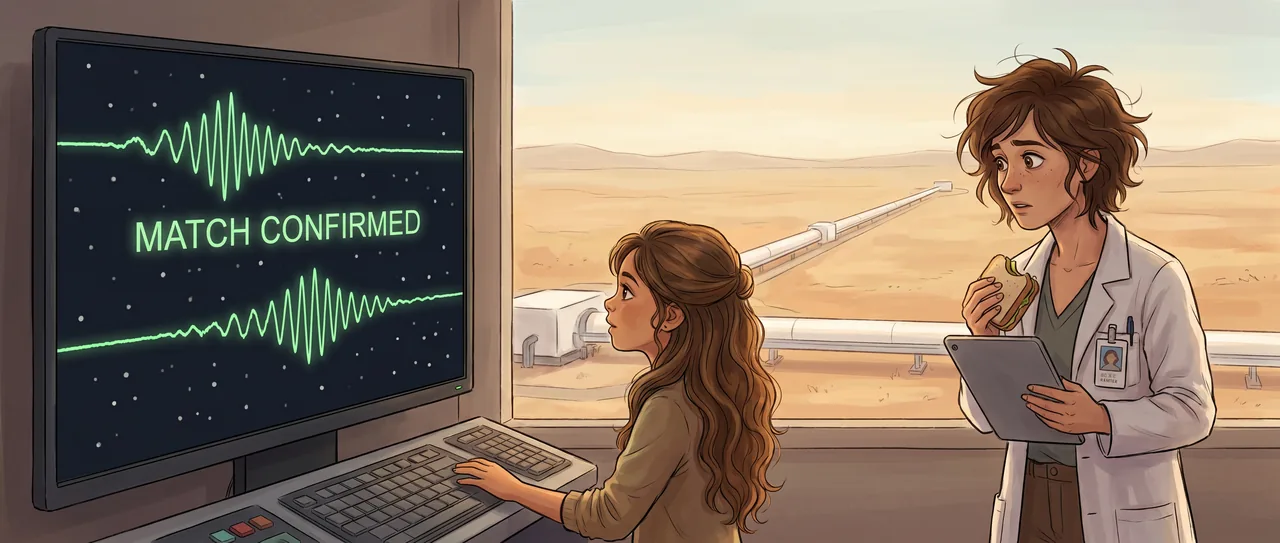
On the screen were two green lines. They were nearly the same shape, a shiver that grew closer together, faster and faster, then stopped. Under them were two names: Louisiana and Washington.
Dr. Vale tapped the glass with one finger. "It should line up when you press compare. A little celebration. Stars. Applause. Very tasteful. Instead, it thinks the black holes did not happen. Which is awkward for everyone."
Maya leaned closer.
The two lines did not match. Almost. Not quite. The not-quite was the interesting part.
Behind the screen, through a huge window, one of the real LIGO arms ran away across the desert, a straight white tube so long the far end blurred in the heat. Four kilometers of laser path in one direction. Four kilometers in another, making an L too large to hold in your head at once.
A poster on the wall said that Einstein had predicted ripples in spacetime in nineteen sixteen. Another said the first direct detection happened in two thousand fifteen. A third had a drawing of Earth being squeezed one way and stretched the other by less than one thousandth the diameter of a proton.
Maya had read that number three times on the drive in.
Less than a proton already felt too small. Less than one thousandth of a proton felt like trying to split a whisper into crumbs.
"It cannot be real stretching," she said.
Dr. Vale looked up from his tablet. "It is. Very real. Very tiny. We use lasers. Mirrors. Interference. Tremendous fussiness."
"No," Maya said. "I mean, not like pulling taffy. If Earth stretched that much, nobody felt it."
"Correct," Dr. Vale said. "Nobody felt it. The detector did. That is its whole brag."
He pressed the compare button again. The whoop rose. The screen blinked, NO MATCH.
"I am going to turn it off and pretend the educational mission is taking a thoughtful pause," he said.
Maya put her hand over the button before he could press anything.
Dr. Vale blinked at her.
"It is matching wrong," Maya said.
"Yes. That is what broken means."
"No. It is being asked the wrong question."
Outside the window, heat made the white tube wobble. Inside the case, the two green lines waited.
Maya had a list in her head of things that did not make sense yet. The list was always there, like teeth. The chirp was on it. The two labels were on it. The fact that the lines were almost the same but shifted sideways was on it. The word almost kept biting.
She pressed compare and watched carefully.
The exhibit slid the Washington line directly on top of the Louisiana line. The beginning of one shiver met the beginning of the other. The tall bump arrived too early. The ending missed by a sliver.
"It is trying to make them happen at the same time," Maya said.
"That would be traditional for matching," Dr. Vale said, but his voice had changed.
Maya looked at the map beside the screen. Two red dots: one in Louisiana, one here in Washington. The distance between them was bigger than any school map made it feel. A ripple crossing Earth would not touch both dots in the same instant unless it came from exactly the right direction. Space had to cross the planet too.
She dragged the Louisiana line a hair to the left.
NO MATCH.
She dragged it more.
NO MATCH.
The governor was probably closer now. Someone in the hall laughed too loudly. Dr. Vale’s tablet buzzed. He ignored it.
"How much?" Maya asked.
"For the first event? Livingston saw it first. Then Hanford, about seven thousandths of a second later."
Maya moved the slider until the small number in the corner read seven milliseconds. The tall bump lined up. The ending lined up. The beginning still looked wrong.
NO MATCH.
Maya smiled.
Dr. Vale said, "That is not usually the reaction."
"One arm gets longer while the other gets shorter," Maya said.
She held both hands in front of her in an L. She pulled one hand away and pushed the other closer. Then she reversed them.
The detector outside was not just a giant ear. It was a giant disagreeing thing, made to notice when one direction said yes and the other said no.
Maya looked at the two labels again.
"Are the detectors turned the same way?"
Dr. Vale’s sandwich lowered slowly. "Not exactly."
"So the same wave would not draw exactly the same squiggle."
"Not exactly," he said again.
There was a button marked invert. Maya pressed it.
The Washington shiver flipped upside down.
She dragged the line one tiny step back. The two shapes settled into each other, not perfectly, but the way two hands settle when they belong to the same person and one is seen in a mirror.
For one second the screen went black.
Then the speaker gave the chirp.
This time it did not sound like a bird. It sounded like something enormous becoming one thing instead of two.
The screen filled with quiet silver points. No applause. No cartoon stars. Just the two green lines, one from Louisiana and one from Washington, laid together across the dark.
MATCH CONFIRMED, the screen said.
Dr. Vale let out a breath. "The update reset the time shift and the inversion. Of course it did. Of course." He looked at Maya, then at the exhibit, then back at Maya. "You fixed the first black holes. Temporarily. In a visitor-center sense."
Maya kept looking at the lines.
The signal was smaller than small. Smaller than anything her fingers could pinch. It had crossed galaxies, stars, dust, darkness, and the roofs of houses where people were eating breakfast and losing socks. It had passed through bones and oceans and library shelves. It had gone through Maya too, long before she was born, while Earth was just another thing in its way.
And the only reason anyone knew was that some people had built a machine fussy enough to care.
In school, when Maya pointed out that the clock ticked unevenly after lunch or that the projector hummed in two notes at once, people looked at her as if she had brought them a pebble and expected it to hatch. Here, the whole building was for pebble-hatching. The mirrors hung in vacuum. The lasers bounced back and forth. The ground’s ordinary muttering had to be sorted from tides, trucks, wind, and heat. Almost nothing was not nothing here.
Dr. Vale opened his mouth, but footsteps filled the hall. Voices. The visitors.
He straightened his backward badge and shoved the sandwich into his lab coat pocket. "I have to explain black holes to people who want photographs," he said. "Can you run the button once when they come in? Just once. Not twice. They will all want twice."
Maya nodded.
The first visitors crowded into the lab. They looked at the long white arm through the window. They looked at the big red button. They looked at Dr. Vale because adults in badges looked official.
Maya looked at the small live monitor in the corner.
It did not have stars or labels. It did not sing. It only drew two restless green traces across black, one above the other, while the detector listened.
A child near the front asked, "Can it hear another one?"
Dr. Vale turned toward the crowd, smiling too fast. "That is exactly the hope."
Maya stepped away from the button.
Read the interactive version, listen to the narration, and earn a gold star →
A science-verified short story for curious kids · Curiosity Land