The Wrong That Wasn't a Letter
The hospital gave Soren a sticker with his name on it, a paper bracelet, and a purple-capped tube of his own blood.
The tube bothered him most.
Not the blood part. Blood was only red plumbing. What bothered him was that the tube already knew where it was going. It sat in a clear plastic bag on the counter with a barcode across its belly, waiting for the genome lab.
Soren had been told the study might help children whose tests had come back with no answer. He had one of those tests folded in his pocket. It said no reportable findings. It did not say why he still got dizzy after running, or why his hands sometimes trembled when he was hungry, or why doctors used the word interesting in voices that were not interesting at all.
The genetic counselor hurried into the room carrying a tray of paper strips.
“I have eight minutes before the lab meeting,” she said. “Maybe nine if the elevator is kind.”
She had silver shoes, a coffee stain shaped like Australia on her sleeve, and the look of a person whose brain was already in three rooms at once.
“Your grown-up signed the permission,” she said. “But for research, we ask you too. Your yes matters.”
Soren looked at the tube.
“I don’t know what I’m saying yes to.”
The counselor blinked, then set down the tray.
“Fair,” she said. “Very fair. Have you learned DNA is like a long word?”
“Yes,” Soren said.
“Good. Sometimes disease comes from one letter being different.”
“I know that part.”
She smiled too fast, relieved to be back on her planned road. “Then this will be easy. SNP arrays look at lots of common single-letter places. Like checking certain windows in a very long train.”
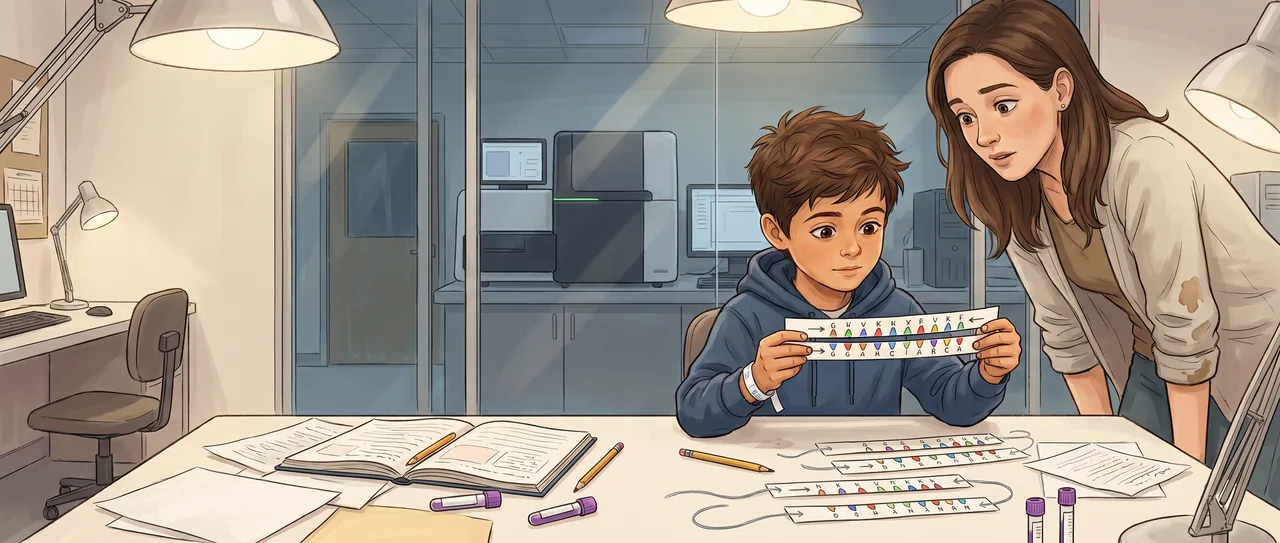
She clipped a sheet to the table. It was a strip of letters, A, C, G, and T, printed in tiny rows. Colored flags poked up at certain spots.
“These are the windows?” Soren asked.
“Exactly. A SNP array checks those marked places. Fast. Useful. Much cheaper than reading everything.”
Soren took the folded letter from his pocket. “Mine was this?”
The counselor read the top line.
“Yes. A SNP microarray.”
“So they checked the windows.”
“They checked many windows.”
“But not the train.”
The counselor opened her mouth, closed it, and looked at the clock.
“The lab meeting can start without me,” she said.
She pushed the tray closer.
On it were short paper pieces, each with DNA letters. Some had little arrows. Some were in pairs, connected by thin gray thread.
“This is a practice case,” she said. “The array found nothing. The whole genome data has something. Most people hunt for a wrong letter first.”
Soren hunted.
He lined up the first strip under the printed reference genome. Then the second. Then the third. His pencil moved down the rows, touching each flagged place. A matched A. C matched C. G matched G. Every colored window showed the letter it was supposed to show.
The wrongness was somewhere else.
He did not write that down. He only stopped moving.
The counselor was answering a message on her wrist screen. “If you find a red flag, call me back to Earth.”
“There isn’t one,” Soren said.
“That happens. Keep looking.”
“No,” he said. “There really isn’t one.”
He picked up one of the paired strips. The gray thread said the two ends had been read together. One end lined up neatly near the middle of the genome page. The other end did not belong nearby. It belonged much farther down, and its arrow pointed the opposite way.
Soren turned the strip around.
Now the letters matched, but the arrow was wrong.
He tried another. Same thing. Then another. A whole stack of reads behaved like children in a hallway drill, all pointing calmly toward the wrong exit.
The counselor’s wrist chimed. She ignored it.
“What made you turn it?” she asked.
“The letters were fine,” Soren said. “The direction was not.”
He pulled two long blank strips from the scrap pile. On one he copied a chunk from the reference genome. On the other he copied the same chunk again. Then he flipped the second strip so the arrows ran backward and placed it beside the first.
The paper table became too small.
The genome stopped being a word. It became a shelf of books in the dark, where a whole chapter could be copied, turned around, and shoved back between the pages. If someone checked only a few letters, every checked letter could still be perfect.
Soren placed the colored flags along his new paper arrangement. Every flag landed on the expected letter.
He pushed it toward the counselor.
“The windows are all right,” he said. “The train car is backward. And there are two of it.”
The counselor was very still for a person with silver shoes and a late meeting.
“That is a duplication with an inversion,” she said softly. “A structural variant.”
Soren touched the gray-threaded reads. “The whole genome pieces show the edges.”
“Yes. Split reads. Paired reads. Depth, sometimes. Different clues, all pointing at the shape.”
“Arrays can miss that.”
“They can miss it completely,” she said. “Especially if the marked spots still look normal.” The counselor turned over the answer card for the practice case. On it was a diagram almost exactly like Soren’s paper version, only cleaner and less alive.
“This is why some families with no answer get one after whole genome sequencing,” she said. “Not all. I won’t promise that. Sometimes the genome gives no answer. Sometimes it gives a question no one knows how to answer yet. But a significant number of missed answers are not spelling mistakes. They are rearrangements.”
Soren looked at his old letter again.
No reportable findings.
It had felt like a closed door when it arrived in the mail. Now it looked smaller. Not false. Just smaller. A door someone had painted on one wall of a much larger building.
At school, teachers wanted answers written on the line provided. Soren’s notebook had arrows between pages, folded corners, maps of failed attempts, and lists of things that behaved wrong. Adults sometimes tapped the margins and asked if he could make it neater.
On the table, the neat answer had been invisible until the messy shape appeared.
The counselor picked up his paper inversion carefully, as if it were a specimen.
“I usually explain this with slides,” she said. “The slides are worse.”
“They probably go in order,” Soren said.
“They do,” she said. “That may be the problem.”
For the first time that morning, she laughed without looking at the clock.
Then she set a tablet in front of him. The screen did not say cure. It did not say answer. It said whole genome sequencing research assent, and below that were two buttons.
“Yes,” the counselor said, “means your sample can be sequenced and analyzed. No means it cannot. Either is allowed.”
Soren glanced through the glass.
Beyond it, a technician slid racks into a machine with a clear lid. Each rack held small tubes in straight rows. The machine was not dramatic. It did not glow blue or whisper secrets. It simply waited to read what was there, including the parts nobody had thought to check.
Soren peeled the small assent sticker from its backing and pressed it onto the clear sample bag.
Read the interactive version, listen to the narration, and earn a gold star →
A science-verified short story for curious kids · Curiosity Land