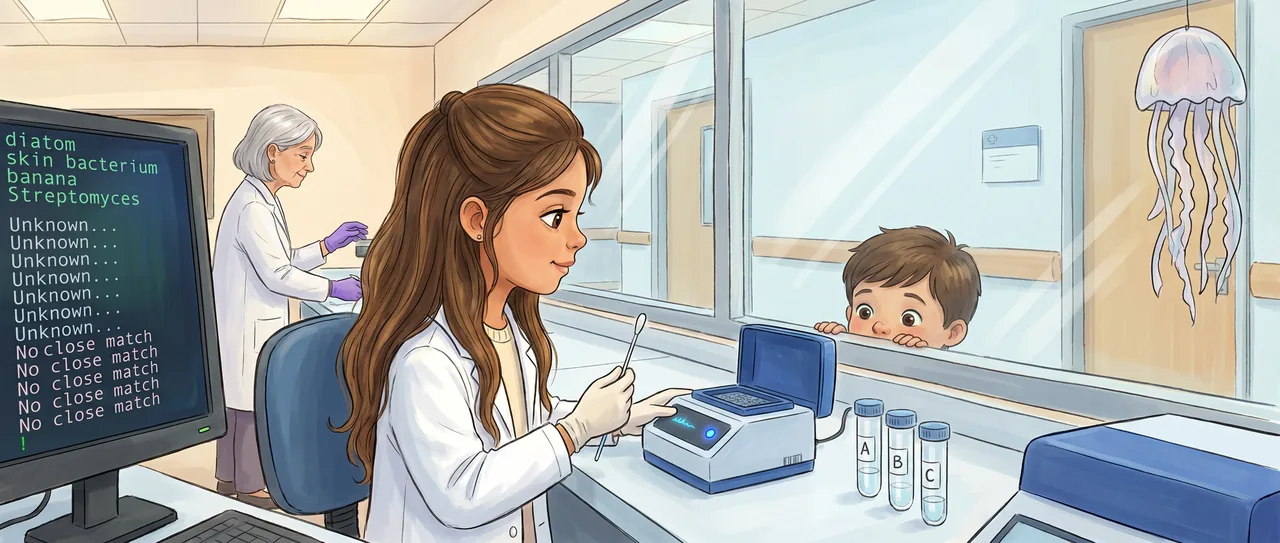
The Things That Would Not Grow
Maya was supposed to find the ocean in three clear tubes.
That was the whole job, according to the lab manager, who had said it as if oceans were famous for staying where people put them.
The tubes stood in a little rack beside a machine no bigger than a lunchbox. One tube held a spoonful of soil from the hospital roof garden. One held seawater from the pier behind the hospital. One held a swab washed off the silver handrail outside the newborn ward.
The labels had come off.
They had been printed in a hurry for the hospital’s open day, and the steam from the sterilizer had loosened the glue. Now three white stickers curled on the counter like dead moths, all blank side up.
The lab manager pressed her thumbs between her eyebrows. She had silver hair, purple gloves, and the brisk sadness of someone whose schedule had been bitten in half.
“We can redo them,” she said. “Soil, sea, surface. It is not a tragedy.”
Maya looked at the tubes. They were all almost clear. The soil tube had already settled, leaving only a faint tea-colored cloud. The seawater, if it was seawater, had not bothered to look blue. The hospital swab had not bothered to look like anything.
“You need these exact ones,” Maya said.
“For the display, no. For my peace of mind, yes.”
On the other side of the glass, volunteers were taping paper jellyfish to the hallway ceiling. The open day banner sagged at one corner. Families would arrive in less than an hour to see how the hospital used DNA machines to find infections quickly, track outbreaks, and study the invisible life that came in on shoes, flowers, skin, and air.
Maya picked up the rack, held it to the light, and put it down again.
“Do not open them,” the lab manager said.
“I wasn’t.”
“You were thinking about it.”
“I was thinking about smelling them.”
“Absolutely not.”
Maya nodded. Smelling was a bad plan anyway. Oceans could hide. Soil could pretend. Hospital railings smelled mostly like everyone trying very hard for them not to smell like anything.
Beside the tubes were three round dishes from yesterday’s attempt. The lab manager had rubbed each sample onto jelly-like food in a plastic plate to see what would grow. One plate was empty. One had two yellow dots. One had a fuzzy gray island spreading tiny threads.
The lab manager pointed at them. “If the labels had stayed on, we would already know. The fuzzy one is probably soil. The empty one is probably the cleaned handrail. The two dots could be seawater. Or not. Cultures are tidy when they behave.”
Maya leaned closer.
The empty plate bothered her most.
Not because it was empty. Because it was too good at being empty.
A hospital handrail had been touched by parents, nurses, delivery carts, toddlers, sleeves, balloons, cups, and probably someone’s sandwich. Then it had been cleaned. Cleaned was not the same as never happened.
“What if the empty one is full?” Maya asked.
The lab manager stopped sorting pipette tips. “That is a very Maya sentence.”
“Things can be there and not grow on that.”
She pointed at the jelly plate.
The lab manager looked at the plate. Her mouth went to one side. “Yes. Most microbes do not grow just because we invite them to. Some need exact temperatures, exact neighbors, exact food, exact salt. Some are dead but their DNA is still present. Some are alive and stubborn.”
“So the plates are the wrong question.”
“They are one question.”
Maya looked at the lunchbox machine. A blue light pulsed on its lid.
“That asks a different one.”
The lab manager followed her gaze. “That asks a messier one.”
“Good.”
The lab manager gave a short laugh, then checked the clock and lost the laugh. “I have six posters to fix.”
“I know how to load it,” Maya said.
“You know how to load the practice banana DNA.”
“I know how to change gloves. I know how to use the blank control. I know not to touch the inside of the tube cap. I know the barcode pieces go in so the computer can tell which sample is which.”
The lab manager stared at her.
Maya stared back.
“I watched three times,” Maya said.
“That is not the same as being trained.”
“No. But you can stand there and be annoyed while I do it.”
The lab manager made a sound that was not yes. Then she pulled a stool to the bench with her foot.
“Fine. You do the safe steps. I do the enzyme mix. If you contaminate everything, I will become a ghost and haunt your shoelaces.”
Maya grinned, then put on fresh gloves.
The tubes became A, B, and C. She swabbed the outside of each cap before opening it. She changed tips every time. She added clear drops to clear drops. The lab manager added the parts that cut and copied and prepared the DNA. Tiny plastic tubes clicked shut with neat little snaps.
The machine waited with a black square at its center. Inside that square were holes so small Maya could not see them. DNA strands would pass through and disturb an electric current. Not the organisms themselves. Not photographs. Not names written on little flags. Pieces.
Enough pieces, and the computer could say, this looks like a diatom, this looks like a skin bacterium, this looks like wheat from somebody’s lunch, this looks like an oak leaf, this looks like something we have seen before.
Not enough pieces, and it would leave the line unnamed.
Maya loaded A. Then B. Then C. The lab manager loaded the blank.
“Now we wait,” the lab manager said.
The first lines appeared almost immediately.
Maya had expected the screen to feel like an answer sheet. It did not. It felt like standing in a dark auditorium while, one by one, seats began to creak.
Sample A filled with human. Human skin. Human again. Then Staphylococcus epidermidis, a common skin bacterium. Corynebacterium. Cutibacterium. More human. A trace of banana. Maya glanced at the volunteers outside the glass, where someone was eating a muffin with one hand and taping jellyfish with the other.
“Handrail,” Maya said.
“Likely,” said the lab manager.
Sample B began slowly. Then the screen spilled green words. Diatom. Diatom. A kind of algae. Copepod. Fish. Brown seaweed. More diatom. Bacterial names Maya could not say without warming up first.
The plate with two yellow dots had made the ocean look almost empty. The screen made it crowded enough to need traffic rules.
Maya forgot to breathe for a second.
The ocean tube had not looked blue because blue was what the sky did on top. Inside, it was a city of glass-shelled drifters, tiny grazers, seaweed threads, fish dust, bacterial specks, and broken messages from bodies that had passed through the water and gone on.
Sample C smelled like nothing because it was closed, but the computer made it feel damp and root-dark. Plant. Fungus. Streptomyces, the soil bacteria that helped give earth its after-rain smell. Beetle. Worm. Moss. More fungus. More plant. Lines and lines and lines.
“Soil,” Maya said.
The lab manager did not answer right away. She was looking at the blank control, which had almost nothing in it, only a few weak matches that the computer marked as too faint to trust.
Maya tapped the three tubes in order. “A is the handrail. B is the sea. C is roof soil.”
The lab manager exhaled through her nose. “That is better than my plates.”
“The plates only counted things willing to live in your little circles.”
“My little circles have feelings.”
“They missed almost everything.”
“They often do.”
The lab manager said it quietly, without joking.
Maya looked back at the culture dishes. The empty one was not empty. The two yellow dots were not the ocean. The fuzzy gray island was not the soil. They were only the volunteers who had stepped onto the stage.
On the screen, many rows had ordinary names. Many had names too long to hold in her mouth. Some said uncultured bacterium, which sounded to Maya like a person standing outside a party because the music inside was wrong.
Then there were the other rows.
Unclassified.
No close match.
Unknown.
They appeared in all three samples. Not as many as the named ones, but enough that Maya began counting and stopped at twenty-seven because more kept arriving.
“What are those?” she asked.
The lab manager came to stand beside her. “Fragments that do not match the database well enough. Damaged DNA, maybe. Or organisms whose genomes are not in the library. Or parts of genomes nobody has mapped. The machine can read what is there. It cannot recognize what no one has taught it yet.”
Outside the glass, the first families began to gather. A little boy pressed both hands and his nose against the window. Behind him, the crooked banner finally gave up on one corner and drooped lower.
The lab manager reached for the poster about the three samples. “I will print new labels.”
Maya did not move.
On the handrail sample, under human and skin bacteria and muffin banana, an unknown line blinked as more fragments joined it. The match score climbed, then stopped below the place where the computer would dare to name it.
The lab manager followed Maya’s gaze. “We do not put unknowns on open day posters. People like tidy.”
Maya picked up a fresh sterile swab from the box.
The lab manager looked at the clock, then at the families, then at Maya. “New gloves. Blank control. One surface only.”
Maya snapped on clean gloves and stepped out of the glass room.
The little boy pulled his hands from the window.
Maya crouched beside the drooping banner, held the unopened swab above the silver elevator button, and waited for the doors to open.
Read the interactive version, listen to the narration, and earn a gold star →
A science-verified short story for curious kids · Curiosity Land