The Switch in the Wrong Animal
The fly on the wall had no wings yet.
It was only a gray shape on the museum screen, made of segments like beads pushed together. Beside it floated a mouse embryo, curled like a comma. A fish shimmered in blue lines. Each animal waited under a row of slots.
Maya liked the slots. They were too neat.
Soren liked the drawers below them. Each drawer was full of plastic gene tiles, heavy as dominoes, printed with letters in long rows.
A, T, G, C.
The new exhibit was called Build the Body. Dr. Bex had invited six kids to test it before opening night, but the other four had found the cafeteria robot and left. Maya and Soren stayed because the fly was missing its middle.
On the screen, where the fly should have had a normal thorax, the body bent into a wrong little knot.
“That one’s not sad enough,” Dr. Bex said from the ladder. She was taping a banner with one hand and holding a mug with the other. Her silver hair had a pencil stuck through it. “The knot should look scientifically unfortunate.”
“It looks broken,” Maya said.
“Perfect. Broken is educational.”
Soren slid a gene tile into the empty fly slot.
The slot flashed red.
ORGANISM MISMATCH.
He pulled it out and checked the label. “Mouse.”
Dr. Bex looked down from the ladder. “Ah. That drawer again. Put the mouse genes with the mouse. The interns alphabetized by cuteness, I think.”
“Mice are not cuter than flies,” Maya said.
Dr. Bex blinked. “We can discuss that after the mayor leaves. For now, sort by animal. Fly with fly. Mouse with mouse. The exhibit opens in forty minutes.”
She climbed down, hurried across the hall, and began arguing with a projector that was showing a jellyfish upside down.
Soren held up the mouse tile.
Maya had already turned back to the screen. The red warning was gone, but the empty slot remained. So did the bent fly.
“What made you try that one?” she asked.
“It was in the fly drawer.”
“Bad reason.”
“Yes,” Soren said. “But listen.”
He placed the tile beside a fly tile on the table. The labels were different. The animals were different. The long rows of letters were mostly different too.
Then he pointed to the middle.
There was a short stretch where the letters marched in a pattern so alike that even Maya, who usually saw shapes before details, leaned closer.
ATTA. Then gaps. Then more matching islands. Not perfect. Not copied. But related, like two songs with the same tune hiding under different instruments.
“That part repeats,” Maya said.
“The homeobox,” Soren said. “I read the side panel.”
Maya glanced at the panel. It had too many cheerful arrows.
Soren did not read it aloud. He never did that when the thing itself was better.
He took three more tiles from three drawers. Fish. Mouse. Fly. A tiny sea star from the bonus drawer. He lined them up by the matching stretch, not by the label at the top.
The colored letters made a crooked stripe across the table.
Maya tapped the stripe. “The scanner is sorting by fur and wings.”
“By species,” Soren said.
“Too shallow.”
The fly on the wall waited with its wrong middle.
Soren tried a fly tile in the empty slot. The screen changed. The knot loosened. Segments lined up. Small dark marks appeared where wings would later grow.
“Good,” said Maya. “Now wrong again.”
“That was right.”
“Right is too easy.”
Soren looked at her, then at the mouse tile still in his hand.
The slot flashed red again when he inserted it.
ORGANISM MISMATCH.
Maya crouched under the table.
“What are you doing?” Soren asked.
“Looking for the rule.”
Beneath the exhibit, clear plastic panels covered the wiring so children could see how the puzzle worked. There were no dangerous parts, only colored cables plugged into labeled ports. Species Gate. Position Gate. Segment Result.
Maya read the labels with her finger.
“Here. It asks, is the animal fly? Then it asks, is the gene fly? If no, it stops.”
“That is what Dr. Bex said to do.”
Maya made a small impatient sound. “Dr. Bex also thinks upside-down jellyfish are an emergency.”
Soren opened the instruction flap. It showed how museum staff could change the puzzle mode. No code. Just patch cords, switches, and cards. He liked that. A machine that admitted its thinking.
There was a second port under Species Gate.
Sequence Match.
It was unplugged.
Soren held the cable, but did not plug it in.
“If we do this, it might say the mouse gene belongs in the fly.”
Maya slid out from under the table. Dust clung to her sleeve. “Does it?”
Soren looked at the tiles. He looked at the panel about Hox genes, the one with the cheerful arrows. Then he found the small gray paragraph at the bottom, the paragraph no one had made cheerful.
In classic experiments, related Hox genes from one animal could sometimes replace the job of a missing Hox gene in another. A mouse Hox gene put into a fruit fly embryo could rescue normal fly development. These genes come from an ancient toolkit shared by nearly all animals.
Soren read it twice.
Maya only read the first sentence. Then she took the cable from his hand and held it near the port.
“Wait,” Soren said.
She waited. Barely.
He went to the screen and reset the fly to the broken version. Then he removed the fly gene tile, leaving the slot empty. He set the mouse tile on the table, not in the slot yet.
“Now,” he said.
Maya plugged the cable into Sequence Match.
The exhibit made a soft chime, like a glass being tapped.
Soren inserted the mouse tile.
The slot flashed yellow.
The screen did not write ORGANISM MISMATCH.
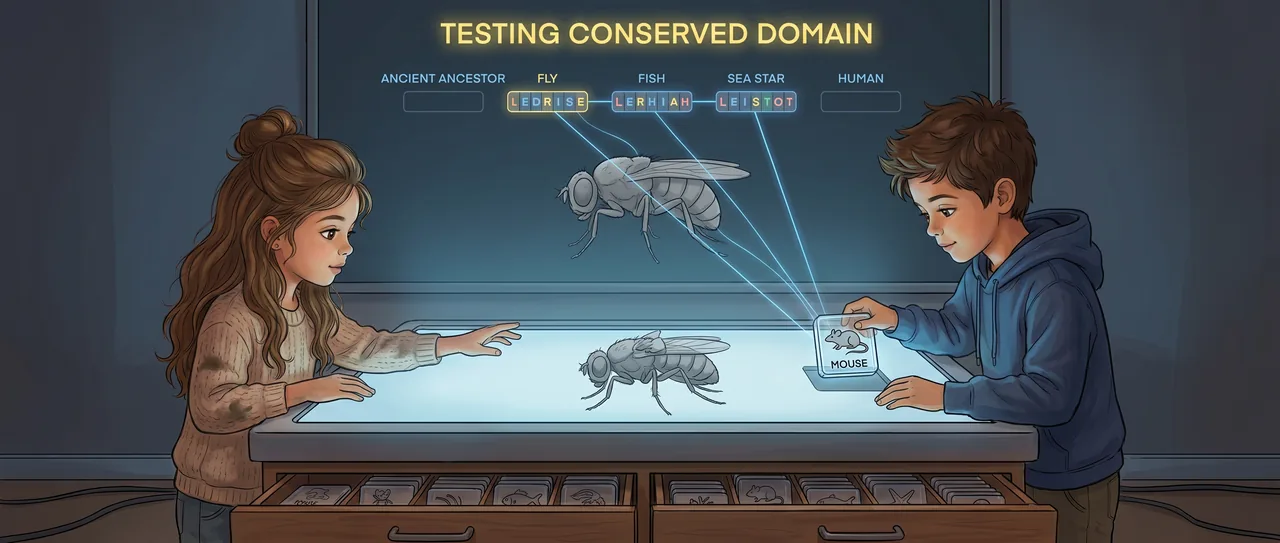
It wrote TESTING CONSERVED DOMAIN.
The letters on the wall rearranged themselves. The mouse gene’s matching stretch glowed. The fly’s missing stretch glowed beside it. Lines connected them, thin and blue.
The bent fly shivered into motion.
Not fast. Not magically. The gray beads softened, then sorted. The middle segments became even. Tiny wing patches appeared in the right place. It became more fly.
Maya’s mouth opened, but no words came out.
Soren stepped closer until his nose almost touched the screen. The blue lines ran from mouse to fly, fly to fish, fish to sea star, and farther back, into a dim place on the wall where the exhibit had drawn no animal at all.
“Six hundred million years,” he said quietly.
Maya pressed both hands against the table. “That switch was old before bones.”
The projector across the hall shouted, “JELLYFISH INVERTED.”
Dr. Bex hurried back, carrying tape, a wrench, and half a sandwich.
“Why is my fly fixed?” she asked.
“The mouse did it,” Maya said.
Dr. Bex stared at the screen.
Soren pointed under the table. “The exhibit was blocking the thing it was supposed to show.”
Dr. Bex put down the sandwich very slowly.
The wall now displayed the mouse tile in the fly slot. Not red. Not wrong. Yellow, with a question mark pulsing beside it.
“I told them to sort by animal,” Dr. Bex said.
“Yes,” Maya said.
Dr. Bex looked at the drawers. Fly. Mouse. Fish. Sea star. Human. The labels suddenly seemed like the smallest words in the room.
The mayor’s group appeared at the far doors, all shiny shoes and name tags.
Dr. Bex sucked in a breath. “Can you make it do that again?”
Soren pulled out the tile. The fly bent.
Maya held up the mouse tile for the visitors to see. “It looks wrong first.”
The mayor stopped walking.
Soren slid the tile in.
Yellow light. Blue lines. The ancient stripe. The fly’s body gathering itself back into order.
No one spoke until the chime faded.
A little boy in the front row raised his hand, though nobody had asked for questions.
“If a mouse switch can help a fly,” he asked, “what else is carrying the same switches?”
Dr. Bex looked at Maya and Soren.
Maya was already pulling open the human drawer.
Soren took out a tile and lined it up with the others. Fly. Mouse. Fish. Sea star. Human. The same hidden stripe crossed all five, imperfect and unmistakable.
On the wall, one empty square lit beside the row.
Maya reached up and touched the blank square.
Read the interactive version, listen to the narration, and earn a gold star →
A science-verified short story for curious kids · Curiosity Land