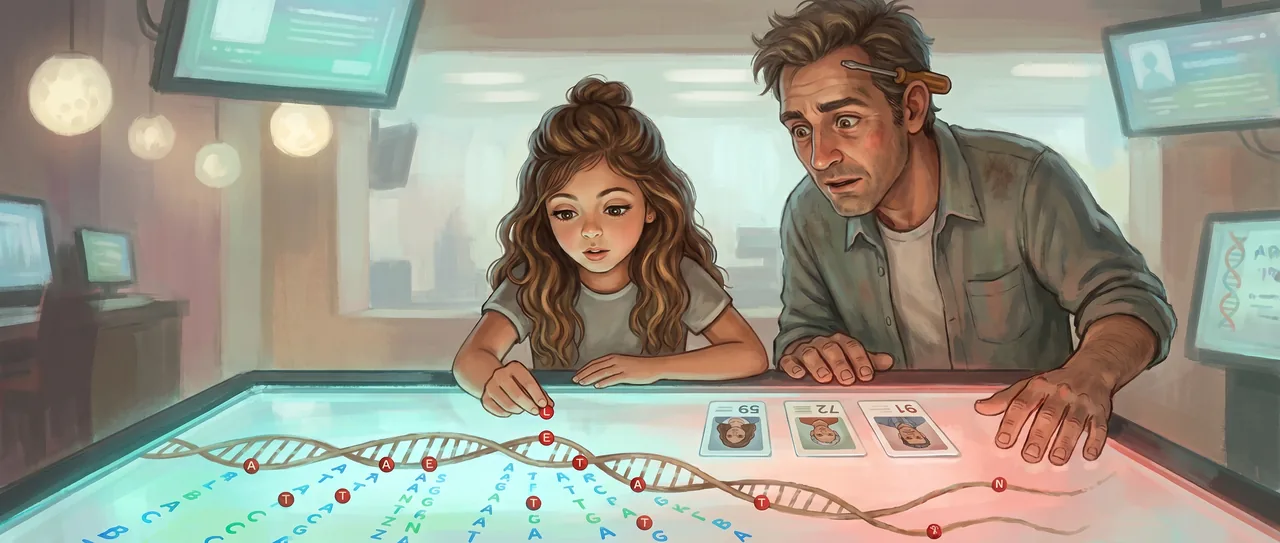
The Seventy Red Beads
The machine said Maya had built an impossible child.
It did not say this politely.
The glass table flashed red from one end to the other, and the child strand of DNA, which Maya had just snapped together from blue and green letter tiles, lifted itself out of its groove like a zipper coming undone.
On the screen above it, large white words appeared.
No parent source found.
The exhibit manager made a sound like a door closing on her finger.
"Again," she said.
Maya did it again.
The table was called the Inheritance Loom. It filled half the room at the city genomics center, under lights as soft as moon jellyfish. Visitors were supposed to choose two parent strands, press a button, and watch the table weave a child strand from them. Half from one parent. Half from the other. Simple enough for little kids. Beautiful enough for donors.
That was what the exhibit manager kept saying.
"Simple and beautiful," she said, smoothing the sleeve of her yellow jacket. "Not red and alarming. The doors open in forty minutes. We need the red to go away."
Maya’s father was on a ladder across the room, tightening a projector the size of a loaf of bread. He was fifty-two and still climbed ladders like they had personally insulted him.
"How red is it?" he called.
"Tomato," Maya said.
"Bad tomato or soup tomato?"
"Emergency tomato."
The exhibit manager did not laugh. She tapped the glass with one fingernail.
"The scanner must be misreading the parent files. Try the practice family. Family Twelve. It was clean yesterday."
Maya loaded Family Twelve.
The table hummed. Two parent strands appeared, one blue, one green, each made of thousands of tiny glowing letters. Most of the letters were A, C, G, and T. They slid past so fast they became glitter.
Maya pressed Weave.
The child strand formed, neat as a braid.
Then red lights pricked through it.
One. Another. Another. Not in clumps. Not like spilled paint. The red places were lonely, scattered along the strand with lots of ordinary letters between them.
Maya leaned closer.
"Not a smear," she said.
"It is a software smear," the exhibit manager said.
"Smears smear."
The manager looked at her.
Maya pointed. "This one is one letter. Then nothing for a long way. Then another one letter. They are not messy. They are waiting."
"Waiting for what?"
Maya did not answer because the table had given her a better question.
She opened the side drawer where the exhibit parts were kept. There were replacement tiles, cleaning cloths, a tiny suction cup, and a tray of red beads that had not been used. They were small and round, each with a single white letter printed on it.
"What are these for?" Maya asked.
"Decoration from the old design," the manager said. "We decided red made it look like something was wrong."
Maya picked up one bead. It warmed under her thumb.
On the ladder, Dad said, "Red usually means I wired something backward."
"Not here," Maya said.
She loaded the practice family again, but this time she did not press Weave. She opened Compare.
The parent strands flattened into two long rows. The child strand slid underneath. The table marked every place where the child matched one parent or the other.
Blue match. Green match. Blue. Blue. Green. Green.
Then a red bead-sized gap.
At that place, the child had a T.
Parent one had a C.
Parent two had a C.
Maya checked the other copy of the parent strands. Still C.
The child had T.
She moved to the next red place.
The child had A.
Both parents had G.
The next red place was the same kind of wrong. Not big. Not broken. One letter standing where neither parent had put it.
The exhibit manager folded her arms. "Could be a typo in the data."
"Then it should be embarrassed in one family," Maya said.
She loaded Family Seven.
Red freckles appeared.
Family Nine.
More.
Family Three.
More.
She stopped trying to make the table behave.
Maya sorted the families by the tiny information cards attached to them. Mother age. Father age. Child age. Sequencing lab. Consent code. The cards were boring in exactly the way useful things were boring.
Family Two had a father who was twenty-four. The red counter showed fifty-nine.
Family Twelve had a father who was thirty-one. The red counter showed seventy-two.
Family Six had a father who was forty-six. The counter showed ninety-one.
Maya dragged the cards into a row on the glass.
The exhibit manager came close despite herself.
"That cannot be the exhibit," she said. "Parents will ask why older fathers make more red lights."
"Then they can ask," Maya said.
Dad climbed down from the ladder. He had dust in his hair and a screwdriver behind one ear.
"Older fathers make more red lights?" he asked.
Maya moved Family Six beside Family Two. "The counter goes up. Not perfectly. But it creeps."
Dad looked at the red freckles, then at his own hands. His hands were wide, with small cuts from tools. They had held Maya’s bicycle seat when she learned to ride and let go without telling her.
"Huh," he said.
The exhibit manager was already shaking her head. "The sign says: A child is made from the DNA of two parents."
Maya slid a red bead into one empty gap on the child strand. It clicked down cleanly.
The table accepted it.
The red warning vanished from that spot.
Maya put in another bead. Click.
Another. Click.
The child strand did not reject them. It settled around them.
"The sign is too small," Maya said.
"The sign is six feet wide."
"Not that kind of small."
The exhibit manager opened her mouth, then shut it.
Maya gathered a handful of red beads. There were too many to hold without some escaping between her fingers. They pattered back into the tray like hard rain.
She had heard grown-ups say things like, "You are your mother’s eyes," and "You are your father’s feet," and, usually when she asked the third question in a row, "Where did you come from?"
The loom had an answer with room in it.
Not all of the child strand came from the parent strands.
Not because anyone had failed. Not because the child was impossible. Because copying living things was not the same as stamping coins. A letter could arrive that had not been in either row above it.
Maya looked at the red bead between her finger and thumb.
"How many?" Dad asked.
Maya checked the counter on three families, then four, then the practice set.
"Around seventy," she said. "For these. Per child. Some more. Some less."
The room changed size without moving.
The walls stayed where they were. The glass table stayed under Maya’s hands. Dad still smelled faintly like warm wires.
But every person who would come through the doors in thirty minutes had become less finished than they had been a moment ago. Each would carry letters their parents had not carried. Quiet letters. Real letters. New ones, tucked among billions of old ones.
The exhibit manager took off her glasses and rubbed one lens with the hem of her yellow jacket.
"If we leave them red," she said, "people will think they are errors."
Maya pushed the tray of beads to the center of the table.
"Then do not call them errors."
The manager looked at the huge sign. A child is made from the DNA of two parents.
"What do we call them?" she asked.
Maya turned the sign controls toward herself. The keyboard was projected on the glass, pale and waiting.
She did not make the sign explain everything. Explaining everything made people stop looking too soon.
She changed one line.
The new sign read: Most letters are inherited. Some letters are new.
Dad read it aloud softly. "Some letters are new."
The exhibit manager watched the words for a long second.
Then she opened the doors.
Light from the hallway spilled over the floor. The first visitors came in, a parent carrying a toddler, two grandparents, a child with one shoelace untied. Their voices bounced against the glass walls.
The Inheritance Loom cleared itself for the next weaving. Two parent strands appeared. Beneath them, an empty child strand waited.
Maya picked up one red bead and held it above the empty strand.
Read the interactive version, listen to the narration, and earn a gold star →
A science-verified short story for curious kids · Curiosity Land