The Same Letters
The answer key was wrong before the bees even arrived.
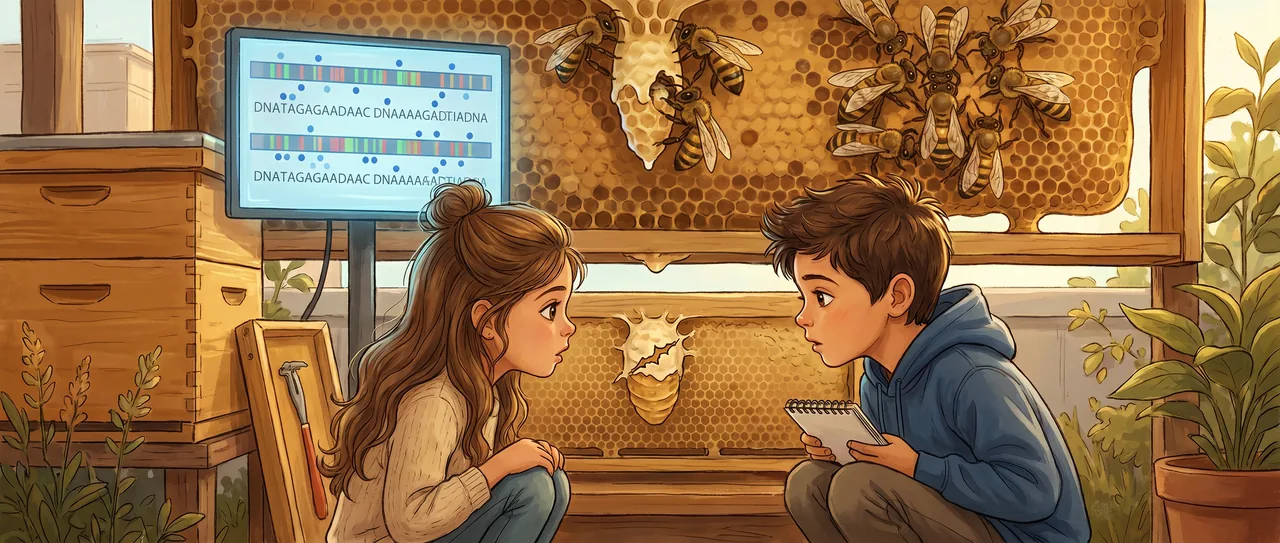
Maya knew because the screen said FIND THE FUTURE QUEEN IN THE DNA, and the two glowing DNA strips underneath were exactly the same.
She leaned closer until her breath fogged the glass.
“That cannot be the game,” she said.
Soren had already pulled the paper printout toward him. He ran his finger down the columns of letters. A, C, G, T. A, C, G, T. The same in sample A. The same in sample B.
“Maybe the queen part is farther along,” he said.
“It says full scan.”
“Maybe the machine missed it.”
“The machine did not miss every letter.”
Across the lab, Dr. Iqbal was trying to tape a banner to the wall with one hand while speaking into a headset. The banner said TOMORROW’S GENOMICS FAIR in letters large enough to be read from space.
She saw them staring at the display and winced.
“Please tell me the queen finder works,” she said.
“It finds nothing,” Maya said.
“It finds sameness,” Soren said.
Dr. Iqbal dropped the tape. “That is not a fair activity. Children do not line up to be told sameness.”
Maya looked at the two sample pictures beside the DNA. Each showed a tiny white curve of a larva in wax. One lay in an ordinary worker cell. One hung in a larger, peanut-shaped queen cell.
“That one is different,” Maya said, pointing.
“Yes, visually,” Dr. Iqbal said. “But the point is genomics. The dean wants a clean button. Press here, find queen genes, everybody gasps, lunch.”
“There are queen genes?” Soren asked.
Dr. Iqbal opened her mouth, closed it, and glanced at the headset buzzing against her shoulder.
“There are genes involved in queens,” she said. “That is not the same sentence. I have to rescue the printer. Do not touch the live hive panel.”
She hurried away with the banner dragging behind her like a defeated flag.
Maya touched the glass of the display, not the hive panel.
“Same letters,” she said.
Soren wrote that down.
“Do not make that face,” Maya said.
“What face?”
“The face where your head is building stairs.”
“It is not stairs yet,” Soren said. “It is a ladder with missing rungs.”
The live hive panel stood in the next room, sealed behind clear plastic. A tube led from it through the wall to the rooftop, so the bees could come and go over the city. Inside, thousands of honeybees moved in golden-brown rivers across the comb.
Maya did not look at all the bees. She looked where the motion snagged.
“There,” she said.
Soren followed her finger.
At the lower edge of the comb hung three queen cells, longer than the rest, pointing downward. Nurse bees crowded one of them so tightly that their bodies made a trembling knot. Every few seconds, one bee backed out and another pushed her head in.
“They keep feeding that one,” Maya said.
“They feed all larvae,” Soren said, but he opened his notebook.
For ten minutes, Maya counted the bees going into the worker cells while Soren timed the queen cell visits. He did not make the columns neat. He made them useful. Short visit. Long visit. Head all the way inside. White paste visible. Worker cell, then queen cell, then queen cell again.
A little boy from the tour pressed his nose to the opposite side of the glass.
“Is the queen already the boss?” he asked.
“No,” Maya said.
Soren looked up.
Maya was still watching the crowded queen cell.
“She is not even a bee yet,” she said.
The boy stared at the hanging cell as if it had become much heavier.
Back in the lab, the genome screen still insisted on its useless sameness.
Soren set his notebook beside the keyboard. “The difference is not in the letters we are showing.”
Maya was already clicking through the menu. “What else can the machine show?”
“Protein activity. Methylation marks. Gene expression.”
She stopped. “Methylation.”
“That is a tag on DNA,” Soren said. “It does not change the letters.”
“It changes what gets read?”
“Sometimes. It can help turn genes up or down.”
Maya clicked.
A new image unfolded across the screen. The same DNA strips appeared again, but now tiny blue dots freckled them in different places. Sample A had one pattern. Sample B had another.
The room did not get louder. It got larger.
The same letters sat there twice, no longer simple at all. Soren did not speak for a while.
Then he turned his notebook sideways and drew the feeding times under the blue dots. The longer queen-cell visits lined up with the sample that had the different marks.
“Royal jelly,” he said.
Maya looked at the hive panel through the doorway. “The white paste.”
“Nurse bees make it. All very young larvae get some. A queen larva keeps getting fed royal jelly, and she gets a queen cell.”
Maya clicked the next layer. The screen changed from blue dots to bands of color, showing which genes were more active.
Sample A glowed in one set of bands. Sample B glowed in another.
“Same starting text,” Soren said. “Different reading.”
Maya grinned at him. “Your ladder works.”
“It is still missing rungs.”
“Good.”
They rebuilt the exhibit without asking permission.
The first button still said FIND THE FUTURE QUEEN IN THE DNA. When a visitor pressed it, both samples lit up and the screen answered SAME STARTING LETTERS.
The second button said WHAT DID THE NURSE BEES DO? It showed the timed visits, the royal jelly, the larger wax cell.
The third button said WHAT CHANGED WITHOUT CHANGING THE LETTERS? It opened the blue methyl marks and the gene activity bands.
Soren made sure the screen did not say magic food. Maya made sure it did not say born better.
When Dr. Iqbal came back, she had tape in her hair and a printer cartridge under her arm.
“No,” she said at once. “Why are there three buttons? The dean asked for one gasp.”
Maya pressed the first button.
The screen answered SAME STARTING LETTERS.
Dr. Iqbal stared.
Soren pressed the second.
The screen showed nurse bees lowering their heads into the queen cell again and again.
Maya pressed the third.
Blue marks appeared over the identical DNA, then the bands of gene activity opened like colored windows.
Dr. Iqbal set down the printer cartridge very carefully.
“Oh,” she said.
The headset buzzed. She ignored it.
“Oh, that is much worse for the dean,” she said. “And much better for everyone else.”
At the fair the next morning, children did line up. Some pressed the DNA button three times, as if the machine might surrender a secret queen letter if bothered enough. It never did.
One girl with silver glasses watched the blue marks appear and did not move on with her class.
“So the queen was not hiding in the code?” she asked.
“Not as a crown,” Soren said.
Maya pointed toward the sealed hive panel, where nurse bees moved over the hanging cells. “The hive keeps feeding one possibility.”
The girl looked from the screen to the bees and back again. She lifted one hand to the glass but did not touch it.
Late in the day, when the banners sagged and Dr. Iqbal had finally found all the tape in her hair, a sound came from the hive panel.
Maya heard it first. Not buzzing. Not tapping.
Scraping.
Soren was beside her before she called him.
They crouched in front of the lowest queen cell. The wax cap at the end had a pale, ragged line across it.
From inside the wax, something scraped once, stopped, and scraped again.
Read the interactive version, listen to the narration, and earn a gold star →
A science-verified short story for curious kids · Curiosity Land