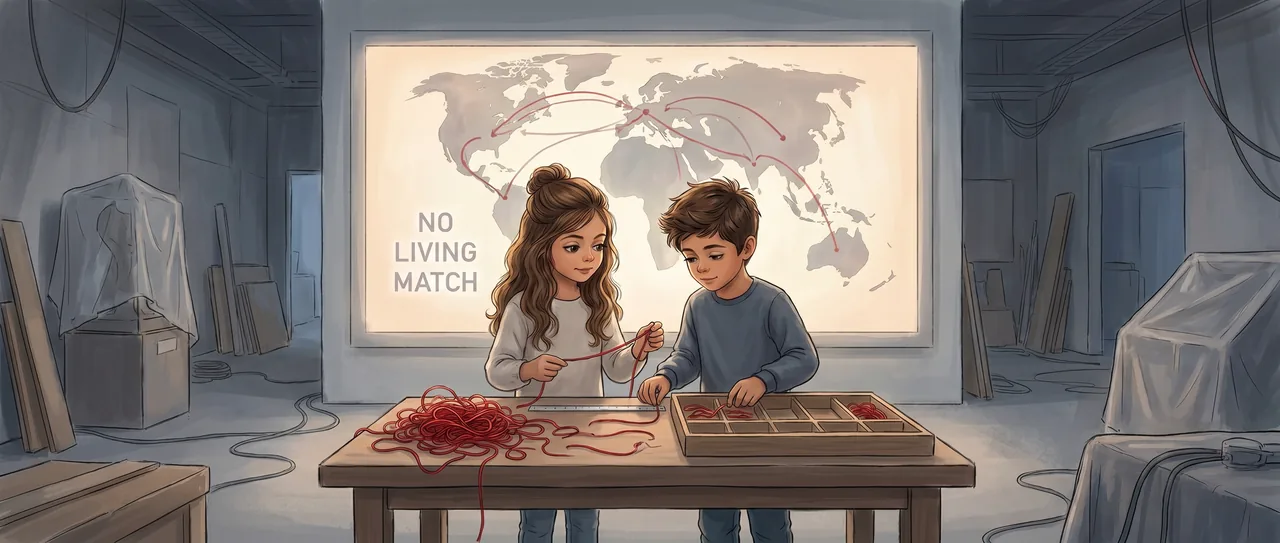
The Red That Would Not Sort
The family tree refused to grow.
On the museum screen, the trunk appeared, then two pale branches, then a blinking red box that said NO LIVING MATCH.
Soren tapped the reset square. The trunk appeared again. The branches appeared again. The red box came back, brighter than before.
Maya leaned so close her nose almost touched the glass. Behind the screen, sealed under a clear cube, lay a piece of bone smaller than a sunflower seed. It was not the real bone. The real one was locked away in another country, in a cleaner room than any room Maya had ever been allowed to enter. This was a cast, shaped from scans, sitting on black velvet like a crumb from the moon.
The exhibit manager hurried past with a roll of blue tape around her wrist and a coffee cup in each hand.
“Do not worry about the red,” she said. “The matching program is fussy. Ancient DNA is broken and messy. If it cannot place something, put it in the reject bin. We open in twenty minutes.”
“What if the red is the point?” Maya asked.
The exhibit manager had already crouched under a hanging sign that read MEET YOUR ANCIENT COUSINS.
Soren did not put the red in the reject bin. He wrote NO LIVING MATCH on the top of a page, then drew a box around it so hard the pencil dented the paper.
“It could be contamination,” he said.
“Does contamination come back in the same shape?” Maya asked.
Soren did not answer yet. He made the screen show the controls.
The gallery smelled like new paint, warm plastic, and the sharp lemon spray adults used when they wanted tables to look cleaner than tables could possibly be. All around them, the unfinished exhibit waited. A Neanderthal skull cast watched from one shelf. A wall map of Eurasia glowed faintly. Three bins of colored fiber strands sat under the screen, ready for visitors to build ancestry pictures with their hands.
The control marked EMPTY TUBE showed nothing. The control marked MODERN HANDLER showed a clean match to living humans. The ancient bone sample showed gray, blue, gray, blue, then red.
Soren ran the comparison again with the red pieces hidden.
The screen smiled politely. PROBABLE NEANDERTHAL RELATIVE.
He ran it with the red pieces included.
The screen stopped smiling. NO LIVING MATCH.
Maya pulled a red fiber from the bin. It was thin and slick, like a thread from a robot spider.
“Again,” she said.
Soren changed the search. Instead of asking the program to place the whole ancient genome on a tree, he asked it to look for tiny matching stretches in living people.
The map woke up.
A small red mark appeared near Siberia. Then another. Then a faint scatter across East Asia. Then Central Asia. Then South Asia. Not everywhere. Not in one neat country. Not in one kind of face or one language or one flag. Just little red sparks, caught inside long living genomes.
Maya stopped moving.
The bone in the cube did not look small anymore. The museum did. The glass walls, the tape, the coffee cups, the whole bright room shrank around that crumb of bone. Somewhere, forty thousand years before the sign makers and the cleaning spray and the blinking screen, a person had carried blood and breath and ordinary hunger through a cold place. That person’s people had not vanished in the tidy way a tree diagram wanted. Tiny pieces of them had crossed mountains, rivers, births, winters, and names nobody had written down.
Soren touched one red mark on the map.
“If the whole thing does not match any living population,” he said, “but pieces match living people...”
“Then the tree is lying,” Maya said.
“Not lying,” Soren said. “Too simple.”
Maya grabbed three fiber strands, gray, blue, and red. She laid the gray one straight on the table.
“Modern humans,” she said.
Soren put the blue one beside it.
“Neanderthals.”
Maya held the red one over them both, not touching.
“What do we call the red before it has a name?” she asked.
Soren looked at the tiny bone cast. “The reason to make a new name.”
The exhibit manager returned, trailing a strip of tape from one shoe.
“Please tell me the family tree works,” she said.
“No,” Maya said.
The manager closed her eyes for exactly the length of one tired breath.
“But the exhibit works,” Soren said.
He switched the display from TREE to SEGMENTS. The blinking red box disappeared. In its place, the ancient genome became a long bar with broken colors. Under it, the living genomes lined up as thinner bars. Most did not carry the red. Some did. The red appeared in small pieces, tucked among gray, here and there, like embers under ash.
The manager leaned closer.
“That looks complicated,” she said.
“It is,” Maya said.
“We can make it touchable,” Soren said.
They worked fast.
Maya moved the skull cast to one side and cleared the center table. Soren found clips, labels, and a roll of clear line. They set three upright shapes on the table. One was labeled living humans. One was labeled Neanderthals. The third had no face and no name yet, only a blank oval of frosted plastic.
The manager watched them with the expression adults get when they are deciding whether stopping children will take longer than letting them continue.
Maya clipped gray fibers from the living humans shape across the table to the present-day map. Soren clipped blue fibers between Neanderthals and the ancient bone sample. Then he handed Maya the red.
“Not too many,” he said. “Small amounts.”
“I know,” Maya said.
She did not spread the red everywhere. She placed it where the map had shown it, a thin strand here, another there, crossing into the living human lines. Each red thread looked almost accidental until there were enough of them to make the blank shape seem less blank.
The manager read the screen aloud. “Ancient DNA from Denisova Cave. A previously unknown human group, identified from DNA.”
“Denisovans,” Soren said.
The word sat between them, new and old at the same time.
A family entered the gallery early, then stopped because there was no path around the three of them and the table full of threads. A small child pointed at the blank figure.
“Where is that one’s face?” the child asked.
Maya looked at Soren.
“We do not have it,” he said.
The exhibit manager opened her mouth, probably to say something cheerful about artists’ impressions.
Maya said, “Leave it blank.”
The manager looked from the faceless shape to the red threads to the bone crumb under glass. Then she peeled the tape from her shoe and stuck it to the underside of the table where nobody could see it.
“Blank,” she said.
Soren made one last label. He did not put it on the figure. He clipped it below the red strands, where visitors would have to bend down to read it.
Some human stories are found first as pieces that do not fit.
Maya pinched the loose red strand from the table. Soren held the far end over the blank figure, and the fiber shivered in the air between their hands.
Read the interactive version, listen to the narration, and earn a gold star →
A science-verified short story for curious kids · Curiosity Land