The Parent Line
The red string was supposed to go from parent to child.
That was the whole exhibit.
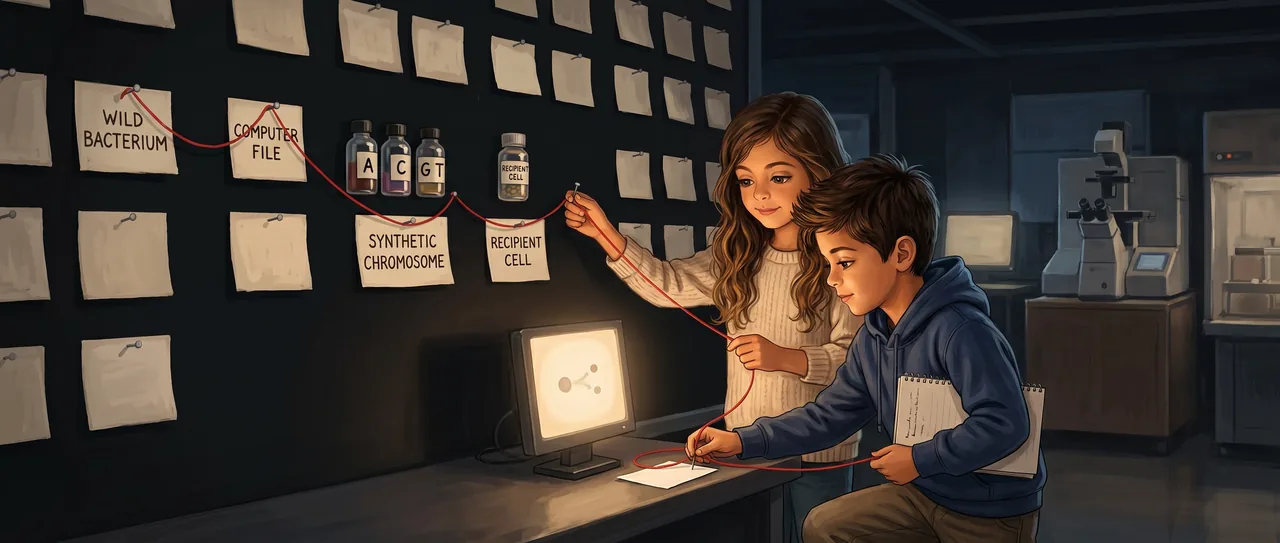
There were metal pins on a black wall, each one holding a round white label. One said WILD BACTERIUM. One said RECIPIENT CELL. One said SYNTHETIC CHROMOSOME. One said COMPUTER FILE. At the bottom, under a glass shelf, a screen showed pale dots drifting in a drop of broth.
“They divide every forty minutes if the temperature stays right,” said the curator, who had a tape measure hooked over one shoulder and a purple marker behind her ear. “Please do not touch the incubator. Please do not breathe on anything blue. Please do not let the opening begin with a blank family tree.”
Then she hurried away because someone had hung the banner crooked.
The banner said SCIENTISTS CREATE LIFE.
Soren looked at it for a long time.
“No,” he said.
Maya had already taken the red string. “No to the banner or no to the string?”
“Yes,” said Soren.
Maya grinned. “Good. I hate both.” A machine labeled DNA SYNTHESIZER had a clear door and a row of bottles with names that looked too short to be powerful: A, C, G, T.
Maya held the end of the string against COMPUTER FILE.
Soren held the other end back. “A file is not a parent.”
“It was first,” Maya said.
“A recipe is not a cake’s mother.”
“A genome is not a recipe.”
“It kind of is.”
Maya let the string sag between them. “Kind of is not enough.”
Soren took out his paper notebook. The gallery computer, noticing the motion, woke up and said, “Welcome, young researcher.”
Soren shut the notebook halfway. “It thinks paper is a medical emergency.”
Maya touched the screen. A timeline bloomed across it.
First, researchers read the DNA sequence of a bacterium. Then the letters were stored in a computer. Then short pieces of DNA were chemically made from those letters. Then the pieces were joined into a complete bacterial chromosome. Then that chromosome was placed into a different bacterial cell. The cell began using the synthetic genome. Its descendants carried that genome.
Maya read fast, lips barely moving.
Soren read every word.
“Booted,” Maya said.
The screen had used that word too. Booted. Like waking a machine by giving it instructions. Except the thing waking was a cell.
Soren pointed with his pencil. “It still needed a cell. It did not start from powder and lightning.”
“I know.”
“So the parent is the cell.”
Maya touched RECIPIENT CELL on the wall. “Then why don’t the children become that kind?”
Soren stopped with his pencil in the air.
On the glass shelf, the pale dots drifted. One of them squeezed in the middle, slowly, like an invisible thread was pulling it into two beads.
Maya moved closer without touching. “That one is doing it.”
Soren leaned beside her.
The dot narrowed. It held. It pinched. Then there were two dots, almost touching.
The gallery speaker made a soft chime.
“Live microscope feed,” said the screen. “Descendants of a synthetic-genome lineage. Display culture is nonpathogenic and sealed.”
Soren whispered, “They keep making the file.”
“Not the file,” Maya said. “The chromosome.”
“From the file.”
“From the letters.”
“From bottles.”
“From somebody deciding the order.”
They looked back at the wall. The red string hung from Maya’s hand like a question that had gotten tired.
The curator passed by carrying a stack of glossy programs. “Wonderful! Put the string wherever it looks dramatic. Press arrives in twelve minutes.”
“Dramatic is not a rule,” Soren said.
“It is in museums,” the curator said, and vanished behind the banner.
Maya clicked another tab. The heading said WATERMARKS.
A row of DNA letters filled the screen, A and C and G and T in blocks. Under it, the computer translated chosen parts into ordinary letters.
Soren read aloud. “The researchers put identifying sequences into the synthetic chromosome.”
“Like signing it,” Maya said.
“Like proving it was not natural contamination.”
“Also signing it.”
The screen showed that the synthetic genome carried coded messages, including names and an email address, and words chosen by the researchers. The letters were not genes the cell needed for eating or dividing. They were marks placed so anyone reading the DNA could tell where it came from.
Maya tapped the glass over the drifting cells. “They have that?”
“If they descended from it,” Soren said.
The screen offered a button: FIND THE WATERMARK.
Maya pressed it.
A new image appeared, not the microscope now, but a sequencing readout from the exhibit culture. Long lines of A, C, G, and T ran across the screen. Most of it looked like weather made of letters.
Soren took the printed guide from a holder. “It says the watermark is in this region.”
Maya dragged the search box. “There are too many letters.”
“Use the flanks.”
“The what?”
“The guide says there are matching stretches before and after. Like bookends.”
Maya’s fingers moved quickly. Too quickly. She overshot the region twice. Soren read the coordinates, steady as footsteps.
“Start near one million, eighty thousand.”
“That is not near anything.”
“For a genome, it is.”
“Say smaller numbers.”
“One, zero, eight, zero, zero, zero, zero.”
Maya pulled the slider. The letters jumped.
“There,” Soren said.
“I see the left bookend.”
“And the right.”
Maya highlighted the block between them.
The computer paused, then changed the four-letter DNA into the alphabet code the exhibit used.
The words appeared.
What I cannot build, I cannot understand.
No one spoke.
The dots in the sealed drop kept drifting.
Soren’s notebook had fallen open against his wrist. On the page were half-finished lines, arrows, crossed-out guesses, a small drawing of the family wall. The living cells on the screen carried a message that had started as chosen letters and then become chemistry and then been copied by something too small to see with bare eyes.
Maya did not bounce or grin. She put one finger against the glass, not touching the blue seal.
“They left a thought inside it,” she said.
Soren swallowed. “And it copied the thought when it divided.”
“Not because it cared.”
“No.”
“Because that is what cells do.”
Soren looked at the labels again.
The curator’s voice rose from across the room. “Nine minutes! Why is my banner still insulting bacteria?”
Maya pulled the pin from WILD BACTERIUM and moved it higher on the wall.
“Hey,” Soren said.
“It matters, but not there.”
He watched her place it at the top left, above COMPUTER FILE. Then he nodded once and moved SYNTHETIC CHROMOSOME between the file and the recipient cell.
“Not a family tree,” he said.
“A boot path,” Maya said.
“Also a family tree.”
“Wrong in an interesting way.”
They worked fast.
The red string began at WILD BACTERIUM, because the original DNA sequence had been read from something alive. It ran to COMPUTER FILE, because the sequence had been stored there. It crossed to the DNA SYNTHESIZER display, where bottles of A, C, G, and T waited behind plastic. It looped around SYNTHETIC CHROMOSOME, then passed through RECIPIENT CELL, then dropped to the screen of dividing dots.
Soren added small gray string from RECIPIENT CELL to the first booted cell.
Maya looked at it. “Body help.”
“Cytoplasm,” he said.
“Body help is better for the wall.”
“Cytoplasm is true.”
Maya found a blank label and wrote CYTOPLASM, THEN BODY HELP under it in smaller letters.
Soren did not object.
The curator arrived with the crooked banner rolled under one arm. She stared at the wall. Her mouth opened, closed, then opened again.
“You changed it,” she said.
“Yes,” Maya said.
“It was supposed to be simple.”
“It was wrong simple,” Soren said.
The curator read the labels in order. Her purple marker slipped from behind her ear and bounced on the floor.
Behind the glass, another pale dot began to pinch.
The curator picked up the marker and crossed out SCIENTISTS CREATE LIFE on the banner. Under it, in large uneven letters, she wrote THE FIRST ORGANISM WHOSE GENOME PARENT WAS A COMPUTER FILE.
“That is too long for a banner,” she said.
“It fits the universe better,” Maya said.
A bell rang near the entrance. The first visitors were being let in.
Soren was still looking at the bottom of the wall. The red string ended at the live microscope screen, but the screen was not an ending. The dots were dividing again.
He took one more blank label from the stack.
Maya took another pin.
They placed the empty label below the screen, where the wall had nothing printed yet.
Maya pinched the empty label open, and Soren tied the red string to its string.
Read the interactive version, listen to the narration, and earn a gold star →
A science-verified short story for curious kids · Curiosity Land