The Letters That Had To Be Fed
On the morning the six-letter cells refused to make their green protein, the lab director blamed the clock.
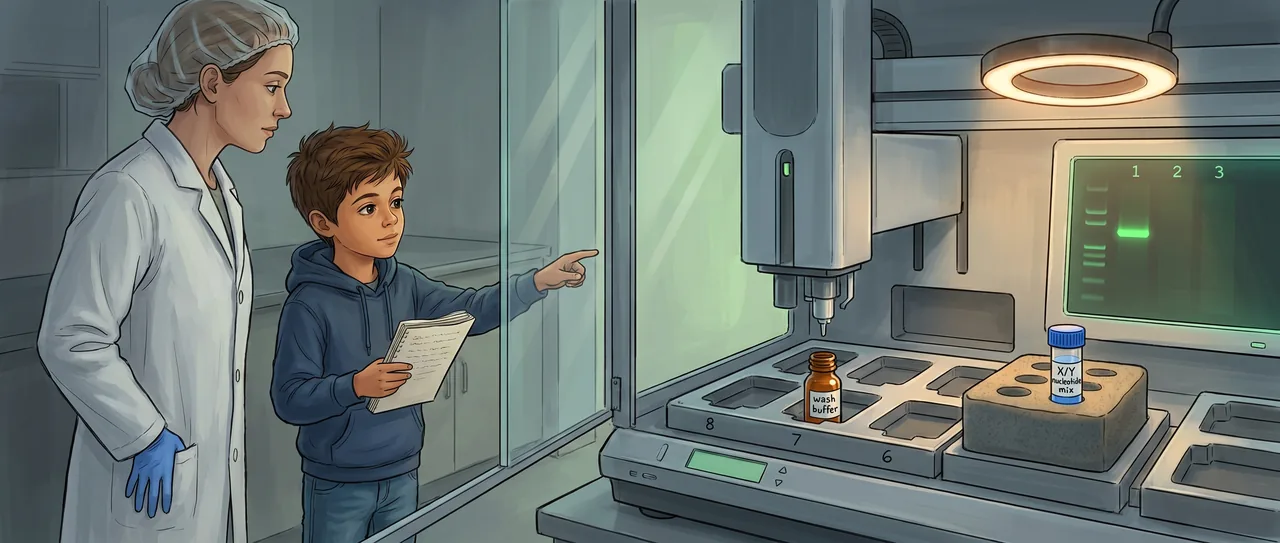
"Overnight cultures are moody," she said, tapping the glass of the incubator as if the bacteria inside could hear manners. One glove was tucked into her sleeve. Her hairnet had escaped over one ear. Behind her, a room of silver machines hummed softly, each with a window and a blinking light.
Soren stood at the front because everyone else had stepped back when the display screen showed the result.
Lane one had a bright green band. That was the ordinary test protein.
Lane two was empty. That was the control without the special instruction.
Lane three was supposed to be the exciting one. It was labeled expanded alphabet.
Lane three was empty too.
The other visitors made disappointed sounds. Soren opened his paper notebook. A boy beside him whispered, "Does that thing need charging?"
Soren did not answer. The empty band was better than a glowing one, but only if it was empty for the right reason.
The lab director clapped once. "Good news. Failure is a real lab result. Bad news. Our schedule says you were supposed to gasp right now. Please imagine gasping. Then we will move to the protein printer."
Soren raised his hand.
The director looked at him, then at the clock, then back at him. "Fast question. Donors in ten minutes."
"Did the cells lose the extra letters?"
The room got quieter in the way rooms do when someone asks a question that is not on the tour.
The director lowered her hand from the incubator. "That is not the fast question I expected."
Soren turned his notebook so he could see his own marks. He had drawn the path as boxes, because paths behaved better when they were trapped on paper. Cell alive. DNA inside. Extra letters present. Message copied. Ribosome reads it. Non-natural amino acid added. Protein folds.
The printed troubleshooting sheet on the wall had only four boxes. Cells alive. DNA inside. Protein made. Contamination.
Soren had drawn a fifth box between DNA inside and message copied. He had drawn it as a small doorway.
"The cells grew," he said. "So they were alive. Lane two is empty, so the detector works. If lane three is empty, maybe the strange part never got copied."
"Or the protein folded badly," said the director. She said it quickly, already reaching for her tablet.
"Then there might be a smear," Soren said. "Or a weak band. It is not trying. It is missing before trying."
The director stopped reaching.
Behind the glass, the incubator shelves trembled with tiny motors. The cultures sat in sealed clear cartridges, each one cloudy with millions of harmless E. coli cells. The director had told them at the beginning that the cells could not make the extra DNA letters themselves. No pond had them. No person had them. They were synthetic molecules, made in a lab and fed to the cells like rare vitamins. The cells carried a bit of DNA with the usual A, C, G, and T, plus two extra bases the tour called X and Y. If X was there, Y paired with it. If both were supplied, the bacteria could copy DNA with six letters instead of four.
Soren had not liked that at first.
In school, the poster said life used four DNA letters. A with T. C with G. Four was tidy. Four fit on posters. The director had said, "Today you will meet cells that can hold two more."
Soren had said, before he could stop himself, "Then the poster is wrong."
"The poster is incomplete," the director had said. Then she had smiled too brightly, as if that fixed anything.
Incomplete things did not fix themselves. They waited in corners.
Now the director swiped through the robot log. "The plasmid was there. The cells grew. The special transfer RNA was there. The non-natural amino acid was in the mix."
Soren pointed to his fifth box. "Where is the X and Y food?"
"Deck slot seven," said the director.
The robot stood behind a clear shield. Its deck held plastic racks, pipette tips, cold blocks, and small amber vials with white labels. Each slot had a number. Slot seven held a vial marked wash buffer.
The director stared at it.
Soren looked at the loading map on the tablet. Slot seven was colored blue and labeled synthetic base triphosphate mix.
He looked back at the robot. Wash buffer.
The director said a word that made several adults near the door pretend to cough.
"Yesterday we photographed the setup for the university page," she said. "We moved the amber vial so the label would face the camera."
Soren looked along the bench. There, in a small foam holder beside a ring light, sat an amber vial with a blue cap. Its label read X/Y nucleotide mix, keep cold.
The director pressed both hands against her hairnet. "We asked them to spell with missing letters."
Soren liked that sentence. It was the exact shape of the failure.
The donors arrived in suits. The director had to greet them with half a glove still tucked in her sleeve. She began explaining the protein printer in a voice that tried to sound cheerful and not like it was thinking about slot seven.
Soren stayed by the sealed cultures.
An assistant, also behind glass, loaded a fresh cartridge with the correct vial while the director talked too loudly about enzymes. Soren watched every step on the screen. The cells would need hours. Living things did not care about tour schedules. They copied when they copied. They read when they read.
The director came back when the donors were busy taking pictures of a robot arm.
"You do not have to wait," she said.
"I know."
"It will be tomorrow before there is enough protein to show."
"I know."
She looked at his notebook. "What is that symbol? The little doorway?"
"A place where the wrong answer can fit," Soren said.
The director did not smile brightly this time. She looked through the glass at the cloudy cartridges.
"Most people ask what the new letters do," she said. "You asked what keeps them from disappearing."
Soren touched the page with his pencil, but did not write. The cells needed the extra letters every time they copied the special DNA. Without the feed, the expanded alphabet was not wicked or magical or fake. It was hungry.
The next morning, Soren came back before the public doors opened. His mother waited in the lobby with coffee and a book. The director met him at the lab window with the same hairnet, now properly trapped.
"Ready?" she asked.
Soren nodded.
On the screen, lane one glowed green. Lane two was empty.
Lane three glowed too.
Not brighter. Not stranger-looking. Just a clean green band in the place where emptiness had been.
The director opened a second display. It showed a string of protein beads, most of them ordinary colors from the twenty amino acids living cells usually use. In the middle sat one silver bead.
"That position was read from a codon containing the synthetic base pair," she said. "The ribosome still did the reading. The engineered transfer RNA brought in an amino acid ordinary E. coli does not use. "
Soren leaned closer to the glass. Yesterday, the extra letters had seemed like stickers pasted onto life from the outside. Now they sat in the same sentence as the old letters, copied by the cell, carried into a message, answered by a ribosome older than bones and trees.
"How many words can it make?" Soren asked.
The director pulled a plastic model from under the counter. It had slots for three-letter codons. The ordinary set was clipped in rows, A, C, G, and T. Beside them was a small tray with X and Y tiles.
"With four letters, sixty-four three-letter codons," she said. "With six letters, two hundred sixteen possible three-letter codons. Possible is not the same as useful. A living cell is picky. Chemistry is picky. But possible is a very large place."
She slid the tray toward him.
Soren took one of the blank codon tiles from the tray. He set X beside Y beside A, and the plastic strand snapped shut around the three letters.
Read the interactive version, listen to the narration, and earn a gold star →
A science-verified short story for curious kids · Curiosity Land