The Letter That Would Not Break
The first time Soren broke the gene, the screen applauded.
Golden confetti burst over his bench. A cheerful voice said, “Target found. Double-strand cut delivered.”
“That sounds bad,” Soren said.
“It is supposed to,” said the instructor. She was already halfway to another table, a woman in a yellow lab coat with a timer clipped to her sleeve and three styluses tucked behind one ear. “Old-style CRISPR challenge. Find the wrong letter, cut there, let the cell repair it. You have eight minutes.”
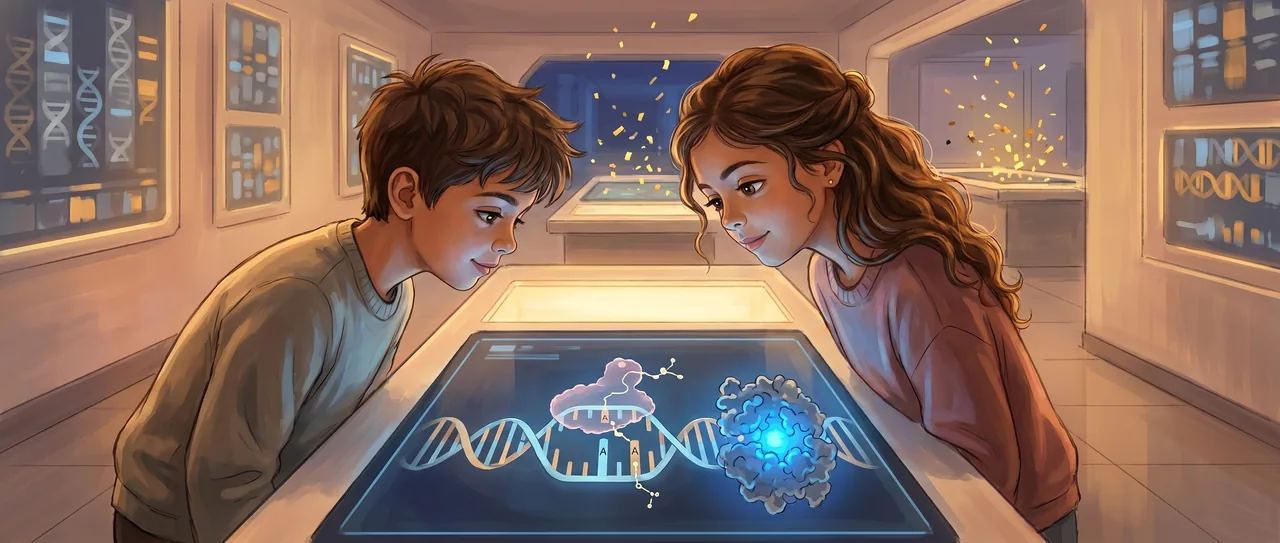
Maya leaned over the glass bench. Under it, a strand of DNA floated like a ladder made of light. Four letters ran along it in repeating colors. A, C, G, T. A, C, G, T. Not words exactly. More like a code that refused to look important until one piece was wrong.
“There,” Maya said.
Soren looked where she pointed. “Why there?”
“It stutters.”
“That is not a measurement.”
“It is a stutter.”
Soren slid his finger along the glowing line, counting groups of three the way the bench had taught them. The training cell was supposed to make a blue protein. It did not. Somewhere in its instructions, one letter had changed. The simulator had folded the protein into a dull gray knot.
At the spot Maya chose, the normal reference above the strand showed a G. Their strand had an A.
Soren tapped it. The bench chimed.
“Target confirmed,” it said.
Maya grinned. “Stutter.”
Soren set the guide. The virtual CRISPR machine drifted in, small and bright, led by its matching strip of RNA. It found the place, clamped down, and snipped both rails of the ladder.
The DNA ends sprang apart.
Then the cell’s repair crew arrived.
They looked, to Soren, like tiny silver beetles with too many elbows. They pulled the broken ends together. They patched. They trimmed. They added a letter that had not been there before.
The protein tried to fold again.
It collapsed into gray.
The screen applauded anyway.
Maya frowned at the confetti. “That is wrong applause.”
At the next bench, someone shouted, “We got ninety percent cut!”
The instructor clapped once. “Good targeting.”
Soren ran their simulation again. Same guide. Same correct place. Same clean cut.
This time the repair crew chewed away two letters.
Gray knot.
He ran it a third time.
One extra T.
Gray knot.
“The target is right,” Soren said. “The fix is not.”
Maya did not answer. She was watching the broken DNA ends twitch before the repair crew caught them. Her face had gone very still, which usually meant she had moved ahead without telling anyone.
“What?” Soren asked.
“It wants to heal,” she said. “Not to spell.”
The instructor arrived with her timer flashing amber. “How are we doing?”
“We found the mutation,” Soren said. “But the repair keeps making new mistakes.”
“That happens,” she said. “Cells repair breaks in different ways. Try another guide. You need the cut closer to the letter.”
“It is already on the letter,” Maya said.
The instructor glanced at the screen. “Then you are learning an important thing. Cutting is powerful, not perfect.” She tapped her timer. “Five minutes.”
She moved away before Maya could make the face she made at answers that walked in circles.
Soren opened the tool menu. There were icons for scissors, clamps, delivery shells, guide strands, repair templates, safety locks. At the bottom, half hidden under a tutorial banner, was an icon shaped like a pencil tip.
Maya touched it before he finished reading.
The bench went quiet.
No confetti. No cheerful voice.
A question appeared.
Which letter change?
Under it were only certain choices. C to T. G to A. A to G. T to C.
Soren felt his mouth go dry in the good way, the way it did when a puzzle stopped being flat.
“Our wrong A should be G,” he said.
Maya tapped A to G.
A different machine appeared over the DNA. It still carried a guide strand, and it still searched by matching letters. But there were no scissor blades. It settled over the stuttering place like a bird covering an egg.
The ladder did not snap.
One rail loosened. The A shivered. A small chemical arm reached in.
The A became something almost A, then not A.
The screen showed G.
“That was too small,” Maya whispered.
Soren leaned so close his nose nearly touched the glass. “It did not cut both strands.”
The repair beetles came anyway, but slower this time, calmer. They did not swarm a break. They followed the changed letter, copying it into the partner strand as if correcting a smudge.
The protein folded.
Blue spread through it.
Not screen blue. Not paint blue. A living sort of blue, deep at the center, as if a tiny evening had turned on inside the molecule.
The bench did not applaud.
It showed one line.
Edit accepted. No double-strand break detected.
Maya’s hands hovered above the glass. “Again.”
Soren ran it again.
The guide found the place. The editor settled. The letter changed. The ladder held.
Blue.
Again.
Blue.
Again.
Blue.
At other benches, confetti kept popping. Children cheered when the scissors found their targets. The room loved noise. It loved big gestures. It loved cutting exactly where it was told to cut.
Their bench made no sound at all.
It only changed one letter.
Maya looked at Soren. Her eyes were bright and almost angry. “This is for tiny wrongness.”
Soren nodded. He thought of all the times people had told him a thing was close enough when it was not close enough. A date copied with two digits reversed. A screw that fit until it stripped. A music note just below the pitch. Here was a machine for the size of wrongness that most people walked past.
The instructor came back. “Why is your applause off?”
“We stopped using scissors,” Maya said.
The instructor blinked. “This is the CRISPR cutting challenge.”
“It kept breaking the sentence,” Soren said.
He showed her the three failed repairs. Extra letter. Missing letters. Gray knot. Then he showed her the quiet run.
The instructor’s timer buzzed red. She did not look at it.
“You found the base editor menu,” she said.
“It was under the banner,” Maya said.
“It changes A to G,” Soren said. “No double-strand cut.”
The instructor put one hand on the bench, not touching the controls. Her yellow sleeve reflected in the glass. “Base editors are newer refinements. They are built from CRISPR parts, but they carry a chemistry tool instead of ordinary scissors. They can only do certain letter changes. When the needed change is one of those, they can be beautifully precise.”
“Then why was it hidden?” Maya asked.
The instructor looked toward the other benches, where confetti burst again and again. “Because I like the scissors demo,” she said. “It is dramatic.”
“It is messy,” Maya said.
“Yes,” the instructor said. “It can be.”
Soren expected her to take over. Adults often did that at the exact moment something became interesting. Instead, she unlocked a side panel and stepped back.
“Since you object to my lesson plan,” she said, “try the real question.”
The bench changed.
The training gene vanished. In its place came a long dark field of letters, too many to count. A label appeared at the top.
Single-letter variants of unknown significance.
Most letters were gray. Some glowed blue. Some glowed amber. Many had tiny tags beside them with question marks.
Maya did not touch anything.
Soren did not either.
The strand kept unrolling beneath the glass, longer than the bench, longer than the room could possibly hold. A code from real people, with names removed. Places where one letter differed. Places where nobody yet knew whether that difference mattered. The room seemed to move farther away without changing size. The benches, the timer, the confetti, the instructor’s yellow sleeve, all of it became small beside the river of letters sliding under their hands.
Maya stepped closer until her breath made a pale oval on the glass. One blue letter blinked. Then another. Then another.
Read the interactive version, listen to the narration, and earn a gold star →
A science-verified short story for curious kids · Curiosity Land