The Letter That Stayed
The first thing Soren did was kill the yeast.
Not the real yeast. The real yeast slept in sealed plastic cartridges under a blue sticker that said harmless strain, do not open. Soren had only killed the simulation yeast, which was less tragic, but still embarrassing because the instructor’s eyebrows climbed almost into her hairnet.
On his screen, the tiny round colonies had gone from brick red to gray.
The instructor leaned over with a mug of cold tea in one hand and a tray of labels stuck to her sleeve. She had been trying to teach twelve children, fix a colony counter, and remember where she had put her glasses, which were on top of her head.
“Double-strand break,” she said. “Very bold.”
“I was trying to fix one letter,” Soren said.
“With a sword.”
“It said CRISPR.”
“It did.” The colony counter made a grinding noise behind her. She winced. “Some CRISPR tools are scissors. Some are not. The repair challenge closes in twenty minutes. Try not to murder any more imaginary yeast.”
Then she hurried away to argue with the colony counter, which had begun counting the sticker on its own lid.
Soren looked back at his screen.
The challenge was supposed to be simple. A yeast gene had one wrong DNA letter. With the wrong letter, the yeast colonies grew red. With the correct letter, they would grow pale cream. The cartridge robot would try the best designs for real, overnight, and tomorrow everyone would see which edits worked.
One letter. Four possible DNA letters. A, C, G, T.
Soren had written the broken word in his notebook because screens let letters slide around too easily. He had copied the target sequence twice, then circled the mistake until the paper almost tore.
Everyone else at the long bench liked the big edits. They made the simulation slash chunks out of DNA or paste glowing jellyfish genes into practice genomes that were not connected to living cells. Their screens flashed with fireworks when they made changes large enough for the program to celebrate.
Soren’s screen did not flash.
It displayed a red colony and one wrong letter.
He opened the tool menu again. The first button showed scissors. He avoided it.
The second button showed something like a pencil riding on a small folded ribbon.
Prime editor.
Soren clicked.
The screen changed into two boxes.
Find:
Replace with:
Soren sat up straighter.
That was not how the videos talked about DNA. The videos talked about twisting ladders and codes and enzymes with names that sounded like broken robots. They did not talk about the old search box in the corner of a document, the one Soren used when a teacher asked for “color” and the assignment template said “colour” six times.
Find. Replace with.
He typed the wrong letter into Find.
The program immediately outlined half the genome in orange.
Too many matches.
Soren made a face. Of course. Looking for one A in DNA was like looking for one grain of rice in a cafeteria.
He copied more letters from the left side of the mistake. Then more from the right. Orange outlines disappeared one by one until only a single bright place remained. The guide RNA on the screen curled toward it, matching the DNA letters the way a zipper finds its teeth.
The program still would not accept the design.
A message appeared: Replacement sequence missing from extension.
Soren frowned at it.
He had told the machine where to go. He had told it the correct letter in the Replace box. The box was full. The box was right.
The tiny pencil-ribbon picture blinked patiently.
Soren clicked the help diagram, not the words, just the diagram.
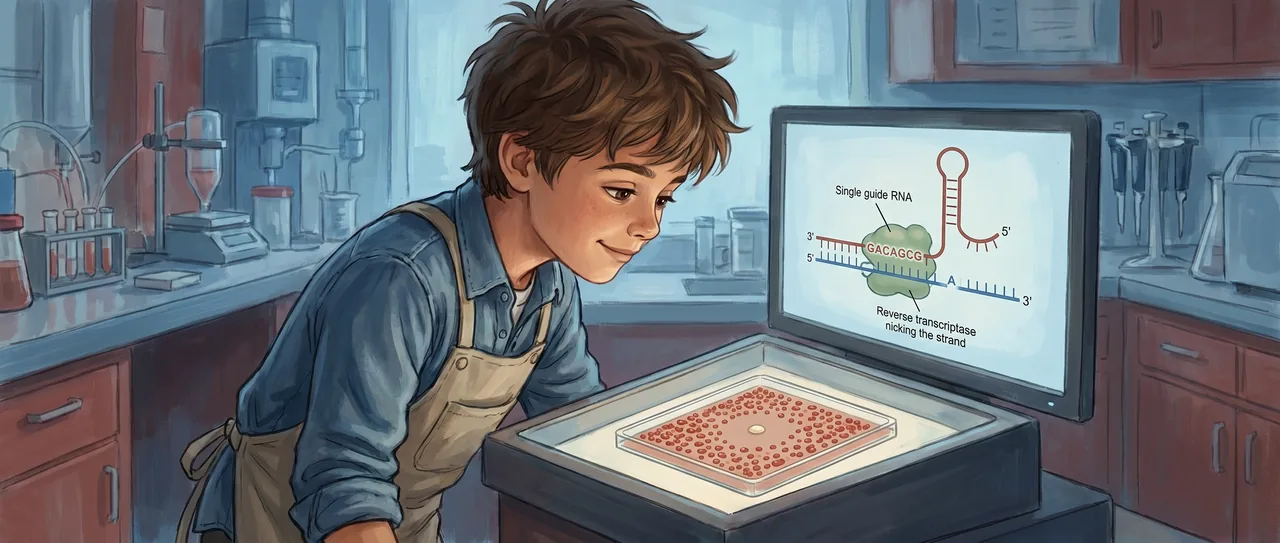
A guide RNA slid across the screen. One part of it matched the target DNA. Another part trailed behind, carrying extra letters. An enzyme rode with it, labeled reverse transcriptase. When the guide found its place, the enzyme did not chop both strands apart. It nicked one strand and wrote from the RNA’s extra letters, making new DNA right there, letter after letter.
Soren touched the screen with one finger, not hard enough to leave a print.
The replacement was not waiting in a separate pile.
The replacement traveled with the finder.
He looked down at his paper. He had drawn the wrong thing. He had drawn a map, then a package somewhere else. But this tool was map and package together. The guide did not only say, go here. It also carried, write this.
The room seemed to tilt wider around him. The colony counter beeped triumphantly.
“It counted the air bubble,” the instructor said from across the room. “Wonderful. Very proud of it.”
Soren erased his design.
This time he did not start with the wrong letter. He started with the neighborhood.
The program needed a place where the editor could sit down beside the DNA. It highlighted little permission marks near the target. Soren chose the one that let the guide reach the mistake without stretching too far. He copied the matching letters into the find arm. Then, in the guide’s extension, he typed the corrected stretch, not only the new letter but the letters around it, so the enzyme would have something to copy.
The simulation hesitated.
A small animation appeared.
The guide RNA drifted through a dark blue tangle of letters. It ignored near matches. It paused at one, tested itself, and drifted on. At the true match, it zipped down. The enzyme bent close. A new strand grew, carrying the cream-making letter inside it.
The red colony on the right did not explode into fireworks.
It simply paled.
Not white. Not shining. Just a quiet cream dot among red dots.
Soren let out a breath he had not meant to hold.
The instructor came back with her glasses now properly on her nose and three labels on her elbow.
“You got a candidate?” she asked.
Soren turned the screen toward her.
She glanced once. Then she glanced again, slower.
“That’s tidy,” she said.
“It only needed one letter.”
“That is usually when tidy matters most.”
She reached for the cartridge tray, but Soren put his hand over the print button before she could press it.
“Wait,” he said.
The instructor froze. Her mug tilted dangerously.
Soren checked the find sequence against his notebook. He checked the replacement extension. He checked that the corrected letter appeared in the writing part, not only in the label box at the top of the screen. He checked the permission mark. He checked the warning list.
No perfect off-target matches.
One possible near match, four letters different.
He did not like the near match. Four letters different seemed like enough, but enough was a word adults used when they were tired.
He lengthened the guide by one letter.
The warning disappeared.
Now the print button glowed.
“Now,” Soren said.
The instructor smiled, but not in the patient way adults smiled when children were taking too long. This smile was small and sharp, like she had found a useful tool in the wrong drawer.
Soren pressed print.
Inside the sealed machine, plastic tubes clicked. The robot would mix the harmless yeast with the prime editing parts. The guide RNA would look for its matching place. The reverse transcriptase would write the corrected sequence into the genome. Some cells might accept the edit. Some might not. By morning, the cells would have voted in colonies.
Soren watched the cartridge slide into the warm incubator.
“Come early tomorrow,” the instructor said. “Color shows up better before everyone fogs the viewing hood with their noses.”
Soren did come early.
The lab smelled like warm plastic and toast. The instructor was already there, feeding labels into the printer the wrong way. She did not say good morning. She pointed with her elbow because both hands were full.
Soren went to the viewing hood.
His cartridge sat in the second row.
Most of the tiny colonies were red.
He leaned closer.
Near the center, no bigger than a pinhead, one colony was cream.
Not glowing. Not announcing itself. Just changed.
The instructor set down the labels very quietly.
“One cell got the rewrite,” she said.
Soren did not answer. He was looking at all the red colonies around it. Same food. Same warmth. Same plastic square. One letter different in one place, and the colony carried the difference where anyone could see it.
“What happens if the edit doesn’t change the color?” he asked.
“Then we have to sequence it,” she said. “Read the letters directly.”
Soren looked from the cream colony to the computer. The next challenge waited on the screen. No colors. No fireworks. Just a stretch of DNA and an empty replacement line.
He pulled the keyboard closer.
On the monitor, the cursor blinked beside a row of A, C, G, and T.
Read the interactive version, listen to the narration, and earn a gold star →
A science-verified short story for curious kids · Curiosity Land