The Gray Between
The cell was singing wrong.
On the glass wall of the Civic Biofoundry, a skin cell had lit up like a festival. Blue for nerve genes. Green for liver genes. A sharp white blink for insulin. Then a tiny gold tooth appeared in the corner of the display, which definitely did not belong in skin.
Maya leaned close enough that her breath made a cloud on the glass.
"It is using every voice," she said.
Soren looked at the control pad, then at the floor, where gray plastic genome tiles lay in stacks around their shoes.
"We did that," he said.
They had been asked to shorten the new exhibit before the afternoon opening. The full human genome display was too long, even when it was folded into loops of light and packed across an entire wall. Three billion base pairs made a lot of wall. Dr. Rao, the exhibit engineer, had marched through with a screwdriver in her hair and a clock panic in her voice.
"Visitors will not stand here for three billion letters," she had said. "Keep the gold tiles. Those are the protein-coding bits. Lose the gray for now. We can add nuance after opening. Nobody comes to a ribbon cutting for nuance."
She had grinned when she said it, but not very much.
The gold tiles were beautiful. They snapped into the wall with a soft click and carried strings of letters that became protein instructions. They were also rare. Out of every hundred letters in the human genome, about two belonged to protein-coding instructions.
The rest of the exhibit had been gray.
"Maybe the model is broken," Soren said.
Maya shook her head. "No. It is too not broken. Look. Everything works. Everything is on."
The wall shimmered. The skin cell tried to be muscle. Then blood. Then a piece of an eye. Each gene-light was clear and bright and wrong.
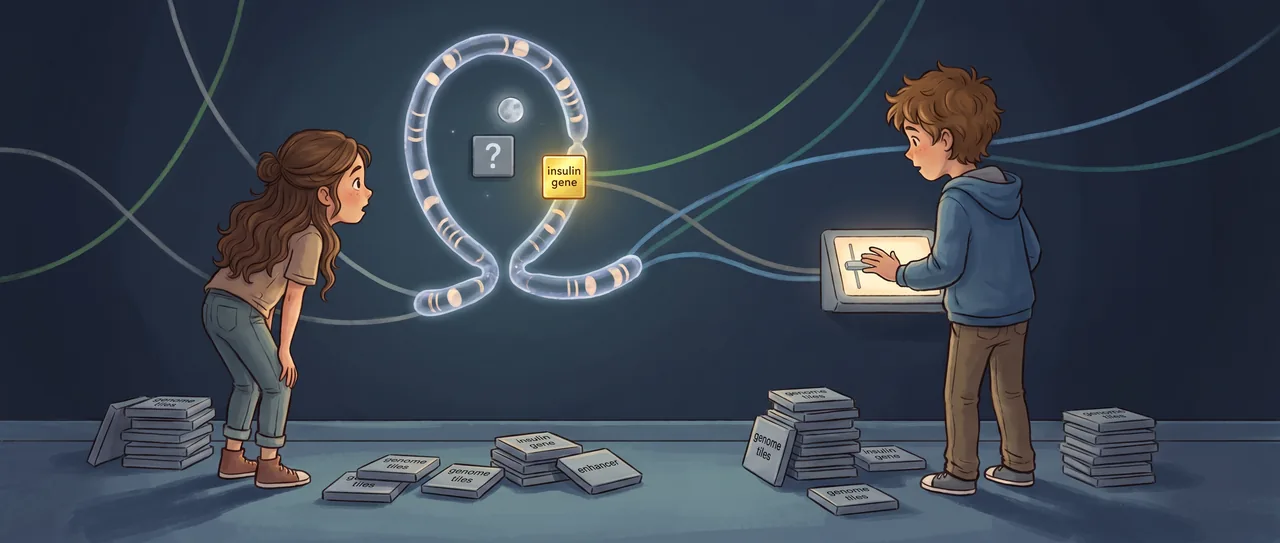
Soren crouched by the discarded tiles. Each gray strip had a small label. Enhancer. Promoter. Insulator. Repeat. Intron. Unknown. Some labels had question marks. Some had tissue names printed in tiny letters.
"They called this junk once," he said.
"People call things junk when they do not know where to put them," Maya said.
Dr. Rao hurried back in carrying a coil of cable over one shoulder.
"How is my simplified genome?" she asked.
The wall produced another tooth.
Dr. Rao stopped. "That is not ideal."
"The cell forgot it was skin," Soren said.
"The cell is a model," Dr. Rao said. "The model forgot it was skin. Important distinction."
"Can we put the gray back?" Maya asked.
Dr. Rao looked toward the lobby doors. On the other side, someone was testing a microphone. It squealed like a startled bat.
"All of it? No. We would need another wall and a calmer fire marshal." She tapped the control pad. "I can lock the demo to protein coding only. Clean story. Genes make proteins. Proteins make you. Fine for opening."
The skin cell flashed an insulin signal again.
Maya said, "That is not the story."
Dr. Rao sighed. Not an angry sigh. A person-with-seven-problems sigh.
"You have eighteen minutes," she said. "If you can make it clear, make it clear. If not, I lock it. Do not touch the live lab door, do not rewrite my code, and do not make any cell grow another tooth."
She ran toward the microphone squeal.
Soren picked up one gray tile and turned it over. "We do not need all of it. The model needs the parts that tell it when to read the gold."
Maya was already moving tiles into piles.
"Skin words. Pancreas words. Nerve words. Unknown words."
"They are not words," Soren said.
"Not-word words."
"Fine. Not-word words."
The exhibit had three cell buttons, skin, neuron, and insulin-making pancreas cell. Same genome behind each one. Different lights, if the switches worked.
Soren opened the data tracks. The exhibit used real genome maps from experiments, Dr. Rao had said that part twice because she was proud of it. Colored bands showed places where DNA was open and active in different cell types. Other bands showed where proteins tended to bind. Some gray regions sat right beside genes. Others were far away, across deserts of letters.
Maya held up a gray tile labeled enhancer, pancreas.
"This one is nowhere near the insulin tile," she said.
Soren checked the map. "In the straight line, no. But DNA folds. Far on the string can be close in the cell."
He dragged the folded-view slider. The wall curled the chromosome into a glowing loop. The gray tile swung inward until it hovered near the gold insulin gene like a small moon beside a planet.
Maya went still.
Thirty seconds before, DNA had been a sentence too long to read. Now it was a room full of folded strings, with distant pieces touching in the dark.
"Across the room counts," she said.
Soren did not answer right away. He was watching the gray moon.
"People keep looking beside the thing," he said. "But the helper may not be beside it."
Maya snapped the pancreas enhancer into place.
The insulin light stopped blinking in the skin cell. When Soren pressed pancreas, the same light came on steady and green, like a window opening.
"Again," Soren said.
They tried a nerve enhancer. In the neuron display, branching blue paths brightened. In skin, they stayed dark. They added a promoter near a gene that made a structural protein. That gene woke in the right cells and slept in the others. They placed an insulator tile and watched a neighboring light stop spilling into the wrong region.
Maya did not read every label. She read the pattern of wrongness. If a gene shouted in all three cell types, she searched for a missing boundary. If a gene stayed silent everywhere, Soren checked for a missing start signal. If a light came on in the wrong cell, they looked for the gray tile marked with the right tissue track and the right folded neighborhood.
The wall changed under their hands. "Six minutes," Dr. Rao called from the lobby.
"We need fewer tiles," Soren said.
"No," Maya said. "We need more gray. But only enough to show it is not empty."
They chose twelve gray tiles. Not all the gray. Not even close. A promoter. An enhancer far away. An insulator. A stretch labeled unknown. A strip that showed an intron inside a gene, removed from the final message but still part of the DNA. A tile with tiny marks from different cell types.
Soren changed the opening button names. Not delete. Listen. Then he hesitated and looked at Maya.
"Too much?"
"Good," she said.
The lobby doors opened.
Visitors came in with paper cups and bright stickers on their shirts. A small boy pressed the skin button before Dr. Rao finished saying welcome.
The wall lit gently. Only some gold genes came on. The skin cell held its shape.
Dr. Rao stood with the microphone near her chin.
"This exhibit," she began, then looked at Maya and Soren and lowered the microphone a little, "apparently has been revised."
Soren pressed the coding-only button.
The gold tiles shone by themselves. The model cell flashed too many colors. A few adults laughed when the tooth appeared.
Maya pressed listen.
Gray tracks flowed between the gold islands. Some lay close. Some looped from far away. The tooth vanished. The insulin light waited quietly until Soren pressed pancreas. The neuron button made blue branches bloom. Same genome. Different reading.
No one laughed that time.
A girl with a missing front tooth pointed to the gray strip labeled unknown.
"What does that one do?" she asked.
Dr. Rao lifted the microphone, then stopped.
Maya looked at the wall. The unknown strip had no tissue name. No clean answer. Just a position, a sequence, and a small white question mark.
"Nobody knows yet," Soren said.
The girl stepped closer.
"But it is still in there?"
"Yes," Maya said.
Dr. Rao reached over and, very carefully, turned the coding-only button off.
Maya slid the gray tile back into the empty place. On the wall, the word unknown shone beside it in small white letters.
Read the interactive version, listen to the narration, and earn a gold star →
A science-verified short story for curious kids · Curiosity Land