The Cut Was Not the Answer
The first thing the cells did was ruin Dr. Rivas's poster.
The poster hung above the demonstration bench in the New Harbor Genomics Studio. It showed a cartoon pair of silver scissors, a neat strand of DNA, and three enormous words.
FIND. CUT. FIX.
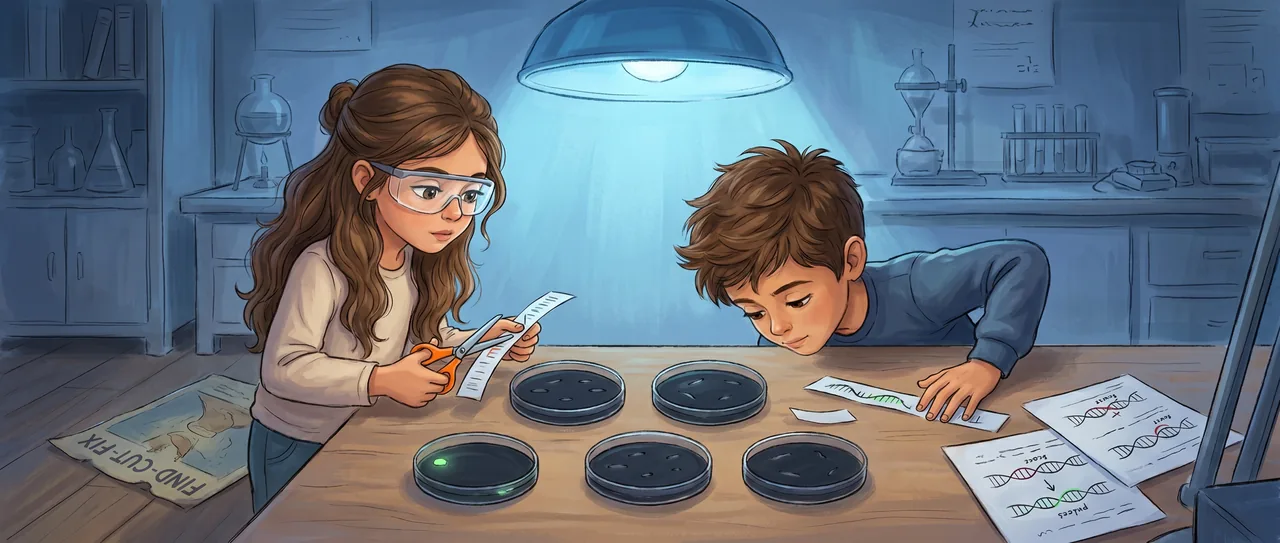
Under the poster, six clear plates sat in a row. Each plate held pale dots of cells, too small to see properly without the blue lamp. Three plates were supposed to glow green. Three were supposed to stay dark.
All six were dark.
Dr. Rivas stared at them through her safety glasses. She had glitter on one cheek from hanging a banner too quickly.
"That is not festive," she said.
Maya leaned close to the sealed lids. "They're not dead. They're dots. Just not glowing dots."
Soren had already pulled the printed readouts toward him. Long lines of DNA letters marched across the pages. Some places had small blank bites. Some had extra letters jammed in. One line had a clean new phrase where the old one had been.
"The poster is bossy," he said.
Dr. Rivas looked at the clock, then at the glass doors where a group of visitors was gathering outside. "The morning robot ran the edits. The guide RNA was correct. The cut site was correct. The donor template should have been added to the green set. I need to find out why the projector thinks my slides are soup. Please do not open anything. Please do not invent a new organism."
"We won't," Maya said.
"Sort the plates if you can," Dr. Rivas said. "The kids need one clean example. CRISPR cuts here, the replacement goes in, the cells glow. Simple."
She hurried away with the tangled projector cord over one shoulder.
Maya watched the door swing shut. "Simple things don't need six plates."
Soren put his finger under the first readout without touching the ink. "Same target in all of them. Same cut place. But this one lost two letters. This one gained one. This one lost seven."
"Random scars," Maya said.
"Maybe mistakes from the machine."
"No. Look." Maya turned on the blue lamp.
The plates flushed with cold light. The dots were still dark, but they were not the same dark. In three plates the colonies looked ragged, like tiny islands nibbled by waves. In the other three, the dots were smoother and more even. One plate had the faintest green speck near the edge, so faint Maya almost missed it, then didn't.
She pointed. "There."
Soren bent so low his nose nearly touched the shield. "One colony. Maybe the repair worked in that one cell. Or its children."
Maya tapped the poster. "Find. Cut. Fix. It says CRISPR does all three."
"CRISPR doesn't fix," Soren said. He said it slowly, like stepping onto ice. "It cuts. The cell fixes."
The blue lamp hummed.
Outside the doors, smaller children pressed their faces to the glass. One wore a shirt covered in planets. Another bounced on their toes with both hands in the air, though nobody had called on them.
Maya picked up the scissors from the paper model table. They were plastic, rounded, and orange. She cut through a strip that read THE GENE MAKES GREEN LIGHT.
The two halves curled away from each other.
"Now fix it," she said.
Soren took tape from the drawer and stuck the cut ends together. The sentence became THE GENE MAES GREEN LIGHT. The missing K left a crooked little jump.
"Still readable?" Maya asked.
"Maybe. Depends where the missing letter is."
She cut another strip in the same place.
This time Soren did not tape it. He looked through the readouts until he found a small printed donor template, a loose strip Dr. Rivas had prepared for the demo. It carried the same sentence, but with a new phrase tucked neatly inside.
THE GENE MAKES GREEN LIGHT WHEN REPAIRED.
He laid it under the cut strip. The matching words lined up on both sides, like train tracks meeting after a bridge.
"The cell can use a matching copy," he said.
"If it has one."
"If it has one at the right time. Cells like copying DNA before they divide. That's when matching copies are around."
Maya slid the six readouts into two groups. Not by glow. By scars.
In one group, every line broke at the same place, then returned with a different little mess. One had lost letters. One had gained a letter. One had both. None of the messes matched the others.
In the second group, most lines still showed the old sentence. But a few carried the same precise replacement, letter for letter, copied from the donor strip.
Soren checked each one, mouth moving silently over the letters.
"The dark plates aren't all the same failure," Maya said.
"They're two different repairs," Soren said.
The door opened. Dr. Rivas came back with the projector cord looped around her arm like a captured snake.
"Please tell me the universe has become more cooperative," she said.
Maya held up the ragged-readout group. "These didn't get the replacement. Or didn't use it. The cells grabbed the broken ends and joined them. Fast. Messy. Different scars. The green gene broke."
Soren held up the other group. "These had the template. A few cells copied the replacement exactly. Not many yet. But the same new letters show up every time it worked."
Dr. Rivas frowned at the pages. Her glitter cheek wrinkled. "But the visitors are expecting the glowing dish."
"Then show them why most of it isn't glowing," Maya said.
"That sounds less like a celebration."
Soren looked at the sealed plates, then at the children outside the glass. "It's better. The cut is not the answer. The repair is the answer. And there are two answers."
Dr. Rivas stopped untying the cord.
Maya picked up the poster. It came off the wall with a soft rip of tape. She flipped it over. The back was blank and bright white.
"We need a new sign," she said.
They made it in nine minutes.
Dr. Rivas found thick markers. Maya drew the DNA as a long ladder and put a red lightning mark where the cut went. Soren drew two paths below it.
On the left path, the broken ends came back together with little missing and added chunks. Under it Maya wrote FAST MEND. DIFFERENT SCARS.
On the right path, a matching strip floated beside the break. Under it Soren wrote MATCHING COPY. PRECISE CHANGE.
Dr. Rivas read the sign and opened her mouth.
"No tiny scissors with faces," Maya said.
Dr. Rivas closed her mouth.
The first visitors came in, smelling like raincoats and cafeteria apples. The planet-shirt child went straight to the blue lamp.
"Why is that one not glowing?" they asked.
"Which one?" Maya asked.
"All of them. Mostly."
Soren turned the lamp lower so the faint green speck could be seen. "This one has one colony that used the matching copy. The others repaired the cut another way."
"Like a bandage?" asked a child with silver beads in their hair.
Maya took two cut paper strips. She shoved the broken ends together, not quite straight. "Like this, sometimes. Quick enough to close the break. Not neat. The gene may stop working."
Soren laid the donor strip beneath another cut. "Or like this. If the cell has a matching piece, it can copy from it. Then the change can be exact."
The planet-shirt child stared at the paper, then at the plates, then at the enormous old poster lying face down on the floor.
"So CRISPR doesn't fix the cell," they said.
Maya and Soren both went still.
Behind them, Dr. Rivas lowered the projector cord without making a sound.
"It makes the place where fixing starts," Soren said.
The child raised both hands, though nobody had asked for questions. "Then when doctors edit genes, are they asking the cell to help?"
Maya picked up the plastic scissors. Soren picked up the clean matching strip.
Under the blue lamp, the single green colony shone at the edge of the dark plate.
Read the interactive version, listen to the narration, and earn a gold star →
A science-verified short story for curious kids · Curiosity Land