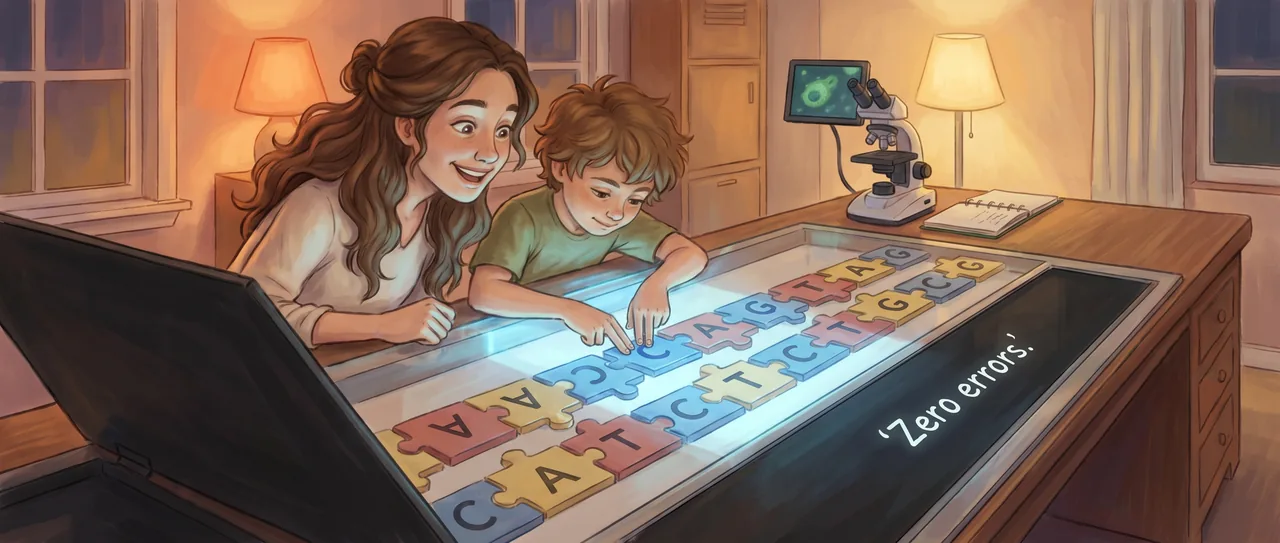
The Copy That Was Almost Impossible
The copying table told everyone they had failed before Maya and Soren even sat down.
A red number blinked above the tiles.
Nine errors.
The family before them laughed and walked away with their paper bracelets spelling names in DNA letters. The table kept blinking, as if it was disappointed in all humans.
Maya leaned over the edge. The tiles were small plastic squares, each printed with A, T, C, or G. A strip of one thousand letters ran under clear glass. Beside it was an empty track.
Soren read the sign twice.
Copy the sequence. Cells do this every time they divide.
Under that, in smaller words, it said, A dividing human cell copies about three billion base pairs and leaves fewer than one mistake per billion copied.
Soren looked at the one thousand empty spaces. Then he looked at the blinking nine.
“That is rude,” he said.
“It is daring us,” said Maya.
Across the room, a woman in a silver lab coat was trying to fix a printer that kept spitting out bracelets with the letter G missing. She had a roll of tape stuck to one sleeve and a line of visitors asking if biotechnology could make dragons.
“Start at the left,” Soren said.
Maya had already started in the middle.
“Maya.”
“It has a rhythm.”
“It has letters.”
“It has both.”
They copied fast the first time because the table had a timer and because the family before them had copied fast. Maya’s hands moved in bursts. Soren’s finger kept returning to the glass strip, then to the new row, then back again.
When they pressed the blue button, the scanner hummed over their tiles.
Six errors.
The table gave a cheerful little buzz, which made it worse.
“At this error rate,” the screen said, “a three billion base pair copy would contain about eighteen million errors.”
Maya pulled one tile out and turned it over in her hand.
“No,” she said.
“No what?” asked Soren.
“No to the way we are doing it.”
Soren opened his notebook, then did not write. He watched her instead.
Maya put the tile back upside down. Its underside had a tiny bump and hollow, like a puzzle piece. She picked up an A and a T. They clicked together. She picked up an A and a C. They would not lie flat.
“The letters choose,” she said.
Soren tried C with G. Click. T with A. Click.
“The model chooses,” he said.
“Because the real thing does.”
Soren nodded once. He liked sentences that became testable when you touched them.
They cleared the track.
This time, Maya did not copy the top strip into the empty row. She built a partner row underneath it. Wherever the glass strip showed A, she placed T. Wherever it showed C, she placed G. Soren followed behind, pressing each pair flat with two fingers. If a tile rocked, he lifted it and checked the letter.
A boy behind them groaned.
“You’re going slower.”
“We’re going less wrong,” Soren said, without looking up.
When the partner row was finished, Maya covered the original strip with a black flap. Now only their new partner row could be seen.
“Again,” she said.
Soren’s eyes widened a little.
“To get back to the first one.”
They built a second row from the partner. A matched T. C matched G. The shapes made tiny clicks down the table, not quick, not slow, just sure.
Soren found one tile that looked right but sat crooked.
“G,” he said.
Maya looked back. “It wants C.”
“It says T.”
“Then T is lying.”
Soren replaced it with C. The row went flat.
They pressed the blue button.
The scanner passed over the track. Its light washed their hands blue-white.
Zero errors.
The cheerful buzz sounded again, but this time Maya grinned at it.
The screen did not give them a bracelet. It did not say winner. It turned black. Then white letters appeared, one line at a time.
One thousand base pairs copied.
To match one human cell division, repeat this three million times.
Expected remaining mistakes, fewer than three.
The room seemed to get longer.
The table did not look like a game anymore. It looked like the first crumb of an enormous loaf. Three million tables end to end would leave the building, cross the parking lot, cross the dark streets, cross towns Maya had never visited, and still keep going. If each base pair were a tiny printed mark one millimeter wide, the copied line would stretch about three thousand kilometers.
Soren put both palms flat on the table.
“Three mistakes,” he said. “In all that.”
“Fewer,” said Maya.
The screen changed again. A simple animation showed a strand unzipping. New letters snapped into place beside old ones. Then a second shape moved along the strand, pausing when one pair bulged. It clipped out the wrong piece. Another shape filled the gap.
Labels appeared beside them.
Base pairing.
Proofreading.
Mismatch repair.
Soren touched the word proofreading on the glass. At school, rereading made people tap pencils and sigh. Here, it had its own bright label.
Maya touched the bulged pair on the animation.
“It stops because the shape is wrong,” she said.
The woman in the silver lab coat hurried over, carrying a handful of bracelets made entirely of A, T, C, and no G.
“Oh,” she said. “You beat the copying table.”
“It beat us first,” said Soren.
“That is what it is for,” she said. She pushed the tape higher on her sleeve. “Most people try to go faster.”
“That makes millions of mistakes,” said Maya.
“Usually more,” said the woman. She glanced toward the bracelet printer, which made a grinding sound. “Cells are better at this than any open-night visitor. Better than our machines in some ways. ”
Soren was still looking at the screen.
“So every cell in me had to do this,” he said.
“Every dividing cell,” she said. “Again and again.”
Maya looked at her hands. There was a half-moon of blue scanner light still fading from her thumb.
“And when it does not fix one?” she asked.
The woman opened her mouth, but the bracelet printer shrieked and shot a paper strip into the air.
“One second,” she said, and ran back to catch it.
The animation looped. Copy. Pause. Cut. Mend. Copy.
Soren finally wrote one line in his notebook, then closed it before Maya could read it.
“What?” she asked.
“It is not an answer yet.”
“Good,” said Maya.
At the far end of the room, a live microscope screen glowed above a dark counter. A small sign said, Human cells grown for teaching. DNA shown in green.
Maya went first. Soren came beside her.
On the microscope screen, a round cell pinched at its middle. The green tangle inside it gathered, parted, and shone in two small knots.
Read the interactive version, listen to the narration, and earn a gold star →
A science-verified short story for curious kids · Curiosity Land