The Chromosome That Would Not Match
Maya's badge said VISITOR, which at Helix House meant do not open panels.
It did not say do not press gray buttons.
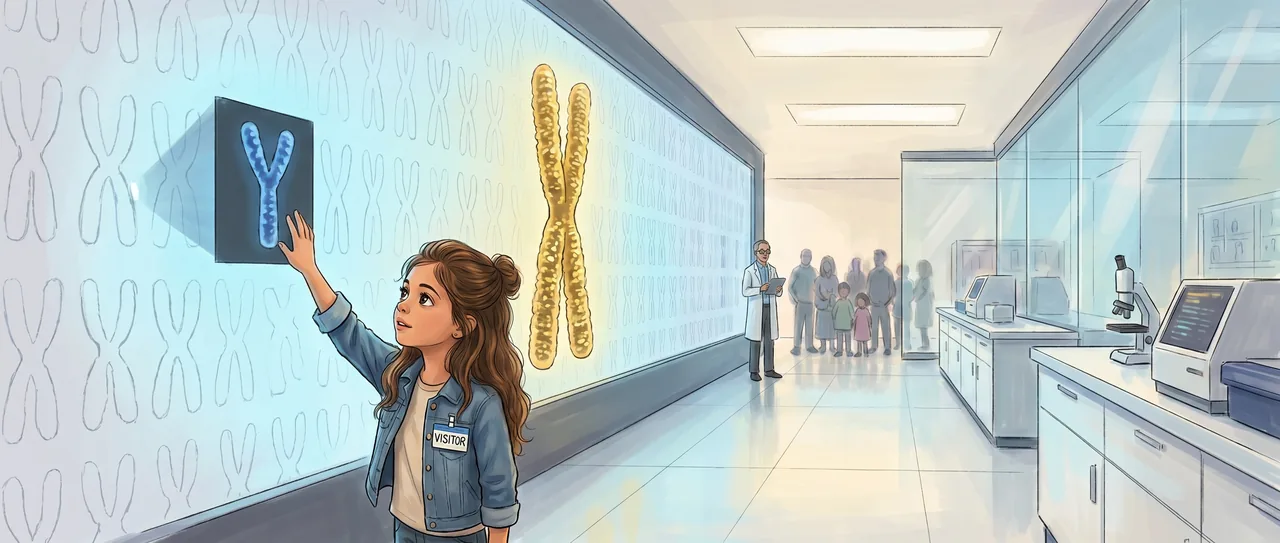
The genomics lab had been polished for open night. Glass walls. White counters. Sequencing machines humming behind clear doors like sleepy refrigerators. On the biggest wall, human chromosomes hung in pairs, bright and neat, except for the twenty-third pair.
The X was long and gold, packed with tiny glowing boxes.
The Y was blue, short, and mostly dark.
Maya stood under it with her head tilted back.
Dr. Bell hurried past carrying a coil of cable over one shoulder. She was the kind of adult who smiled while counting things under her breath.
"Maya, don't start the mammal simulator yet," Dr. Bell said. "The school board people are coming in four minutes, and I need it to behave. Last time it made a platypus. Very educational. Not helpful."
"Why is Y displayed like a damaged file?" Maya asked.
Dr. Bell stopped just long enough to look pained.
"It is not damaged. It is simplified for visitors. Please don't make it complicated before the donors arrive."
"It is already complicated," Maya said.
Dr. Bell had already moved on.
The simulator table woke when Maya's shadow crossed it. A glass surface lit up with two ancient chromosomes, side by side, both the same size. Above them, a label appeared.
ANCESTRAL PAIR, ABOUT THREE HUNDRED MILLION YEARS AGO.
Maya liked that number. It was too large to hold. It made the floor feel thin.
A soft voice from the table said, "Build the path from ancestral chromosomes to human X and Y. Match genes to complete the pair."
Two long ladders appeared. Each rung had a tiny name. Most were too small to read unless Maya spread her fingers and zoomed in.
She dragged the time slider forward.
The right-hand chromosome shrank a little.
A warning flashed.
ERROR. GENE LOSS DETECTED. REPAIR REQUIRED.
"No," Maya said.
The table waited.
Maya dragged the slider farther.
More boxes went dark. The right-hand chromosome shortened again.
ERROR. REPAIR REQUIRED.
Maya looked up at the wall. The modern X blazed with hundreds of boxes. The modern Y held only a small scatter, like lights left on in a city after midnight.
She opened the gene counter.
X CHROMOSOME: ABOUT EIGHT HUNDRED PROTEIN-CODING GENES.
Y CHROMOSOME: FEWER THAN SEVENTY PROTEIN-CODING GENES.
The table was asking her to fix the very thing the wall showed.
Dr. Bell's voice came from behind a screen. "Maya, if the table complains, just press reset. It likes symmetry."
"I don't," Maya said.
She touched the gray button labeled ADVANCED.
A red box appeared.
VISITOR MODE RECOMMENDED.
Maya pressed ADVANCED again.
The table sighed, which was probably only a speaker, but sounded personal.
New controls unfolded across the glass. Mutation rate. Selection pressure. Crossing-over. Recombination map.
Maya knew crossing-over from a video at school. Chromosome pairs lined up and traded pieces before eggs or sperm were made. A swap here. A swap there. A way of shuffling the deck without losing the cards.
The simulator had crossing-over set to FULL LENGTH.
On the display, the ancient pair swapped little colored segments from end to end. The table kept trying to make the two chromosomes match.
Maya set the time slider back to the beginning.
"Something changed," she said.
The table did not answer.
On one chromosome, near the top, a small red tag blinked.
SEX-DETERMINING REGION.
Maya zoomed in until the gene boxes became fat rectangles. The red tag sat in the middle of several ordinary genes, looking much too small to rearrange the history of mammals.
If that region crossed over onto the other chromosome, the simulator marked confusion in orange. The table showed embryos developing along different pathways than the chromosome labels predicted. Then the program stopped and offered a cheerful button.
RESTORE MATCHING PAIR.
Maya did not press it.
She opened RECOMBINATION MAP.
The ancient pair became two roads. Yellow bridges connected them along their whole length.
Maya tapped the bridge nearest the red tag.
A menu asked, ALLOW SWAPPING HERE?
She chose NO.
The bridge vanished.
The table ran forward. Around the red tag, more bridges faded, first nearby, then in a widening block. The right-hand chromosome stopped trading fresh copies through most of its middle. Mutations appeared as tiny black chips. Some genes still worked. Some broke. Some broke and stayed broken.
The warning returned.
ERROR. GENE LOSS DETECTED.
Maya's fingers hovered over the glass.
The program thought a broken gene had to be repaired by copying from the matching partner. But if the two chromosomes no longer swapped through that region, there was no easy matching partner there. The table was grading the Y by rules it had stopped being able to use.
She opened a narrow menu at the bottom.
RECOMBINATION PATTERN.
FULL LENGTH.
NONE.
CUSTOM.
Maya chose CUSTOM.
The roads reappeared. She removed every bridge in the middle and left only the tiny bridges at the tips.
The model ran.
For the first time, it did not stop.
The ancestral chromosomes moved through deep time. Millions of years went by in pulses of blue light. The X kept most of its boxes. The Y lost boxes in waves. Some vanished. Some dimmed. A few remained bright, clustered and stubborn.
A new note appeared beside several surviving Y genes.
IMPORTANT FOR MALE DEVELOPMENT OR SPERM PRODUCTION.
Another note appeared over mirrored stretches of DNA.
PALINDROMIC REPEATS CAN HELP COPY AND REPAIR SOME Y GENES.
Maya leaned closer.
The Y had lost almost everything it started with. Not everything. Not nothing. It was not a little X. It was not a failed X. It was a chromosome with a history that could not be seen if the program forced it to match.
Behind her, Dr. Bell said, "Oh no. What menu are we in?"
Maya did not look away. "The right one."
On the wall, the school board people had arrived. Their shoes squeaked in a row. Dr. Bell whispered something that sounded like an apology and a prayer.
The table projected Maya's model up onto the big wall.
The modern pair appeared again, but now the space beside the Y did not look empty. It filled with ghost boxes, thousands of faint outlines stacked back through time. Lost genes. Broken genes. Genes still present on the X. Genes that had once stood on both chromosomes before the long stopping of swaps. Dr. Bell stepped to the control pad, then stopped with her hand above it.
"Did you set recombination only at the tips?" she asked.
"Most of the Y doesn't cross over with X," Maya said. "Only small regions at the ends do. If the middle can't swap, the losses aren't a glitch."
Dr. Bell lowered her hand.
The simulator counted down the ancestral genes. The number dropped and dropped until only a few percent of the old set remained on the Y. The blue chromosome on the wall stayed small. The gold X stayed crowded. Between them, three hundred million years hung like a ladder with most of its rungs missing.
A boy from the visiting group whispered, "So it got worse?"
Maya turned just enough to see his face reflected in the glass.
"It got different," she said.
The table added a final line.
MODEL ACCEPTED. HUMAN Y CHROMOSOME: FEWER THAN SEVENTY PROTEIN-CODING GENES. ESTIMATED ANCESTRAL GENE LOSS: ABOUT NINETY-SEVEN PERCENT.
Dr. Bell laughed once, very softly.
"That is not the clean demo," she said.
"No," Maya said.
The wall changed again.
Every ghost box beside the Y became selectable. Some had names. Some had question marks. Some pointed toward genes still sitting on the X. Some led into blank stretches where the data ended and the model could not follow.
A new prompt appeared at the bottom of the wall.
TRACE A LOST GENE.
Dr. Bell took one step back to let Maya reach the glass.
Maya set both feet on the floor and touched the nearest dark box.
The screen waited with three hundred million tiny dark boxes and one blinking prompt: CHOOSE A LOST GENE.
Read the interactive version, listen to the narration, and earn a gold star →
A science-verified short story for curious kids · Curiosity Land