Same Letters, Different Lights
The two lines on the wall screen were supposed to lie on top of each other.
They did, at first.
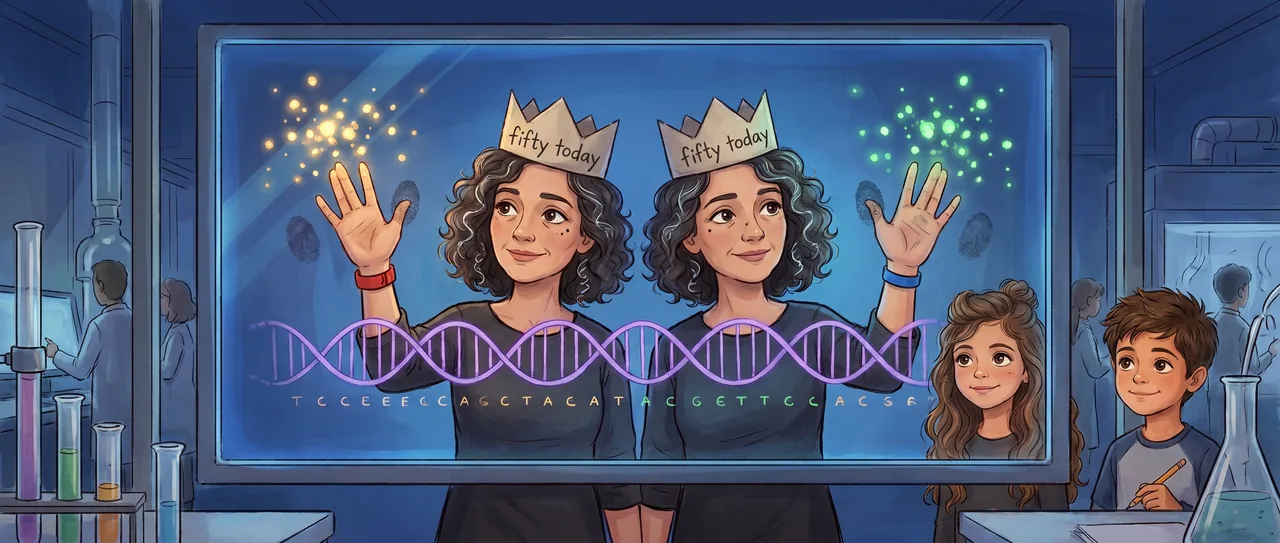
A red string of A, C, G, and T from one cheek swab slid across a blue string from the other. Wherever the letters matched, the screen drew purple. Purple, purple, purple, all the way across.
The audience made the soft sound people make when something difficult has become visible.
The two women on the stools grinned at each other. They had the same small chin, the same freckle beside the left eye, the same silver threads in their dark curls. A paper crown sat crooked on each of their heads. The crowns said fifty today.
Maya leaned forward over the volunteer table.
“Now the caps,” she said.
Soren already had his pencil ready. He did not write yet.
The exhibit director touched the screen. A second layer appeared over the purple letters, not letters this time, but tiny lights. Some were green. Some were gold. Some spaces had no light at all.
On the red twin’s line, a crowd of gold lights blinked near the beginning.
On the blue twin’s line, that place stayed mostly dark.
Farther along, green lights scattered across the blue line like spilled beads. The red line had three.
The audience went quiet in a different way.
The exhibit director’s smile held still. She tapped the screen once. Then twice.
“That is not our cleanest display,” she said.
Maya said, “Don’t erase it.”
The exhibit director did not hear her. She was already bending toward the control panel, her badge swinging. She loved straight edges, smooth charts, and demonstrations that ended before the next tour group arrived.
“These are identical twins,” she said. “The public will think the DNA test failed.”
“It didn’t,” Soren said.
The director looked at him as if a pencil had spoken.
Soren pointed to the first layer. “The letters match.”
“The second layer doesn’t,” the director said.
Maya came around the volunteer table before she had decided to move. The director’s hand hovered over Reset.
“The second layer is not the same thing,” Maya said.
The twin with the red wristband laughed. “We have been trying to tell people that since kindergarten.”
The other twin held up her blue wristband. “They made us share one cubby. One cubby. For two humans.”
A few people laughed. The exhibit director did not.
She said, “It could be swapped tubes.”
Soren’s pencil finally moved. “Check labels, check blank, check control.”
The director blinked. “We do not have time for a full rerun.”
“Not full,” Soren said. “The small checks.”
The lab was shaped like a glass box, so visitors could watch science happen without pressing their noses against anything dangerous. Most of the work was already done by sealed machines, but the small checks were on the open bench. Maya liked those best. A machine could be wonderful, but a strip that changed color right in your hand felt like it was answering you personally.
The director crossed her arms. “Two minutes.”
Maya took the tray. Two clear tubes rested in foam holes. One had a red dot. One had a blue dot. She set them beside the twins’ wristbands.
“Red sat left?” Maya asked.
“Always,” said the red twin.
“Not always,” said the blue twin. “You just think chairs belong to you.”
“For the swab,” Maya said.
“Left,” they said together, then made faces at each other for saying it together.
Soren checked the blank strip. It stayed pale. No stray sample. He checked the control strip. A square at the end turned dark exactly where the printed guide said it should.
“The machine heard what it was supposed to hear,” he said.
Maya looked at the wall screen again. The purple letter-line was so perfectly matched that it was almost boring. The lights were not boring. They made a second map, laid over the same road, with different windows glowing in different houses.
“The caps are the epigenetic part,” Soren said, not to explain to Maya, but to put the piece where both of them could see it. “Methyl groups. They sit on some DNA letters.”
“And genes can listen differently,” Maya said.
“Often,” Soren said. “Not like a switch for everything.”
Maya nodded once. She knew he needed the edges to be right. The edges mattered.
The director rubbed her forehead. “The poster says identical twins start with identical DNA.”
“Start,” Maya said.
That word landed on the bench between the tubes.
The red twin stopped smiling.
The blue twin looked at the wall. “I worked night shifts for twenty years,” she said. “She ran mountain trails and mailed me pictures of sunrise like a show-off.”
“Your coffee was terrible,” the red twin said.
“You drank powdered soup from a mug.”
The audience laughed again, but softly this time.
Soren looked from the twins to the lights on the screen. He did not write down night shifts or mountain trails. The screen was not a fortune-teller. It was not a diary. It could not point to one gold light and say soup, or one green light and say sunrise.
But the pattern was there.
The same letters. Different marks.
The director said, “If we show this, people may ask questions we cannot answer.”
Maya’s face brightened. “Good.”
The director looked pained.
Soren flipped to the back of the program card, where the exhibit schedule was printed. The next talk was called Same Code, Same Person? He crossed out the question mark with his pencil, then stopped. He put the question mark back, darker.
“Don’t say the second layer is a mistake,” he said. “Say this is what fifty years can look like.”
The director’s mouth opened.
Maya pointed to the twins. “Ask them if they want the clean version.”
The director turned.
The red twin adjusted her paper crown. “I am very tired of the clean version.”
The blue twin slid off her stool and walked closer to the screen. Her face, which had been familiar beside her sister’s face, became its own face when she moved alone.
“When we were little,” she said, “people guessed wrong and then acted annoyed at us.”
The red twin came to stand beside her. “They wanted one answer that fit both mouths.”
On the wall, their DNA letters still made one purple line. Above it, the lights blinked in two unsettled constellations.
The exhibit director lowered her hand from the reset button.
“All right,” she said. “But I am not calling them caps. The sign says methylation marks.”
“Say both,” Maya said. “Caps first.”
The director gave her a look, then faced the audience with the kind of breath people take before stepping onto ice.
“These two samples are not contaminated,” she said. “The DNA sequence matches. The pattern of methylation marks does not. Identical twins can become measurably different in these patterns as they age.”
A hand went up in the front row. A small kid wearing dinosaur boots asked, “Did their DNA change?”
“No,” said the director.
“Not the letters,” Soren said.
The director glanced at him, then said, “Not the letters.”
Another hand rose. “Can the marks change again?”
The director looked ready to answer with a long museum sentence.
Maya got there first. “Some can.”
Soren added, “Scientists are still measuring which ones, and when, and how much.”
More hands rose.
The exhibit schedule slipped from the director’s clipboard and see-sawed to the floor. She did not pick it up.
The red twin touched the gold lights above her line. Her finger left a smudge on the glass.
The blue twin touched the green lights above hers.
For a moment, the two women stood shoulder to shoulder, each with one hand raised to a different sky.
Read the interactive version, listen to the narration, and earn a gold star →
A science-verified short story for curious kids · Curiosity Land