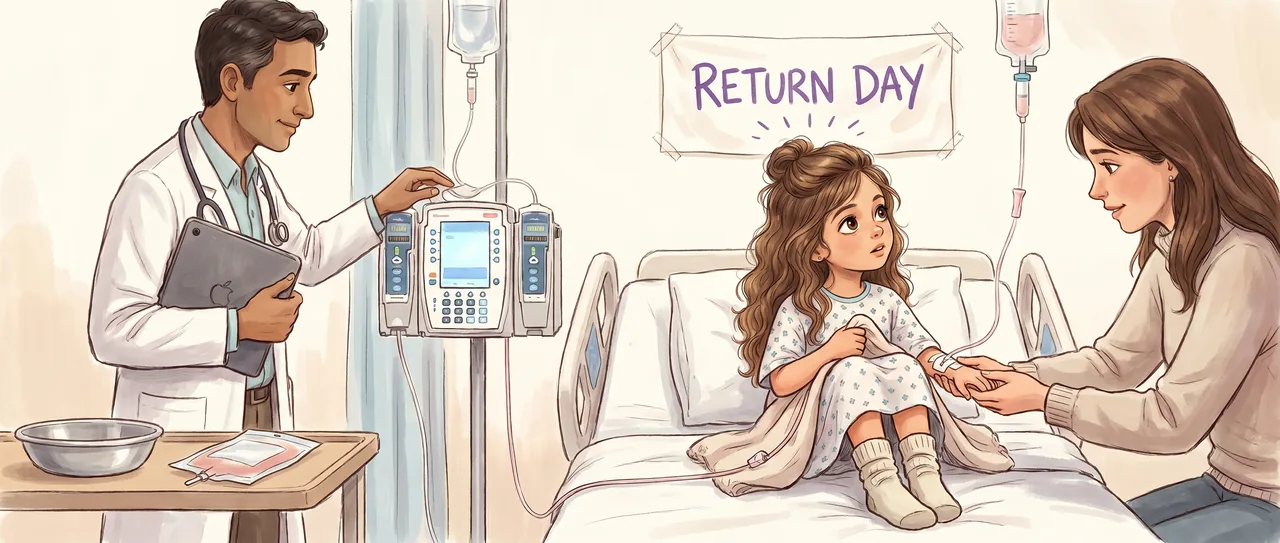
Return Day
The bag was smaller than Maya expected.
She had imagined something important would arrive in a silver case with steam leaking out, or in a machine with blue lights, or maybe carried by two people wearing gloves up to their shoulders.
Instead, Nurse Alvarez came through the double doors holding a plastic pouch in a metal bowl. The pouch had frost around its edges and a label with Maya’s name, her birthday, and a barcode. Inside was a cloudy pink slush.
“That’s it?” Maya asked.
Nurse Alvarez smiled like she had been waiting all morning for somebody to be unimpressed. “That’s it.”
Maya lifted her knees under the blanket. Her room smelled like tape, lemon wipes, and the warm plastic of hospital tubing. On the wall, someone had taped a paper banner with bubble letters.
CORRECTED CELLS DAY.
Maya had turned it around so the blank side faced out.
Her mother had noticed but had not turned it back. She sat in the chair by the window, folding and unfolding a sweatshirt that did not need folding.
Dr. Rao hurried in with his tablet under one arm and a coffee cup in the other hand. He had a way of entering rooms as if he had been sent by a rocket and had not quite landed.
“Good. Good. Product is here,” he said. “We’ll do the checks, thaw, verify, and begin infusion. Maya, this is the exciting part.”
“It looks like old strawberry ice,” Maya said.
“It does,” Dr. Rao said. “Very expensive old strawberry ice.”
Maya looked at the bag again.
Months before, a machine had taken blood from one of her arms and returned it through the other. The machine had hummed for hours. Her blood had gone around in tubes like it had somewhere else to be. The nurses had collected the rare cells that could make more blood, the stem cells that normally lived deep in bone marrow. Then those cells had left the hospital without her.
Maya had not liked that part.
She had pictured them in an airplane cargo hold, freezing and offended.
Now they were back.
Dr. Rao set down his coffee and began reading from the label with Nurse Alvarez. They said Maya’s name, her number, the date, the long name of the product, and the word autologous.
Maya liked that word because it sounded like a dinosaur that had learned manners.
“Autologous means from you,” Dr. Rao said quickly, without looking up. “Your own cells.”
“I know,” Maya said.
He blinked. “Right. Of course.”
He went back to the label.
Maya stared at the blank back of the banner. Corrected Cells Day was still there on the other side, hiding in marker ink.
When she was little, people had drawn sickle cells for her as red crescent moons. Pretty shapes. Bad shapes. They got stiff when they dropped off oxygen. They could jam in tiny blood vessels, especially when she was cold or tired or sick. Adults always drew the normal red blood cells as circles, soft and neat, like cookies.
Maya had once asked why the crescent cells could not just be crescent cells and go another way.
The doctor she had then had said, “Blood vessels don’t have another way.”
That had stayed on Maya’s list of things that did not make sense yet.
Not because it was wrong.
Because it was enormous.
All through her body were roads too small to see. All through her bones were rooms making travelers for those roads. One changed instruction in the hemoglobin made some travelers fold wrong. A pain crisis could begin in a place no larger than a thread.
And now a bag smaller than a sandwich was supposed to change what her marrow made next.
Dr. Rao looked at the monitor, then at the bag. “The lab used CRISPR to make a small edit in a control switch. That helps your new red blood cells make fetal hemoglobin, which can carry oxygen and does not sickle the same way.”
“Fetal,” Maya said.
“Yes. The kind babies make before birth. Most people turn most of it off after they’re born.”
“I made it?”
“You did.”
“When I was inside my mom?”
“Yes.”
Maya turned her head toward her mother.
Her mother stopped folding the sweatshirt.
Dr. Rao was still talking, because Dr. Rao always had more words than there was room for. “ ”
Maya heard him, but the room had tilted larger.
Before she had teeth, before she knew her own name, before she had ever been called too impatient or too quiet or too much, her blood had carried oxygen by a different recipe. Not borrowed. Not invented. Hers. A recipe folded away after birth, like a blanket in a closet nobody opened.
The cloudy bag clicked softly against the metal bowl as Nurse Alvarez lifted it.
Maya pointed at the wall. “That sign is wrong.”
Dr. Rao followed her finger. “The blank sign?”
“The other side.”
Her mother made a tiny sound that might have been a laugh and might not.
Dr. Rao turned the paper over.
CORRECTED CELLS DAY shouted at them in purple.
Nurse Alvarez said, “The art volunteer made it. She meant well.”
“No,” Maya said.
Everyone waited.
Maya hated when rooms waited. Waiting made her words line up badly.
She said, “Corrected sounds like I was a spelling mistake.”
Dr. Rao opened his mouth, then closed it.
Maya pushed the blanket down and swung her feet over the edge of the bed. Her legs felt strange from too many days inside. On the tray table were markers, tape, a paper cup, and a plastic spoon from breakfast. She took the purple marker.
“Maya,” her mother said. “Careful with your line.”
“I’m not getting up.”
She pulled the banner onto her lap. The old words were too big to cover, so she turned the paper over again to the blank side.
Nurse Alvarez checked the clock. “We do need to start soon after thaw.”
“I’m fast,” Maya said.
She wrote:
RETURN DAY.
Then she stopped.
That was not enough.
Under it, smaller, she wrote:
MY CELLS, EDITED OUTSIDE, COMING HOME.
Dr. Rao leaned closer. “That is less catchy.”
“It’s true,” Maya said.
“It is,” he said.
“And don’t tell the next kid they’re fixed.”
Nurse Alvarez looked at Dr. Rao.
Dr. Rao looked at the sign.
Maya added one more line, pressing so hard the marker squeaked.
OLD HEMOGLOBIN DOOR, OPEN AGAIN.
“That part is not exactly how I would phrase the BCL eleven A erythroid enhancer,” Dr. Rao said.
Maya capped the marker. “I know.”
Nurse Alvarez laughed once, bright and surprised.
Dr. Rao took a square of tape from the tray and held it out. “May I?”
Maya nodded.
He taped the new sign to the wall with careful hands, smoothing the corners as if it were a medical dressing.
For a moment, nobody spoke.
Then Nurse Alvarez lifted the bag from the bowl. The frost had softened. The cloudy pink slush had become liquid, pale and ordinary and impossible. She connected it to the clear tubing. Dr. Rao read the label one more time. Maya said her name when they asked. Her mother stood and came to the bedside, but she did not take Maya’s hand until Maya reached first.
The pump made one small beep.
Nurse Alvarez opened the clamp.
Maya held the edge of the blanket in one fist and watched the tube.
The first clear bead slid down the line and disappeared under the tape on Maya’s wrist.
Read the interactive version, listen to the narration, and earn a gold star →
A science-verified short story for curious kids · Curiosity Land