The Wrong-Side Lens
Maya was given the box of broken-looking squares because the lab director thought broken-looking squares were safe.
"Sort these by color," the director said. "Do not sort by importance. Everything is important until it is late, and it is already late."
Maya looked into the box.
Each square was clear plastic with copper printed on it. Some copper looked like little ladders. Some looked like squared-off snails with a gap in the shell. Some looked like combs made for ants.
"They look wrong," Maya said.
"Good," said the director, who had a marker behind one ear and another marker in her hand. "That is why they work. Mostly. Maybe. Today they are being dramatic."
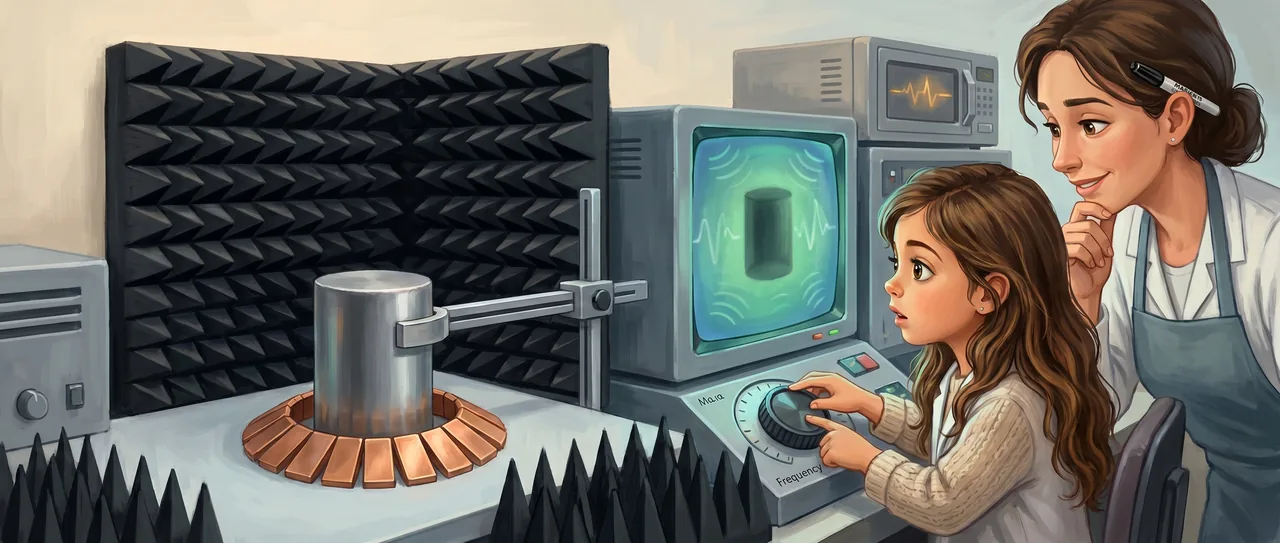
The lab did not look like a place for light. It had black foam spikes on the walls and a table with a metal arm that slid very slowly from side to side. At one end of the table sat a gray box labeled microwave source. At the other end, the sliding arm carried a detector. The detector painted what it felt onto a screen as bright and dark clouds.
Maya knew microwaves were light, even if eyes did not bother with them. She had asked that once and gotten three different answers from three different adults, which meant the answer was probably yes in an interesting way.
On the table were three exhibit signs.
Ordinary materials bend light.
Metamaterials can bend it the other way.
A cloak works only for the wavelength it was built to guide.
The director snatched the second sign and frowned at it.
"Too much," she said. "Children will think we mean magic. We do not mean magic. We mean copper, plastic, patience, and six months of soldering."
"Children can handle copper," Maya said.
The director glanced at her. "You are eleven. You are biased."
The first test was supposed to be simple. The director placed a clear acrylic wedge in the microwave beam. On the screen, the bright cloud moved to the right.
"Ordinary," the director said. "Air to plastic to air. Predictable. Friendly. Now the strange one."
She replaced the acrylic with a wedge made from many stacked copper-patterned sheets. The screen flickered. The bright cloud moved left.
Maya smiled.
The director did not.
"No," she said. "Absolutely not. The camera feed is mirrored again."
"The sticker is not mirrored," Maya said.
A red arrow sticker on the detector arm pointed toward the door. On the screen, the little red arrow icon also pointed toward the door.
The director stared at it. "Then the wedge is backward."
Maya picked up the wedge before the director could. It was heavier than it looked. From the side, the layers made a tiny city of copper streets. She turned it around and set it back in the holder.
The bright cloud moved left again, not the same amount, but the same impossible side.
The director opened her mouth, closed it, and looked at the clock.
"We can use the video," she said.
Maya did not move.
The ordinary wedge had pushed the beam one way. The copper city pushed it the other way. Turning the copper city had changed the road but not the wrongness.
Maya took the acrylic wedge and put it in again.
Right.
She took it out and put the copper wedge in.
Left.
Acrylic.
Right.
Copper.
Left.
The director stopped looking at the clock.
"Again," she said quietly.
Maya did it again.
Right.
Left.
The room seemed to get bigger without moving its walls. The foam spikes, the slow metal arm, the gray box, the ugly copper squares in the tray, all of them shifted from equipment into parts of a sentence nobody had finished saying. Light did not have to take the road glass took. If the pieces were small enough for the wave to treat them as a material, the material could answer differently than nature usually answered.
Maya put one finger on the side of the copper wedge. It was only plastic and printed metal. It was not glowing. It was not humming. It was not even warm.
"Wrong side is the point," Maya said.
The director let out a laugh that sounded as if it had escaped without permission.
"I was about to fix the demonstration," she said. "That would have been unfortunate."
The cloak was worse.
It was a flat ring made of wedge-shaped tiles, each tile printed with copper loops. A metal cylinder stood in the hole at the center. Without the cloak, the microwave beam hit the cylinder and made a dark shadow on the screen. With the cloak, the sign promised, waves at one chosen wavelength would curve around the middle and meet again beyond it.
The director set the ring around the cylinder.
The screen showed a dark bite.
"No," the director said to the ring.
The ring did not apologize.
She turned a frequency dial. The numbers changed. The dark bite stayed.
"Noon," the director said. "The city council sees a video. Videos never have loose connectors."
Maya crouched beside the table. The ring was not a smooth thing. Each tile had its own copper loop, and each loop had a gap. The gaps were not random. Most of them faced around the ring, like tiny mouths whispering in a circle.
One tile was whispering across it.
Maya looked into the broken-looking box. There were reject tiles at the bottom, including one with the same yellow dot as the wrong tile in the cloak. Its copper gap faced the way the others did.
"Why is this rejected?" Maya asked.
"Cosmetic scratch," the director said, already behind the computer. "Unacceptable for donors. Fine for science, probably. Terrible for photographs."
Maya held the scratched tile beside the ring. The scratch ran through a corner, not through copper.
"The pattern goes this way," Maya said.
The director looked up. "The robot sorted by outer shape. I told it outer shape was enough. I have been telling machines the wrong things all week."
She reached for the ring.
Maya pulled it back.
"I can do it," Maya said.
The director put both hands in the air. "You can do it. I will be over here, not saving the day."
The tile screws were tiny, but the lab had a tiny screwdriver. Maya took out the sideways tile. She put in the scratched one with the gap facing along the circular whisper. The ring became almost neat, except for the scratch that only people would care about.
She set it around the metal cylinder.
The director turned the source on.
The dark bite remained.
Maya looked at the sign. A cloak works only for the wavelength it was built to guide.
"Dial," Maya said.
The director moved her hand toward it, then stopped. "You."
Maya turned the frequency dial slowly. The screen changed in small, cloudy breaths. At first the cylinder made a hard shadow. Then the shadow thinned. Then, for one narrow place on the dial, the darkness behind the cylinder filled in until the screen looked almost as if the metal post were not there.
Maya moved the dial a little farther.
The shadow came back.
She moved it back.
The shadow thinned again.
The director did not cheer. She leaned close to the screen with her mouth open.
"Not invisible," Maya said.
"Not to everything," the director said. "Not from every direction. Not for every color of light. But to this microwave, from here, at this wavelength, that metal cylinder just became a detour."
Maya looked at the scratched tile in the ring. The ugly square had not ruined the cloak. The smooth wrong one had.
The director brought out the last piece of the exhibit, a flat slab made of the same copper cities as the wedge.
"This one is dangerous," she said.
Maya looked at it sharply.
"For my schedule," the director said. "Not for you. People hear perfect lens and begin floating away. An ideal negative-index lens could keep details ordinary lenses lose. Real ones have losses. Ours is fussy. Close range only. One frequency. If it sulks, we use the sign."
Maya placed two tiny metal beads on a foam block behind the slab. They were so close together that, without the slab, the screen painted them as one pale lump.
"Too close," the director said.
Maya adjusted the slab, then the detector arm, then the foam block. The lump wobbled. She moved the frequency dial back toward the place where the cloak had worked. The lump sharpened, blurred, sharpened again.
The director reached for the power switch, then stopped with her fingers in the air.
Maya turned the frequency dial one small click. On the screen, the two pale hills stood apart with a black thread between them.
Read the interactive version, listen to the narration, and earn a gold star →
A science-verified short story for curious kids · Curiosity Land